Skip to content
WAnimals
  • Map
  • Species
  • Parks
  • Diving
Log inCreate account
WAnimals

The guide for travellers and animal lovers: discover, plan and share your wild adventures around the world.

Discover wildlife

  • Species
  • Ecosystems
  • Glossary
  • Tags

Explore places

  • Map
  • Countries
  • Parks
  • Diving

Plan experiences

  • Guides

Learn

  • Blog

Resources

  • Help centre
  • Contact
  • Install the app

Follow us

Account

  • Log in
  • Create account

© 2026 WAnimals. All rights reserved.

About usHow we build our profilesTerms of servicePrivacyLegal notice
MapSpeciesParksDiving
  1. Home
  2. Species
  3. Thorny Devil
Thorny Devil (Moloch horridus)

Reptiles · Squamata · Agamidae

Thorny Devil

Moloch horridus

Least Concern

The species is abundant and widely distributed; it faces no significant short-term risk.

Spotted something wrong?

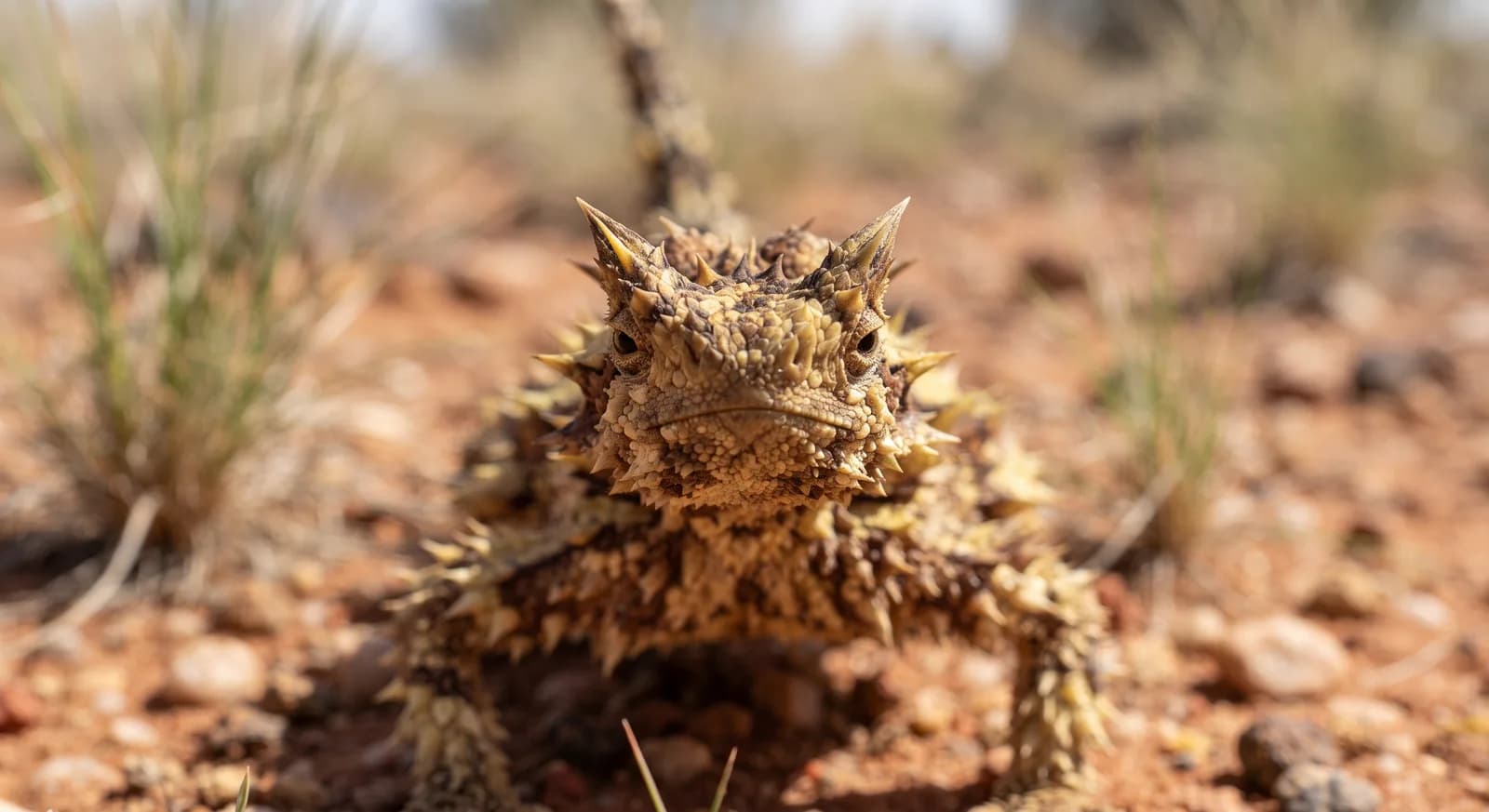
The thorny devil, or moloch, is a small lizard covered entirely in conical spines, including a knob on the nape that acts as a false head. It eats nothing but ants: it can take several thousand a day, one at a time, with a sticky tongue. Its skin collects water from any source and channels it to the mouth by capillary action, so it never needs to drink.

Weight

3 kg – 9 kg

Size

15 cm – 20 cm

Life expectancy

20 years

Diet

Insectivore

Feeds mainly on insects and other invertebrates.

Activity

Diurnal

Active mainly during the day.

Social structure

Solitary

Lives and hunts alone, joining others only to breed.

Sighting difficulty

Easy

DesertGrassland
1countries11parks7same family

AI-generated images: illustrations, not photographs.

Fun facts

  • GeneralIt channels dew along grooves in its skin to its mouth, and eats almost nothing but ants.
  • fisiologíaIt can take up water straight through its skin, through capillary channels between its scales that carry it to the mouth.
  • It drinks through its skin: a network of microscopic channels between the scales collects dew, rain or even moisture from damp sand and carries it by capillary action to the corners of its mouth, against gravity.
  • It has a false head: a spiny knob on the nape that it presents when it tucks the real one down, offering a predator a solid decoy target.
  • It eats nothing but ants, as many as three thousand a day taken one at a time, and its feeding rhythm is synchronised with the ant columns of the Australian desert.

Life cycle and biology

Skeleton type
Vertebrate - internal bony skeleton (reptile)
Habitat and environment
Sandy desert and spinifex scrub of the arid interior of Australia
Size at birth
About 6.5 cm on hatching
Sexual maturity
3 years
Gestation / incubation
120 days of incubation
Litter / clutch size
8 eggs

Sources consulted: https://es.wikipedia.org/wiki/Moloch_horridus

Where to find it

Best time: From August to December in the Australian desert, by day, walking slowly along sandy tracks; at the height of summer it becomes less active.

Loading map…

The pins mark the parks where its presence is documented.

Where to see it

Parks and dive sites where this species has been documented — showing 10 of 11.

Related species

Other species in the catalogue with the most in common with Thorny Devil — same habitat, park, country, tags or family.

Same taxonomic family
Shares a park
Shares a park
Shares a park
Shares a park

Keep exploring

Based on what we already know about thorny devil.

Comments

Share an experience, a fun fact or a tip for seeing the thorny devil.

Be the first to comment.

See full glossary
This page in other languages: Español · Deutsch · Français · Português · Italiano
See its range on the interactive map→
Uluru-Kata TjutaAustralia
Purnululu (Bungle Bungle)Australia
Ikara-Flinders RangesAustralia
Shark BayAustralia
KarijiniAustralia
Cape RangeAustralia
Mungo (Willandra Lakes)Australia
Nambung (the Pinnacles Desert)Australia
Watarrka (Kings Canyon)Australia
Tjoritja (West MacDonnell)Australia
See all 11 parks
Least Concern

Frilled Lizard

Chlamydosaurus kingii

Least Concern

Central Bearded Dragon

Pogona vitticeps

Least Concern

Eastern Snake-necked Turtle

Chelodina longicollis

Least Concern

Eastern Brown Snake

Pseudonaja textilis

Least Concern

Common Bluetongue

Tiliqua scincoides

Least Concern

Rough Knob-tail

Nephrurus asper

CountriesAustralia
ParksUluru-Kata TjutaAustralia
TagsInsectivore
Insectivore
Diurnal
Solitary
Reptile
Desert
Grassland
Australia