 UNESCO
Strict Nature Reserve
Mount Nimba Strict Nature Reserve
Guinea
See parkAn iron massif shared by three countries, home to toads that give birth to live young, on the List in Danger since 1992.
Area
175 km²
Designated in
1981
Region
West Africa
High-altitude grasslands on an iron-bearing massif in the middle of the rainforest
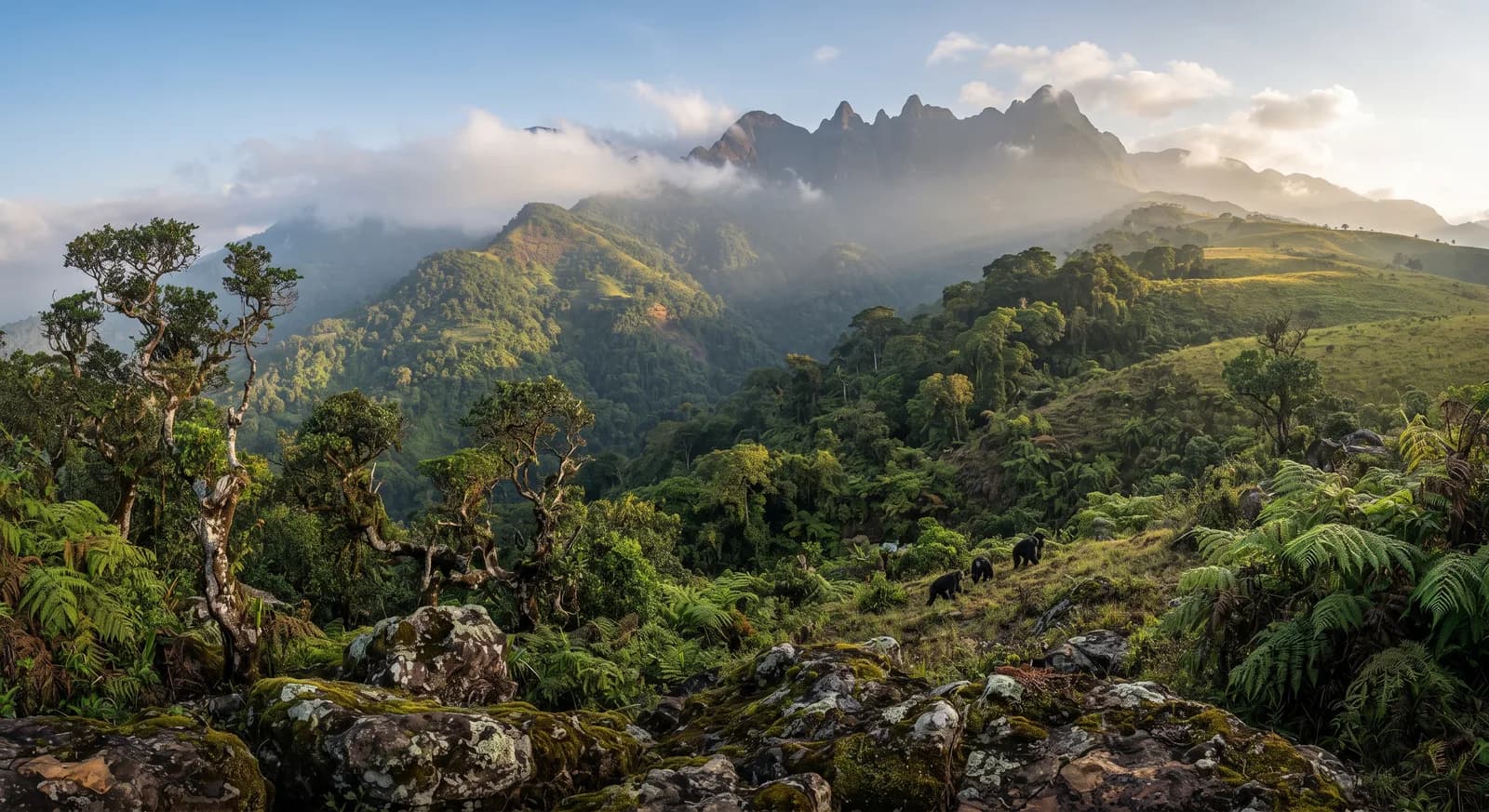
The Mount Nimba Strict Nature Reserve was inscribed on the World Heritage List in 1981 for the Guinean part and extended in 1982 with the Ivorian part, forming a transboundary property. The massif rises at the point where Guinea, Côte d'Ivoire and Liberia converge, and its summit stands above 1,750 metres.
Its uniqueness is ecological: above the lowland rainforest that covers the region, the high slopes of Nimba are occupied by mountain grassland, a habitat that has functioned as an isolated biological island for millions of years. That isolation has produced extraordinary endemism, with more than two hundred species found nowhere but the massif. Two are especially notable: the Nimba viviparous toad, one of the very few amphibians in the world that neither lays eggs nor passes through a larval stage but gives birth to fully formed young, and the otter shrew, a small aquatic mammal of very ancient lineage.
The massif also contains one of the largest and highest-grade iron ore deposits in the world, and that wealth is its threat. The property was placed on the List of World Heritage in Danger in 1992 because of the mining projects and the mass arrival of people fleeing the Liberian conflict, and it remains there. The iron ore projects on the Guinean side continue to be monitored by the Committee.
Ecosystems found in Guinea, where Mount Nimba lies.
Which other parks are like this one?
Same country: Guinea
Same country: Guinea
Same type of protected area: World Heritage Site (Natural)
Same type of protected area: World Heritage Site (Natural)
Based on what we already know about this park.
Share your experience visiting Mount Nimba, or a tip for other travellers.
Be the first to comment.
Climate
Tropical
 Guinea

 Belize
 Brazil