Skip to content
WAnimals
  • Map
  • Species
  • Parks
  • Diving
Log inCreate account
WAnimals

The guide for travellers and animal lovers: discover, plan and share your wild adventures around the world.

Discover wildlife

  • Species
  • Ecosystems
  • Glossary
  • Tags

Explore places

  • Map
  • Countries
  • Parks
  • Diving

Plan experiences

  • Guides

Learn

  • Blog

Resources

  • Help centre
  • Contact
  • Install the app

Follow us

Account

  • Log in
  • Create account

© 2026 WAnimals. All rights reserved.

About usHow we build our profilesTerms of servicePrivacyLegal notice
MapSpeciesParksDiving
  1. Home
  2. Species
  3. Fox Squirrel

One of the 13 squirrels on WAnimals

Mammals · Rodentia · Sciuridae

Fox Squirrel

Sciurus niger

Least Concern

The species is abundant and widely distributed; it faces no significant short-term risk.

Spotted something wrong?

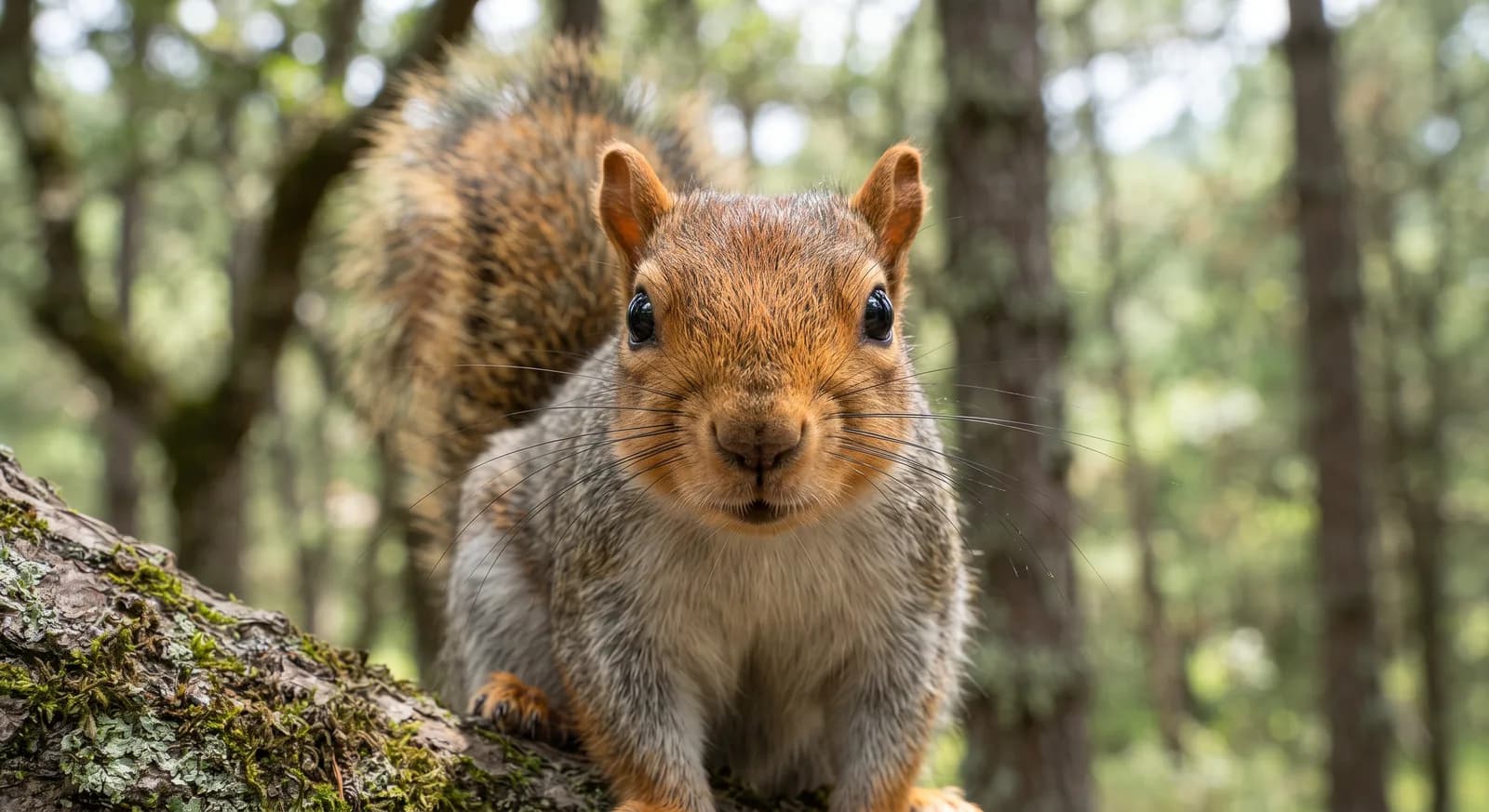
The fox squirrel is the largest tree squirrel in North America and prefers open woodland with well-spaced trees and a clear understorey, unlike the grey squirrel, which seeks dense stands. It spends more time on the ground than its relative and stores acorns and nuts in individual caches spread across its territory. Its colouring varies greatly from region to region, and includes almost black melanistic populations in the south of its range.

Weight

500 g – 1.1 kg

Size

45 cm – 70 cm

Life expectancy

12 years

Diet

Omnivore

Combines animal and plant food depending on availability.

Activity

Diurnal

Active mainly during the day.

Social structure

Solitary

Lives and hunts alone, joining others only to breed.

Sighting difficulty

Easy

Temperate forest
3countries12parks22same family

Fun facts

  • comportamientoIt is one of the largest tree squirrels in North America and can bury thousands of seeds each autumn in scattered individual caches.
  • Its bones have a pinkish tint from an accumulation of porphyrins, a pigment unusual in mammals: it is one of very few species in the world with a coloured skeleton.
  • It remembers where it has buried its stores by combining smell with spatial memory, and organises its caches by type of nut, grouping walnuts, acorns and hazelnuts in separate areas.

Life cycle and biology

Skeleton type
Vertebrate - internal bony skeleton (mammal)
Habitat and environment
Open oak and hickory woodland, wooded savanna and urban parks of eastern North America
Sexual maturity
11.6 months
Gestation / incubation
44 days
Litter / clutch size
3

Sources consulted: https://en.wikipedia.org/wiki/Fox_squirrel

Where to find it

Loading map…

The pins mark the parks where its presence is documented.

Where to see it

Parks and dive sites where this species has been documented — showing 10 of 12.

Related species

Other species in the catalogue with the most in common with Fox Squirrel — same habitat, park, country, tags or family.

Same taxonomic family

Keep exploring

Based on what we already know about fox squirrel.

Comments

Share an experience, a fun fact or a tip for seeing the fox squirrel.

Be the first to comment.
See full glossary
This page in other languages: Español · Deutsch · Français · Português · Italiano
See its range on the interactive map→
Great Smoky MountainsUnited States
Mammoth CaveUnited States
Point PeleeCanada
CongareeUnited States
BadlandsUnited States
Theodore RooseveltUnited States
Wind CaveUnited States
ShenandoahUnited States
Cuyahoga ValleyUnited States
Indiana DunesUnited States
See all 12 parks
Least Concern

Woodchuck

Marmota monax

Least Concern

Southern Flying Squirrel

Glaucomys volans

Least Concern

Eastern Chipmunk

Tamias striatus

Least Concern

Eastern Gray Squirrel

Sciurus carolinensis

Black-tailed Prairie DogLeast Concern

Black-tailed Prairie Dog

Cynomys ludovicianus

Red-bellied SquirrelLeast Concern

Red-bellied Squirrel

Sciurus aureogaster

CountriesUnited States
ParksGreat Smoky MountainsUnited States
TagsOmnivore
Omnivore
Diurnal
Solitary
Temperate forest
Mammal
United States
Canada
Mexico