One of the 10 boas on WAnimals
Reptiles · Squamata · Boidae
Puerto Rican Boa
Chilabothrus inornatus
The species is abundant and widely distributed; it faces no significant short-term risk. See full glossary
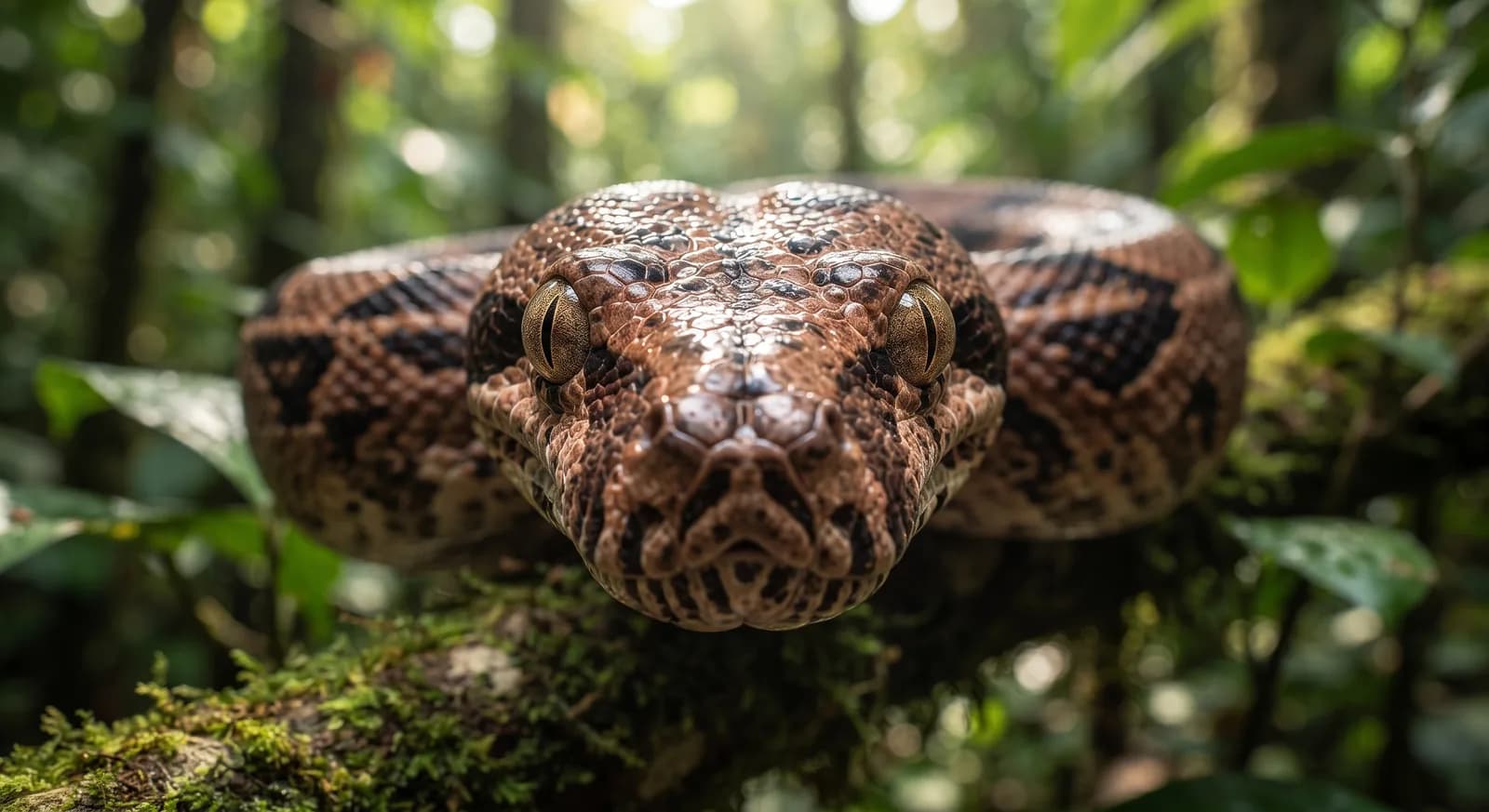
Chilabothrus inornatus, also known as the Puerto Rican boa, is a boa endemic to the island of Puerto Rico. It belongs to the genus Chilabothrus of the subfamily Boinae. It is a terrestrial snake with dark brown colouring. It grows to 1.9 m in length. It feeds on small mammals such as rodents and bats, on birds and on lizards. Like all boas it is viviparous and kills its prey by constriction, squeezing its victims to death.
Weight
1.5 kg – 4 kg
Size
1.5 m – 2.3 m
Lifespan
20 years
Diet
Carnivore
Feeds mainly on other animals.
Activity
Nocturnal
Active mainly at night.
Social structure
Solitary
Lives and hunts alone, joining others only to breed.
Sighting difficulty
Easy
Fun facts
- It hunts bats by hanging from the roof at cave mouths: it holds on by its tail alone and catches its prey in flight in the half-light, behaviour it shares with the Cuban boa.
- In 2022 it was removed from the United States federal list of threatened species after decades of protection: it is one of the few Caribbean reptiles to have completed a formal recovery process.
- It is completely harmless to people, but persecution out of fear remains a cause of death, especially when it turns up in inhabited areas.
Life cycle & biology
- Skeleton type
- Vertebrate - internal bony skeleton (reptile)
- Habitat & environment
- Moist forest, karst, caves and abandoned plantations of Puerto Rico
- Sexual maturity
- 3 years
- Gestation / incubation
- 5 months of gestation
- Litter / clutch size
- 25 live young
Sources consulted: https://es.wikipedia.org/wiki/Chilabothrus_inornatus
Related species
Other species in the catalogue with the most in common with Puerto Rican Boa — same habitat, park, country, tags or family.
Cuban Brown Anole
Anolis sagrei
Cuban Treefrog
Osteopilus septentrionalis
Common Coqui
Eleutherodactylus coqui
 Not Evaluated
Red-tailed Boa
Boa constrictor
Jamaican Fruit-eating Bat
Artibeus jamaicensis
Puerto Rican Barn Owl
Tyto cavatica
Keep exploring
Based on what we already know about puerto rican boa.
Comments
Share an experience, a fun fact or a tip for seeing the puerto rican boa.
Be the first to comment.