One of the 10 boas on WAnimals
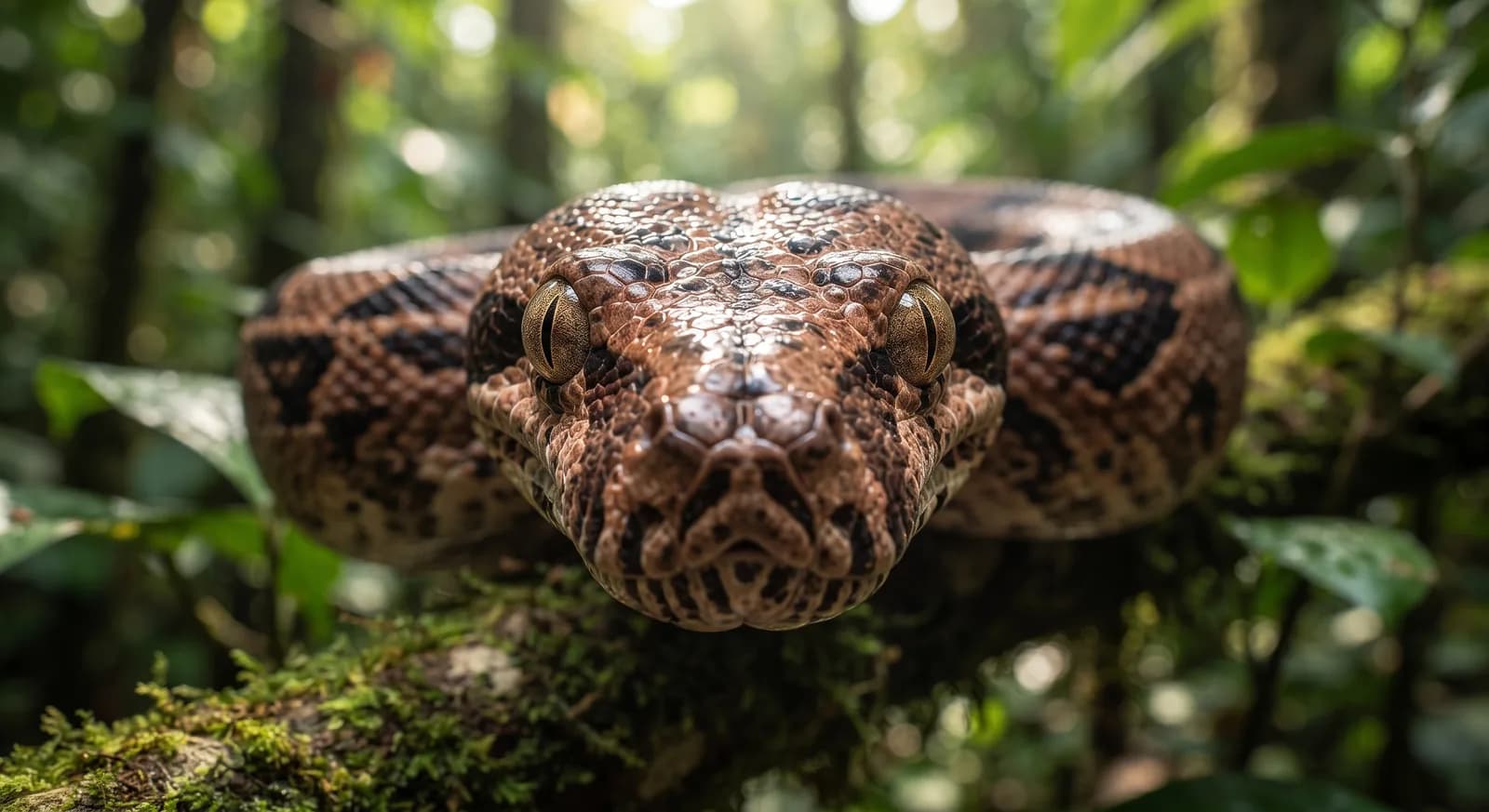
Reptiles · Squamata · Boidae
Red-tailed Boa
Boa constrictor
It has not yet been assessed against the IUCN criteria. See full glossary
In 2010 this species produced the first known case of parthenogenesis in boas: a female with no contact with any male produced young genetically identical to herself.
Weight
up to 45 kg
Size
1.8 m – 4 m
Lifespan
20 years
Diet
Carnivore
Feeds mainly on other animals.
Activity
Nocturnal
Active mainly at night.
Social structure
Solitary
Lives and hunts alone, joining others only to breed.
Sighting difficulty
Unknown
Fun facts
- It kills by constriction, feeding on small and medium-sized mammals, birds and lizards.
- It has vestigial pelvic spurs, evolutionary remnants of its lizard ancestors' hind legs.
- It is ovoviviparous: the young are born live and completely independent, measuring 38 to 60 cm.
Life cycle & biology
- Skeleton type
- Vertebrate - internal bony skeleton (reptile)
- Habitat & environment
- A wide range of habitats across Central and South America: rainforest, savanna and dry woodland
- Birth weight
- 38 - 60 cm long at birth (ovoviviparous, born live)
- Size at birth
- 38 - 60 cm long at birth, completely independent from the start
- Sexual maturity
- 3-5 years
- Gestation / incubation
- 100-120 days (some sources give a wider range of 5-8 months)
- Litter / clutch size
- 10 to 65 young per litter (average 25)
- Lifespan in captivity
- Documented record of 40 years and 4 months in captivity
Sources consulted: AnAge (genomics.senescence.info); Dash Hrecos; Animalia.bio; A-Z Animals; Discover Wildlife; Animals.net; Animal Diversity Web; SeaWorld/Busch Gardens; Wikipedia (Boa constrictor occidentalis)
Where to find it
See its range on the interactive mapWhere to watch it
Parques y spots de buceo donde se ha documentado esta especie — se muestran 10 de 19 documentados.
Related species
Other species in the catalogue with the most in common with Red-tailed Boa — same habitat, park, country, tags or family.
Emerald Tree Boa
Corallus caninus
Rainbow Boa
Epicrates cenchria
Hispaniola Boa
Chilabothrus striatus
Cuban Boa
Chilabothrus angulifer
Puerto Rican Boa
Chilabothrus inornatus
Dominica Boa
Boa nebulosa
Keep exploring
Based on what we already know about red-tailed boa.
Comments
Share an experience, a fun fact or a tip for seeing the red-tailed boa.
Be the first to comment.