Species group · Reptiles
Boas
WAnimals has 10 species of boa, all in the family Boidae.
- 10 species
- 1 family
- 74 countries
- 124 parks
- Weight
- 300 g – 45 kg
- Length
- 45 cm – 4.8 m
- Lifespan
- 20 – 30 years
Ranges calculated from the entries that record the figure, not from all 10.
All 10 species of boas on WAnimals
Each one has its own full entry. This group does not replace them: it brings them together.
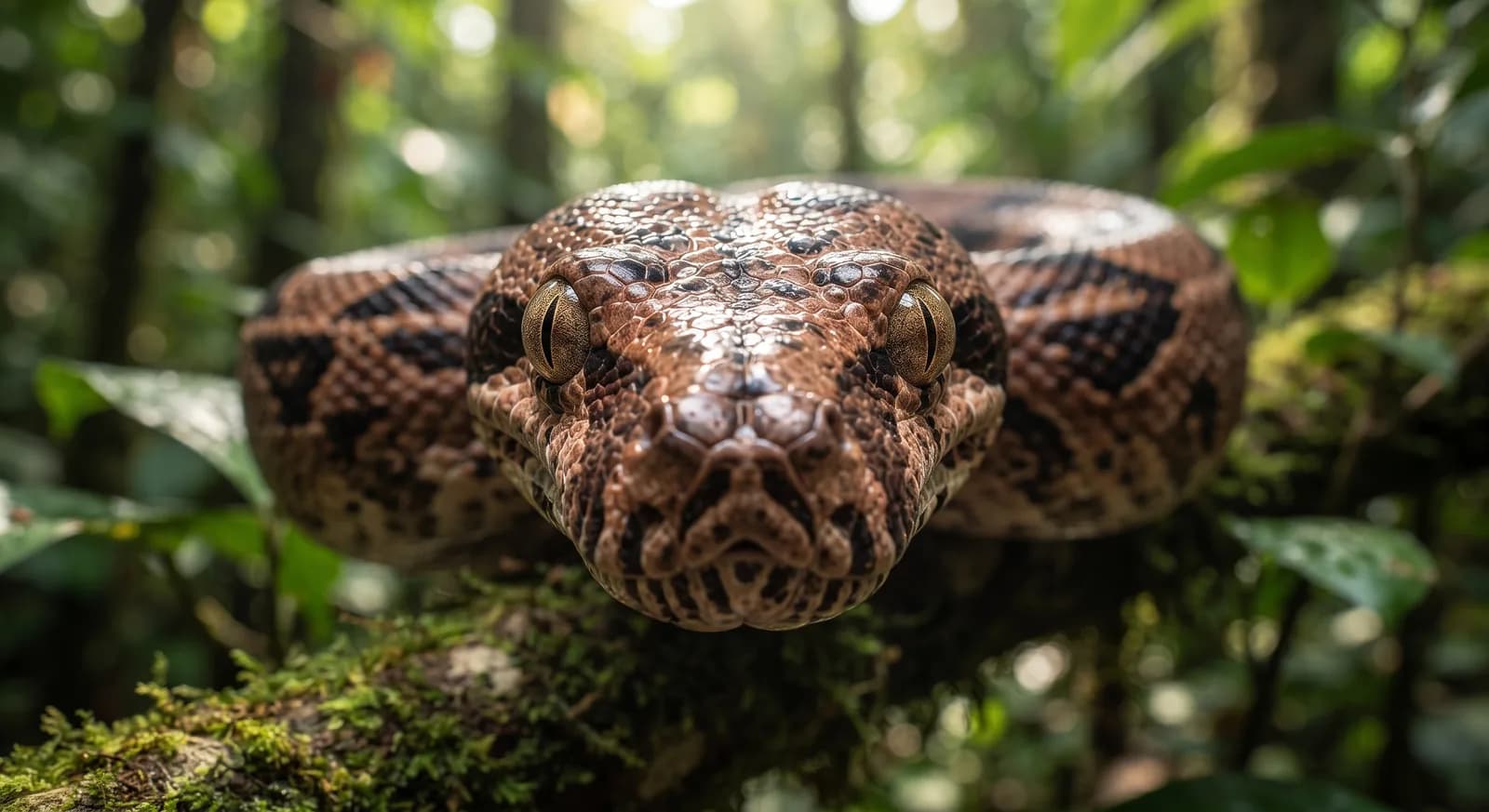 Not Evaluated
Red-tailed Boa
Boa constrictor
Rainbow Boa
Epicrates cenchria
Emerald Tree Boa
Corallus caninus
Kenyan Sand Boa
Eryx colubrinus
Pacific Boa
Candoia carinata
Hispaniola Boa
Chilabothrus striatus
Cuban Boa
Chilabothrus angulifer
Madagascar Tree Boa
Sanzinia madagascariensis
Puerto Rican Boa
Chilabothrus inornatus
Dominica Boa
Boa nebulosa
Conservation status
No species documented in this group is genuinely at risk according to the IUCN, with the data available today.
See the global conservation statusWhere they live
Recorded in 74 countries. The ones with the most species in the group:
Where to see them
Did you know…
It kills by constriction, feeding on small and medium-sized mammals, birds and lizards.
From Red-tailed Boa
It has vestigial pelvic spurs, evolutionary remnants of its lizard ancestors' hind legs.
From Red-tailed Boa
It is ovoviviparous: the young are born live and completely independent, measuring 38 to 60 cm.
From Red-tailed Boa
Its skin throws rainbow iridescence, produced by the microstructure of its scales.
From Rainbow Boa
Its iridescence is not pigment: microscopic ridges on the surface of the scales diffract the light like a prism, breaking it into every colour of the spectrum. In direct sunlight the snake looks as though it were covered in oil on water.
From Rainbow Boa
The effect is only visible in individuals whose skin is in good condition, and it disappears just before a moult, when the outer layer turns opaque.
From Rainbow Boa
It lives in the trees of the Amazon, its deep green hiding it almost completely among the leaves; the young are born orange or red before they change colour.
From Emerald Tree Boa
Its resting posture is unmistakable: it coils its body into stacked, perfectly symmetrical loops over a branch, with its head resting in the centre, an image that has made this species an icon of nature photography.
From Emerald Tree Boa