One of the 15 flies on WAnimals
Insects · Hymenoptera · Tenthredinidae
Figwort Sawfly
Tenthredo scrophulariae
It has not yet been assessed against the IUCN criteria. See full glossary
A wasp-like sawfly, black with yellow bands, that settles on the flowers of umbellifers. The adults are partly predators of other insects, while their caterpillar-like larvae feed on the leaves of figwort and mullein.
Size
1 cm – 1.6 cm
Diet
Omnivore
Combines animal and plant food depending on availability.
Activity
Diurnal
Active mainly during the day.
Social structure
Solitary
Lives and hunts alone, joining others only to breed.
Sighting difficulty
Unknown
Fun facts
- The females owe the group its name to the saw-shaped ovipositor with which they cut a slit in the plant tissue to insert their eggs.
- They are the oldest group of hymenopterans: the sawflies have no wasp waist and keep the broad body of their ancestors, from before the appearance of bees, wasps and ants.
- Their larvae are told from butterfly and moth caterpillars by having more pairs of abdominal prolegs, a classic field identification trick.
- It is not a true wasp: the symphytans, or sawflies, are the oldest lineage of the Hymenoptera and have no wasp waist. The abdomen joins the thorax across its full width.
- Nor do they have a sting. What in wasps is a sting remains here a saw-shaped ovipositor, with which the female cuts into plant tissue to deposit her eggs inside. Hence the family's name.
- Its yellow and black coloration mimics wasps: it is a Batesian mimic, completely harmless.
- The larva looks like a butterfly caterpillar, but can be told apart by having more prolegs and a single ocellus on each side.
- The adult is a predator and hunts other insects on flowers, something unusual in the group, where most species keep to pollen and nectar.
Life cycle & biology
- Skeleton type
- Invertebrate - chitin exoskeleton (insect)
- Habitat & environment
- Damp meadows, verges and streamsides with figworts
Sources consulted: Buglife; Benson, revisiones de Symphyta; NatureSpot
Where to find it
See its range on the interactive mapBest time: May to August, on flowering umbellifers
Related species
Other species in the catalogue with the most in common with Figwort Sawfly — same habitat, park, country, tags or family.
 Least Concern
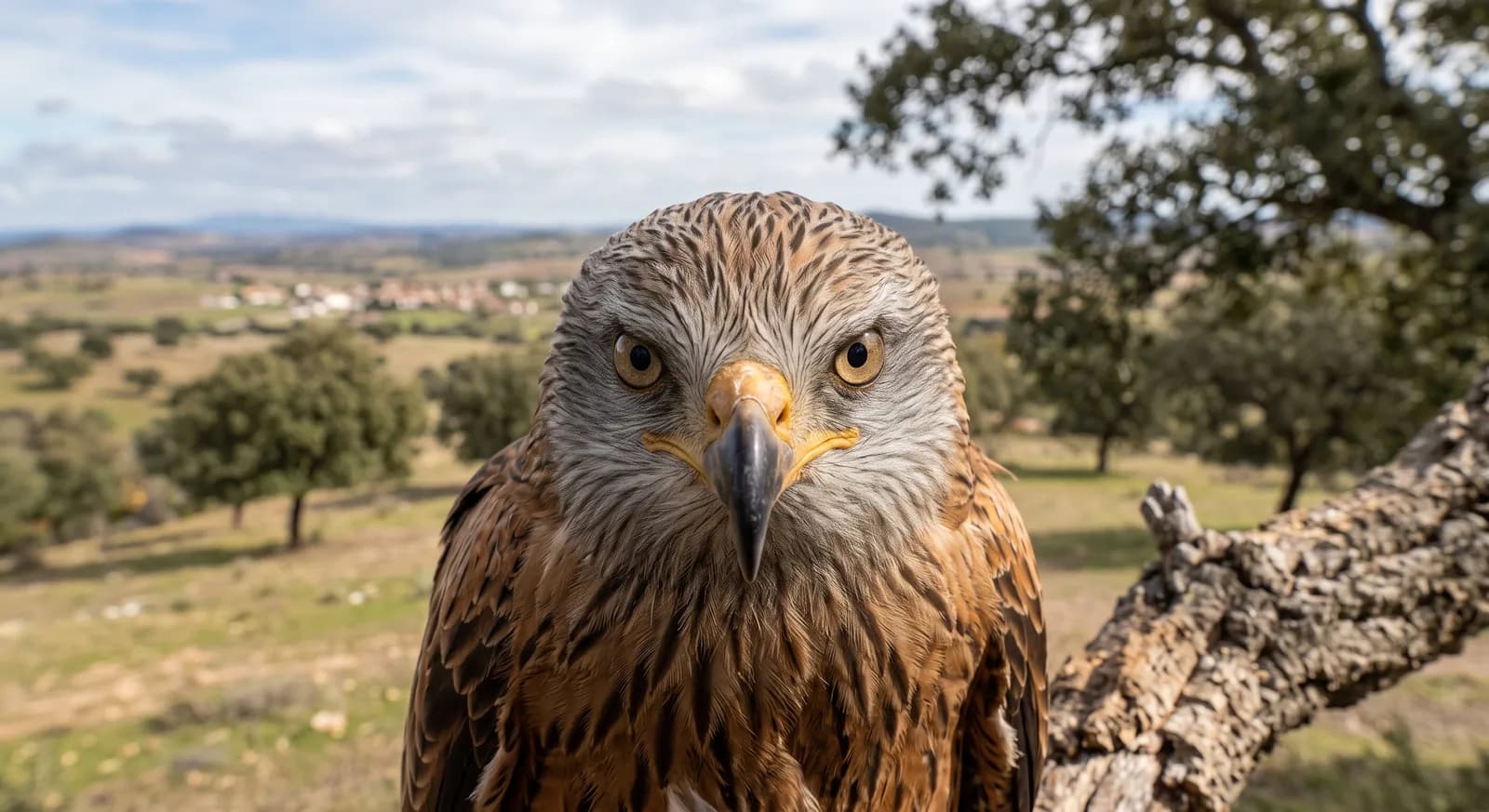
Red Kite
Milvus milvus
Common Chaffinch
Fringilla coelebs
European Robin
Erithacus rubecula
Red Admiral
Vanessa atalanta
Peacock
Aglais io
Keep exploring
Based on what we already know about figwort sawfly.
Comments
Share an experience, a fun fact or a tip for seeing the figwort sawfly.
Be the first to comment.