One of the 2 kites on WAnimals
Birds · Accipitriformes · Accipitridae
Red Kite
Milvus milvus
The species is abundant and widely distributed; it faces no significant short-term risk. See full glossary
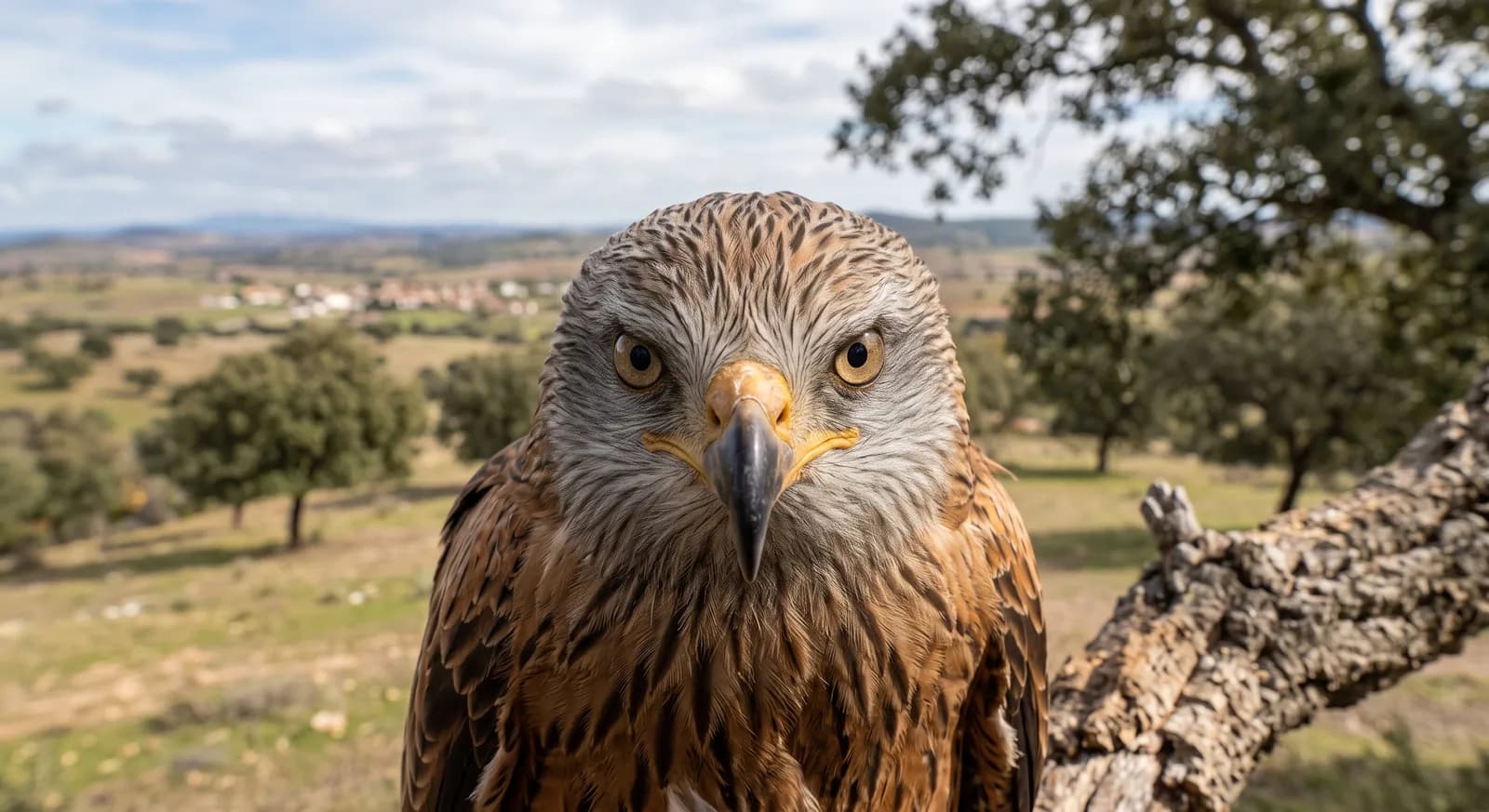
It is recognisable by its striking deeply forked tail, which it uses as a rudder for acrobatic turns in flight.
Weight
800 g – 1.3 kg
Size
60 cm – 70 cm
Lifespan
10 years
Diet
Omnivore
Combines animal and plant food depending on availability.
Activity
Diurnal
Active mainly during the day.
Social structure
Solitary
Lives and hunts alone, joining others only to breed.
Sighting difficulty
Easy
Estimated population
2,312-2,440 breeding pairs in Spain (2014 survey), placing the country third in Europe after Germany and France; as a wintering area it is the most important on the continent, with 73,353 birds and 1,388 roosts in the 2024/2025 survey against 50,297 in 2014. Europe holds 95% of the world total (19,000-23,000 pairs)
Fun facts
- It eats carrion, small mammals, birds, earthworms and occasionally live prey.
- Its reintroduction to the United Kingdom is regarded as one of the most successful raptor conservation projects in Europe.
- A bird ringed in Germany reached a record 26 years and 8 months.
- comportamientoIt often feeds on carrion, and in several European cities it has learned to take food scraps near people, changing its traditional behaviour.
Life cycle & biology
- Skeleton type
- Vertebrate - pneumatised bony skeleton (bird)
- Habitat & environment
- Broadleaf woodland mixed with grassland and farmland in western and central Europe
- Birth weight
- Weight at hatching not found as a precise figure
- Size at birth
- Downy and dependent on hatching
- Sexual maturity
- 2 years
- Gestation / incubation
- 31-32 days per egg (up to 40 days to incubate the whole clutch)
- Litter / clutch size
- 1 to 3 eggs per clutch
- Lifespan in captivity
- A documented record of 26 years and 8 months, in a bird ringed in Germany
Sources consulted: Animal Diversity Web; A-Z Animals; Brickfields Park; Birda; Animal Corner; Bilderreich; AnAge (genomics.senescence.info); Springer (home range study); SEO/BirdLife: tras el fuerte declive de 1994-2004, la población reproductora creció un 15 % hasta 2014 y el censo invernal de 2024/2025 registró unos 20.000 ejemplares más que una década antes || Molina (Ed.) 2015, El milano real en España, III Censo Nacional, SEO/BirdLife; SEO/BirdLife, censo nacional de población invernante 2024/2025 || SEO/BirdLife, III Atlas de las aves en época de reproducción en España, ficha del milano real
Where to find it
See its range on the interactive mapBest time: In winter, between November and February, when Spain holds 60-75% of the European population and the kites form communal roosts of dozens or hundreds of birds, above all in Castile and León
Where to watch it
Parques y spots de buceo donde se ha documentado esta especie — se muestran 10 de 187 documentados.
Related species
Other species in the catalogue with the most in common with Red Kite — same habitat, park, country, tags or family.
Eurasian Sparrowhawk
Accipiter nisus
Lesser Spotted Eagle
Clanga pomarina
Northern Goshawk
Accipiter gentilis
 Least Concern
Short-toed Eagle
Circaetus gallicus
Common Buzzard
Buteo buteo
Booted Eagle
Hieraaetus pennatus
Keep exploring
Based on what we already know about red kite.
Comments
Share an experience, a fun fact or a tip for seeing the red kite.
Be the first to comment.