One of the 4 urchins on WAnimals
Sea urchins · Echinoida · Strongylocentrotidae
Purple Sea Urchin
Strongylocentrotus purpuratus
It has not yet been assessed against the IUCN criteria. See full glossary
For all that it looks simple, it can live up to 70 years without obvious signs of cellular ageing, which makes it an important biomedical model for longevity research.
Size
up to 10 cm
Lifespan
20 years
Diet
Omnivore
Combines animal and plant food depending on availability.
Activity
Nocturnal
Active mainly at night.
Social structure
Colony
Lives in large concentrations, often for breeding reasons.
Sighting difficulty
Unknown
Fun facts
- Its genome was fully sequenced in 2006, revealing a surprising evolutionary closeness to the vertebrates.
- It feeds mainly on kelp, supplemented with dead fish, barnacles and sponges.
- It lives in the low intertidal and rocky subtidal of the eastern Pacific, in kelp forests.
- It is the protagonist of the Pacific's urchin barrens. When its predators disappeared — above all the sunflower sea star, devastated by wasting syndrome since 2013 — its populations exploded and stripped the kelp forests of the North American west coast.
- And they endure: in an urchin barren, with hardly any food, they enter a dormant state with empty gonads and can survive for years lying in wait, which prevents the forest from recovering on its own.
- It carves out its own hollow in the rock, wearing it away with its teeth and spines, and many individuals end up trapped in their own pit.
- It lives up to fifty years or more, and is one of the classic model species of developmental biology: its transparent, externally fertilised embryo was key to understanding fertilisation and the first cell divisions.
- Its genome was sequenced in 2006, one of the first for a marine invertebrate.
- Its gonads are the uni of Japanese gastronomy, and its commercial fishery has grown precisely by taking advantage of the population explosions.
Life cycle & biology
- Skeleton type
- Invertebrate - external calcareous skeleton (test)
- Habitat & environment
- Low intertidal and rocky subtidal zones of the eastern Pacific, from Alaska to Baja California, in kelp forests
- Birth weight
- A microscopic pluteus larva after external fertilisation
- Size at birth
- Microscopic larva after fertilisation
- Sexual maturity
- ~2 years
- Gestation / incubation
- 2-4 weeks as a planktonic larva before settling on the bottom
- Litter / clutch size
- Numerous eggs released by mass spawning
Sources consulted: GBIF; National Marine Sanctuary Foundation; AnAge (genomics.senescence.info); Animal Diversity Web; Oregon Coast Aquarium; California Sea Grant; SeaLifeBase; PMC (larval staging study, extracellular vesicles study)
Where to watch it
Parques y spots de buceo donde se ha documentado esta especie — se muestran 10 de 12 documentados.
Related species
Other species in the catalogue with the most in common with Purple Sea Urchin — same habitat, park, country, tags or family.
Green Crab
Carcinus maenas
Pacific Oyster
Crassostrea gigas
Mediterranean Mussel
Mytilus galloprovincialis
 Near Threatened
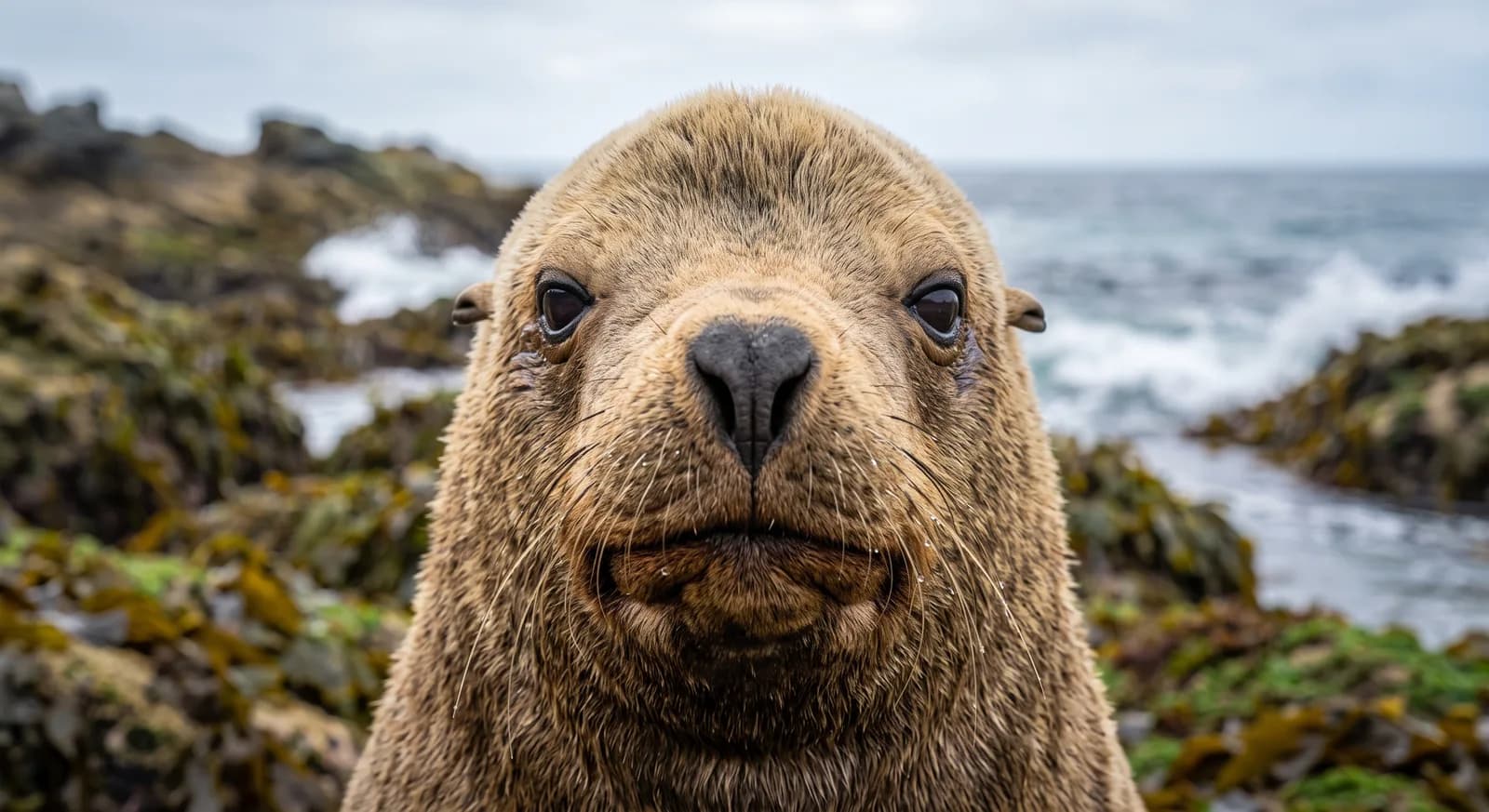
Steller Sea Lion
Eumetopias jubatus
Ghost Shrimp
Caprella linearis
Humboldt Squid
Dosidicus gigas
Keep exploring
Based on what we already know about purple sea urchin.
Comments
Share an experience, a fun fact or a tip for seeing the purple sea urchin.
Be the first to comment.