Skip to content
WAnimals
  • Map
  • Species
  • Parks
  • Diving
Log inCreate account
WAnimals

The guide for travellers and animal lovers: discover, plan and share your wild adventures around the world.

Discover wildlife

  • Species
  • Ecosystems
  • Glossary
  • Tags

Explore places

  • Map
  • Countries
  • Parks
  • Diving

Plan experiences

  • Guides

Learn

  • Blog

Resources

  • About us
  • How we build our profiles
  • Help centre
  • Contact
  • Install the app

Follow us

Account

  • Log in
  • Create account

© 2026 WAnimals. All rights reserved.

Terms of servicePrivacyCookiesLegal notice
MapSpeciesParksDiving
  1. Home
  2. Species
  3. Brown Recluse

One of the 26 spiders on WAnimals

Arachnids · Araneae · Sicariidae

Brown Recluse

Loxosceles reclusa

Not Evaluated

It has not yet been assessed against the IUCN criteria.

Spotted something wrong?

The brown recluse, violin spider or fiddleback spider is a spider belonging to the genus Loxosceles of the family Sicariidae. It is a spider with a powerful necrotic venom and is one of the two spiders of medical importance in North America.

Size

up to 1.2 cm

Life expectancy

2 years

Diet

Carnivore

Feeds mainly on other animals.

Activity

Nocturnal

Active mainly at night.

Social structure

Solitary

Lives and hunts alone, joining others only to breed.

Temperate forest
1countries9parks1same family

Fun facts

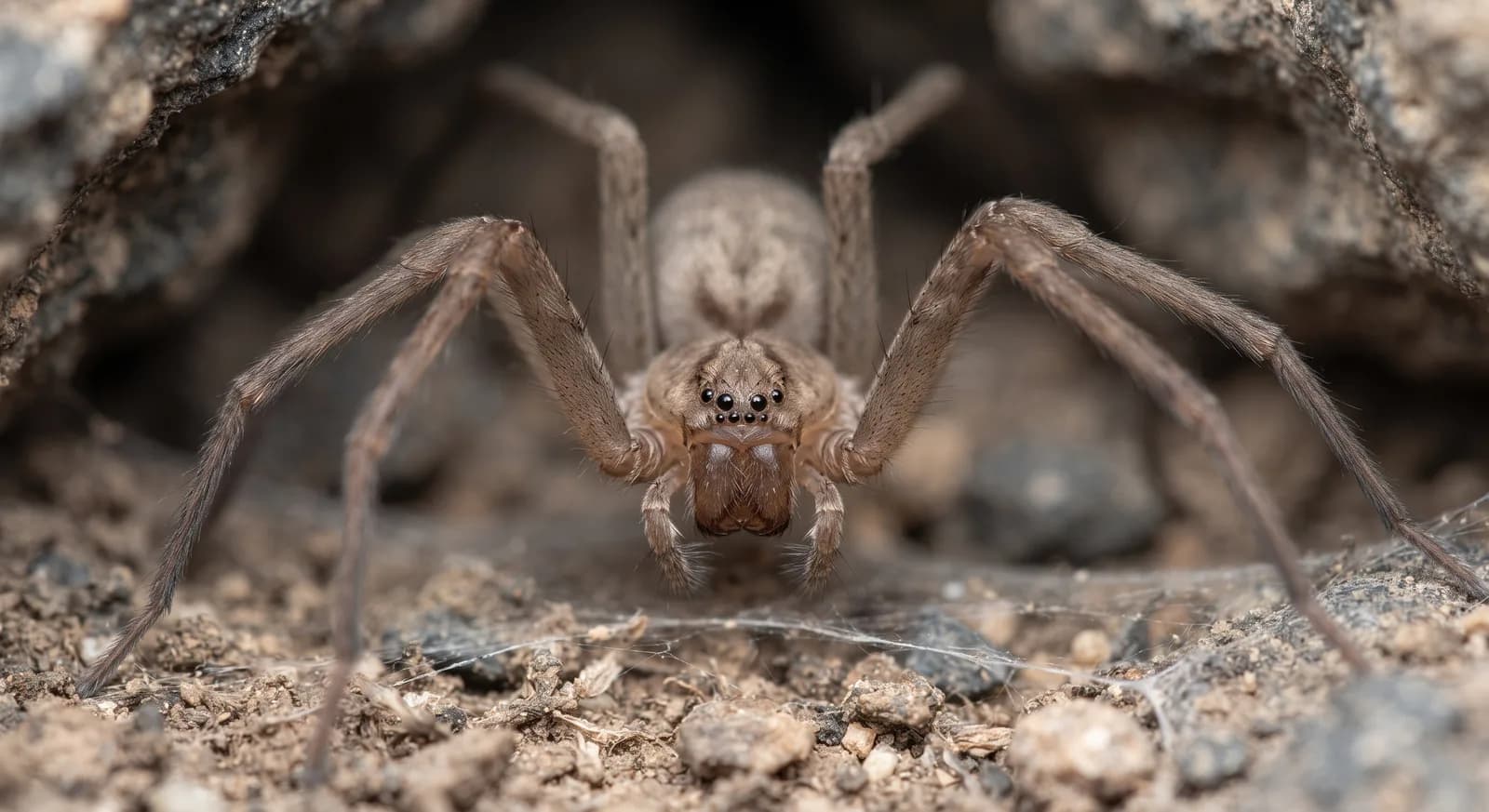
  • It has six eyes arranged in three pairs rather than the eight of most spiders: one of the most reliable features for identifying it.
  • It almost always bites by accident, when it gets trapped against the skin while someone is dressing or reaching into a box.
  • Far more recluse bites have been diagnosed than the species' actual distribution allows: a good share of them are in fact bacterial infections.
  • It is identified by a violin-shaped marking on the cephalothorax and, above all, by its eyes: it has six instead of eight, arranged in three pairs, a far more reliable feature than the violin.
  • Its venom contains phospholipases D, formerly known generically as sphingomyelinase D, which destroy cell membranes and cause the characteristic necrosis.
  • But the main problem with this species is overdiagnosis. Outside its real range, in the south-central United States, it is constantly blamed for necrotic lesions that have some other cause, and in states such as California this has reached the status of urban legend.
  • And that mistake has medical consequences: many of those lesions are in fact MRSA infections or other diseases, and treating them as a spider bite delays the correct diagnosis.
  • Most verified bites cause no necrosis: they amount to redness and itching and heal on their own.
  • Surgically excising the bite area to prevent necrosis is contraindicated and usually worsens the outcome.
  • It is retiring and bites only when trapped against the skin, typically while getting dressed or getting into bed.

Life cycle and biology

Skeleton type
Invertebrate - chitin exoskeleton (arachnid)
Habitat and environment
Corners, storerooms, boxes and dry cavities of houses in the central and southern United States

Sources consulted: Wikipedia (es): Loxosceles reclusa

Where to find it

Loading map…

The pins mark the parks where its presence is documented.

Where to see it

Parks and dive sites where this species has been documented.

Related species

Other species in the catalogue with the most in common with Brown Recluse — same habitat, park, country, tags or family.

Same taxonomic family
Shares a park
Shares a park
Shares a park
Shares a park
Shares a park

Keep exploring

Based on what we already know about brown recluse.

Share an experience, a fun fact or a tip for seeing the brown recluse.
See full glossary
This page in other languages: Español · Deutsch · Français · Português · Italiano
See its range on the interactive map→
Great Smoky MountainsUnited States
Big BendUnited States
Mammoth CaveUnited States
CongareeUnited States
BadlandsUnited States
Wind CaveUnited States
Carlsbad CavernsUnited States
Guadalupe MountainsUnited States
Hot SpringsUnited States
Chilean RecluseNot Evaluated

Chilean Recluse

Loxosceles laeta

Least Concern

Great Horned Owl

Bubo virginianus

Least Concern

Eastern Newt

Notophthalmus viridescens

Least Concern

Eastern Tiger Salamander

Ambystoma tigrinum

Not Evaluated

Southern Black Widow

Latrodectus mactans

American MinkLeast Concern

American Mink

Neovison vison

CountriesUnited States
ParksGreat Smoky MountainsUnited States
TagsCarnivore
Carnivore
Nocturnal
Solitary
Temperate forest
Arachnid
United States