Skip to content
WAnimals
  • Map
  • Species
  • Parks
  • Diving
Log inCreate account
WAnimals

The guide for travellers and animal lovers: discover, plan and share your wild adventures around the world.

Discover wildlife

  • Species
  • Ecosystems
  • Glossary
  • Tags

Explore places

  • Map
  • Countries
  • Parks
  • Diving

Plan experiences

  • Guides

Learn

  • Blog

Resources

  • About us
  • How we build our profiles
  • Help centre
  • Contact
  • Install the app

Follow us

Account

  • Log in
  • Create account

© 2026 WAnimals. All rights reserved.

Terms of servicePrivacyCookiesLegal notice
MapSpeciesParksDiving
  1. Home
  2. Species
  3. Goat

One of the 5 goats on WAnimals
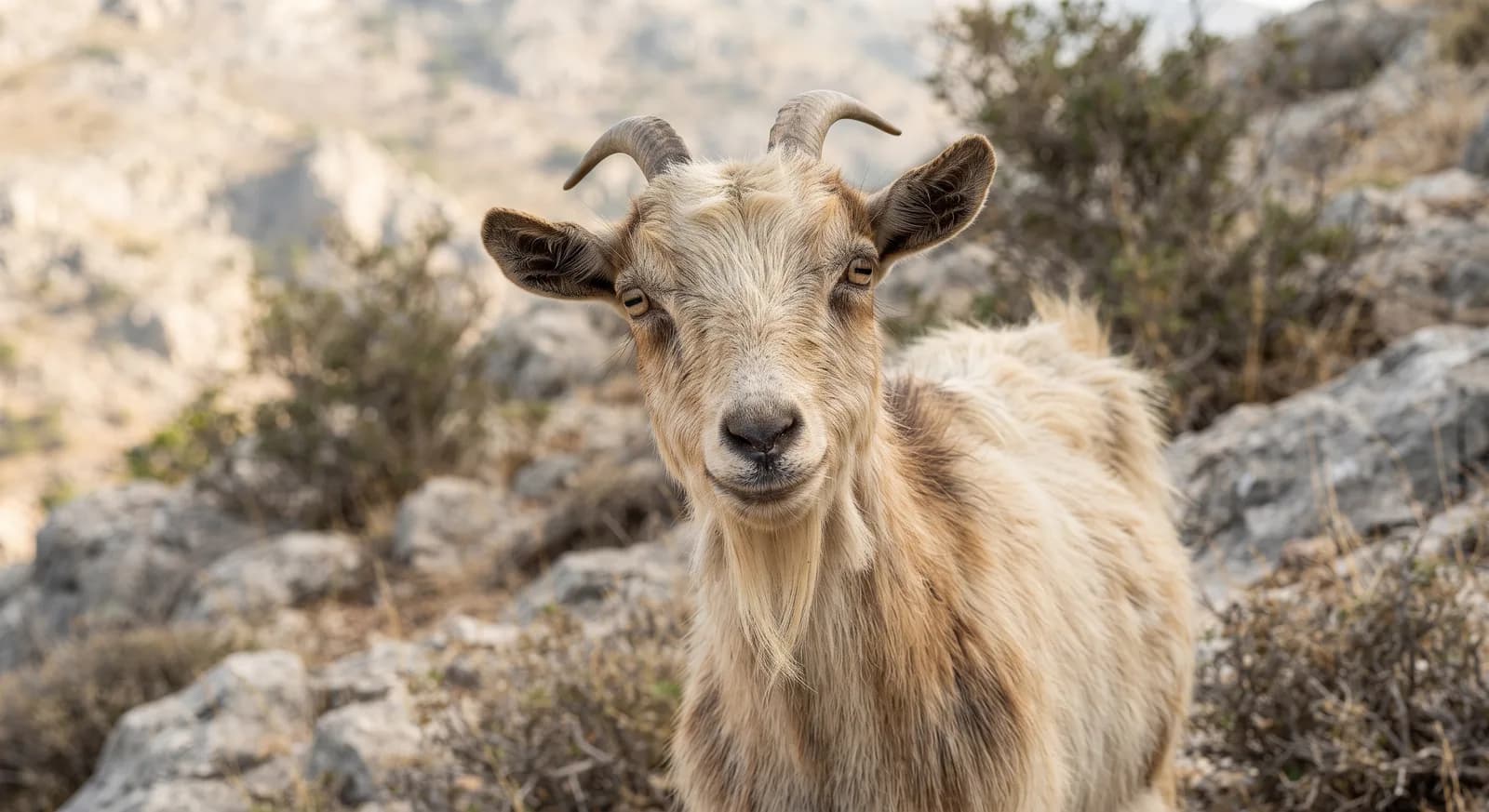
Goat (Capra hircus)

Mammals · Artiodactyla · Bovidae

Goat

Capra hircus

Not Evaluated

It has not yet been assessed against the IUCN criteria.

Spotted something wrong?

The domestic goat descends from the bezoar goat (Capra aegagrus) and was domesticated some 10,000 years ago in the Zagros Mountains. It is the most versatile ruminant in livestock farming: it withstands heat, drought and poor grazing, browses shrubs that other animals refuse, and climbs ground that not even a sheep can reach. That is why it is fundamental to the economy of arid parts of Africa and Asia. That same capacity makes it a threat when it goes feral on islands, where it strips out the native vegetation.

Weight

20 kg – 140 kg

Size

1.1 m – 1.7 m

Life expectancy

15 years
Diet

Herbivore

Feeds mainly on plants.

Activity

Diurnal

Active mainly during the day.

Social structure

Herd

Lives in large groups as a strategy against predators.

DesertMountainGrassland
86same family

AI-generated images: illustrations, not photographs.

Fun facts

  • In south-western Morocco it climbs into the branches of argan trees, up to eight metres off the ground, to eat their fruit.
  • Its rectangular pupil rotates to stay horizontal even when the goat lowers its head to graze, so that it never loses its panoramic view of the horizon.
  • It descends from the bezoar, Capra aegagrus, and its domestication had at least two centres: south-eastern Turkey about 10,500 years ago, and the southern Zagros Mountains and the Iranian plateau almost 10,000 years ago.
  • Today's goats retain six distinct maternal lineages, but the great majority of farm goats descend from only two of those events.
  • It truly climbs. In south-western Morocco it clambers up argan trees, as high as eight metres off the ground, to eat their fruit, and in the Alps it has been photographed on near-vertical dam walls licking the salt from the concrete.
  • Its ability to make use of woody scrub and steep terrain made it the animal of the places where cattle and sheep do not thrive, and that is why it accompanied the first farmers in their expansion.

Life cycle and biology

Skeleton type
Vertebrate - internal bony skeleton (mammal)
Habitat and environment
Hills, scrub and livestock holdings, especially on arid and steep ground
Sexual maturity
13.3 months
Gestation / incubation
5.1 months
Litter / clutch size
1.5 (average)
Life expectancy in captivity
18

Sources consulted: Wikipedia (es): Capra aegagrus hircus

Related species

Other species in the catalogue with the most in common with Goat — same habitat, park, country, tags or family.

Same taxonomic family

Keep exploring

Based on what we already know about goat.

Share an experience, a fun fact or a tip for seeing the goat.
See full glossary
This page in other languages: Español · Deutsch · Français · Português · Italiano
Near Threatened

Saiga

Saiga tatarica

HirolaCritically Endangered

Hirola

Beatragus hunteri

Near Threatened

Chiru

Pantholops hodgsonii

American BisonNear Threatened

American Bison

Bison bison

Least Concern

Klipspringer

Oreotragus oreotragus

Least Concern

Kob

Kobus kob

TagsHerbivore
Herbivore
Diurnal
In herds
Desert
Mountain
Grassland
Mammal