Skip to content
WAnimals
  • Map
  • Species
  • Parks
  • Diving
Log inCreate account
WAnimals

The guide for travellers and animal lovers: discover, plan and share your wild adventures around the world.

Discover wildlife

  • Species
  • Ecosystems
  • Glossary
  • Tags

Explore places

  • Map
  • Countries
  • Parks
  • Diving

Plan experiences

  • Guides

Learn

  • Blog

Resources

  • About us
  • How we build our profiles
  • Help centre
  • Contact
  • Install the app

Follow us

Account

  • Log in
  • Create account

© 2026 WAnimals. All rights reserved.

Terms of servicePrivacyCookiesLegal notice
MapSpeciesParksDiving
  1. Home
  2. Species
  3. Terciopelo

Reptiles · Squamata · Viperidae

Terciopelo

Bothrops asper

Not Evaluated

It has not yet been assessed against the IUCN criteria.

Spotted something wrong?

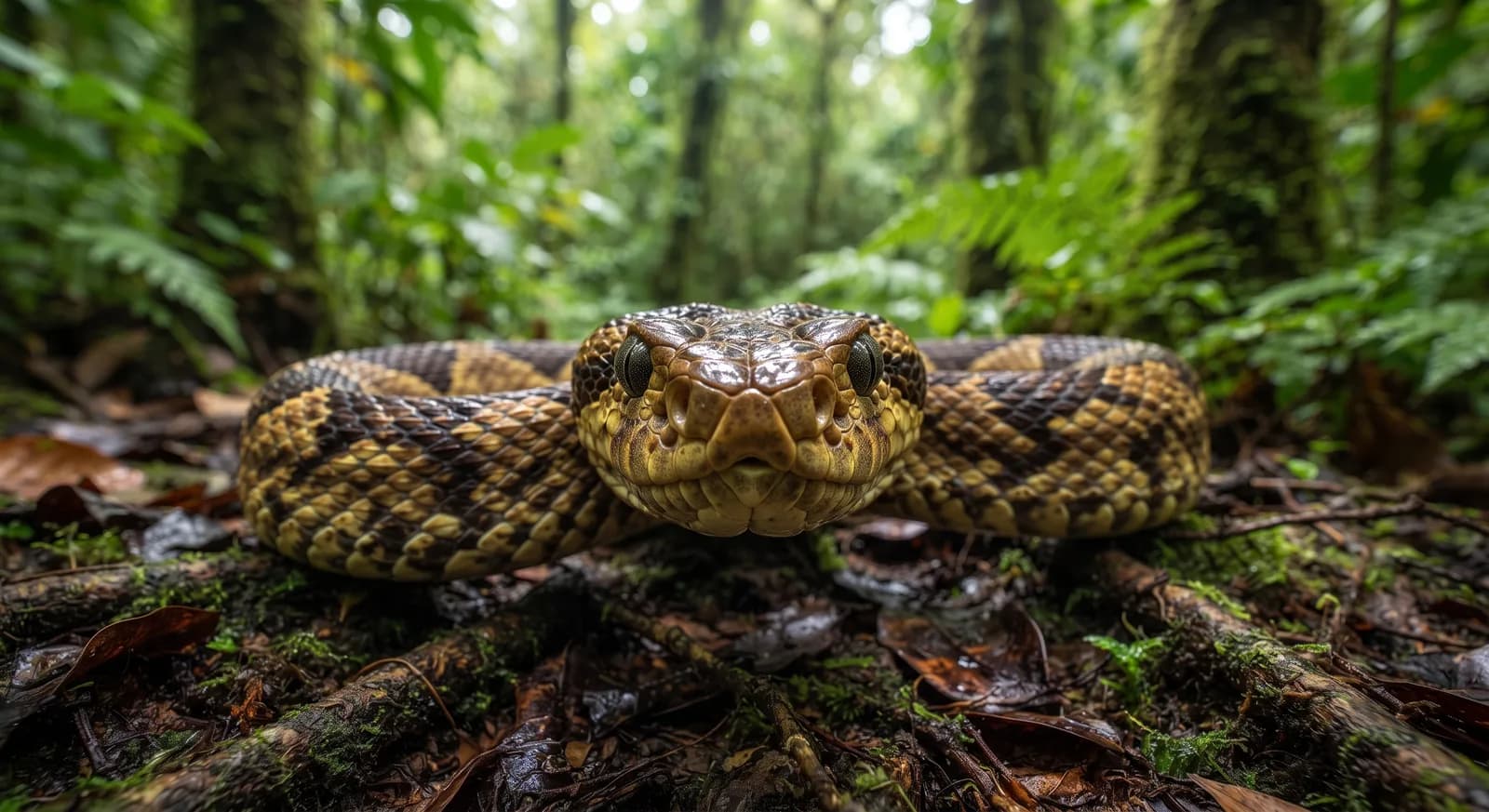
It is responsible for more snakebites than any other species within its range, because it so often lives close to farmland and human settlement.

Weight

up to 6 kg

Size

1.4 m – 2.5 m

Life expectancy

15 years

Diet

Carnivore

Feeds mainly on other animals.

Activity

Nocturnal

Active mainly at night.

Social structure

Solitary

Lives and hunts alone, joining others only to breed.

Rainforest
5countries22same family

Fun facts

  • Newborns use the bright yellow tip of their tail as a lure to draw in small prey.
  • It eats small mammals, birds and amphibians, taken from ambush.
  • It is reckoned the most prolific snake in the Americas, with as many as 90 young to a litter.
  • fisiologíaIt accounts for a large share of the snakebites recorded in Central America, and its venom acts mainly on blood clotting and local tissue.

Life cycle and biology

Skeleton type
Vertebrate - internal bony skeleton (reptile)
Habitat and environment
Tropical rainforest, farmland and lowlands of Mexico, Central America and northern South America
Birth weight
25-30 cm long at birth, the yellow tail tip used as a lure to draw in prey
Size at birth
25 - 30 cm long at birth
Sexual maturity
~3 years (the male at 99.5 cm, the female at 111.3 cm long)
Gestation / incubation
6-8 months (180-240 days), a viviparous species
Litter / clutch size
5 to 90 young per litter, reckoned the most prolific snake in the Americas
Life expectancy in captivity
Documented record of up to 20.4 years in captivity

Sources consulted: Instituto Clodomiro Picado · AnAge (genomics.senescence.info) · Storyteller Travel · Animal Diversity Web · Tico Travel · Delamazonas · Grokipedia (Bothrops asper) · Wikipedia (Bothrops asper) · Reptiles of Ecuador

Where to find it

Loading map…

Related species

Other species in the catalogue with the most in common with Terciopelo — same habitat, park, country, tags or family.

Same taxonomic family

Keep exploring

Based on what we already know about terciopelo.

Share an experience, a fun fact or a tip for seeing the terciopelo.
See full glossary
This page in other languages: Español · Deutsch · Français · Português · Italiano
See its range on the interactive map→
Least Concern

Eyelash Viper

Bothriechis schlegelii

South American BushmasterVulnerable

South American Bushmaster

Lachesis muta

Least Concern

Western Diamond-backed Rattlesnake

Crotalus atrox

Least Concern

Sidewinder

Crotalus cerastes

Least Concern

Cascabel Rattlesnake

Crotalus durissus

Least Concern

Mohave Rattlesnake

Crotalus scutulatus

CountriesColombia
TagsCarnivore
Carnivore
Nocturnal
Solitary
Reptile
Rainforest
Colombia
Costa Rica
Ecuador
Mexico
Panama