One of the 3 birds-of-paradise on WAnimals
Birds · Passeriformes · Paradisaeidae
Greater Bird-of-Paradise
Paradisaea apoda
The species is abundant and widely distributed; it faces no significant short-term risk. See full glossary
The greater bird-of-paradise is the species that gave the whole family its name. The male wears a mantle of ornamental yellow and white plumes springing from his flanks, which he spreads in a cascade during courtship, hanging upside down from a branch. The males gather at leks in the canopy and compete in coordinated displays. Its scientific name, apoda, means footless, and conceals one of the most celebrated misunderstandings in the history of natural history.
Weight
170 g – 320 g
Size
43 cm – 1 m
Lifespan
20 years
Diet
Omnivore
Combines animal and plant food depending on availability.
Activity
Diurnal
Active mainly during the day.
Social structure
Solitary
Lives and hunts alone, joining others only to breed.
Sighting difficulty
Easy
Fun facts
- Its scientific name means footless: the first specimens to reach Europe in the sixteenth century were skins prepared by Malay traders with the feet and wings removed, which led naturalists to believe that these birds floated perpetually in the air and never perched.
- Alfred Russel Wallace spent months in the Aru Islands watching its leks, and his descriptions of the displays were central to the development of his ideas on sexual selection.
Life cycle & biology
- Skeleton type
- Vertebrate - internal bony skeleton (bird)
- Habitat & environment
- Lowland and hill rainforest of south-western New Guinea and the Aru Islands
- Size at birth
- Altricial: born blind, naked or with sparse down and entirely dependent
- Sexual maturity
- 4 years
- Gestation / incubation
- 18 days of incubation
- Litter / clutch size
- 2 eggs
Sources consulted: https://es.wikipedia.org/wiki/Paradisaea_apoda
Where to find it
See its range on the interactive mapBest time: June to December in the Aru Islands and southern New Guinea, at dawn, when the males display at their leks in the canopy.
Where to watch it
Parks and dive sites where this species has been documented.
Related species
Other species in the catalogue with the most in common with Greater Bird-of-Paradise — same habitat, park, country, tags or family.
Western Superb Bird-of-Paradise
Lophorina superba
Common Bluetongue
Tiliqua scincoides
Moluccan Eclectus
Eclectus roratus
Wilson's Bird-of-paradise
Cicinnurus respublica
Common Phalanger
Phalanger orientalis
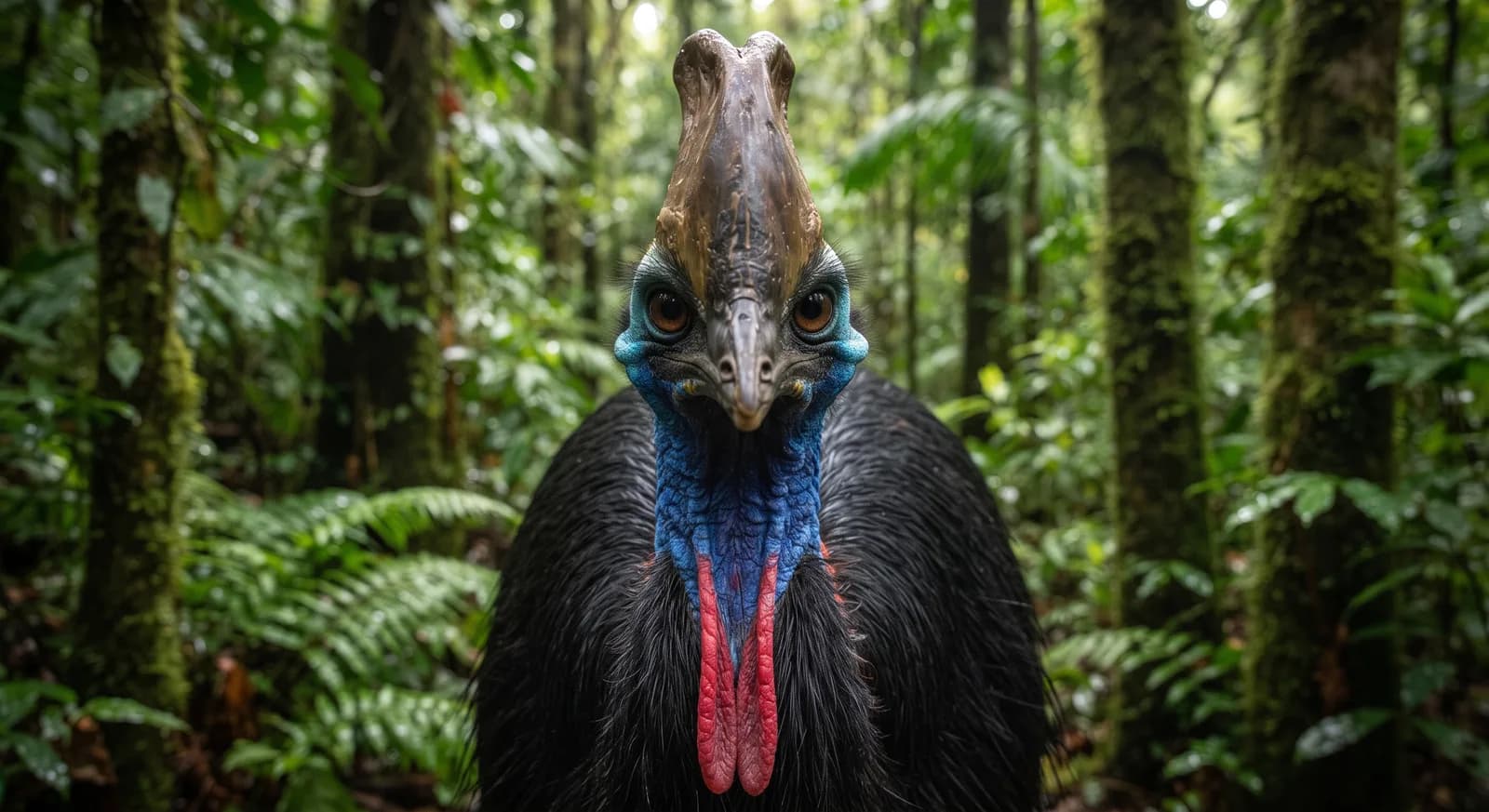 Endangered
Southern Cassowary
Casuarius casuarius
Keep exploring
Based on what we already know about greater bird-of-paradise.
Comments
Share an experience, a fun fact or a tip for seeing the greater bird-of-paradise.
Be the first to comment.