One of the 2 cassowaries on WAnimals
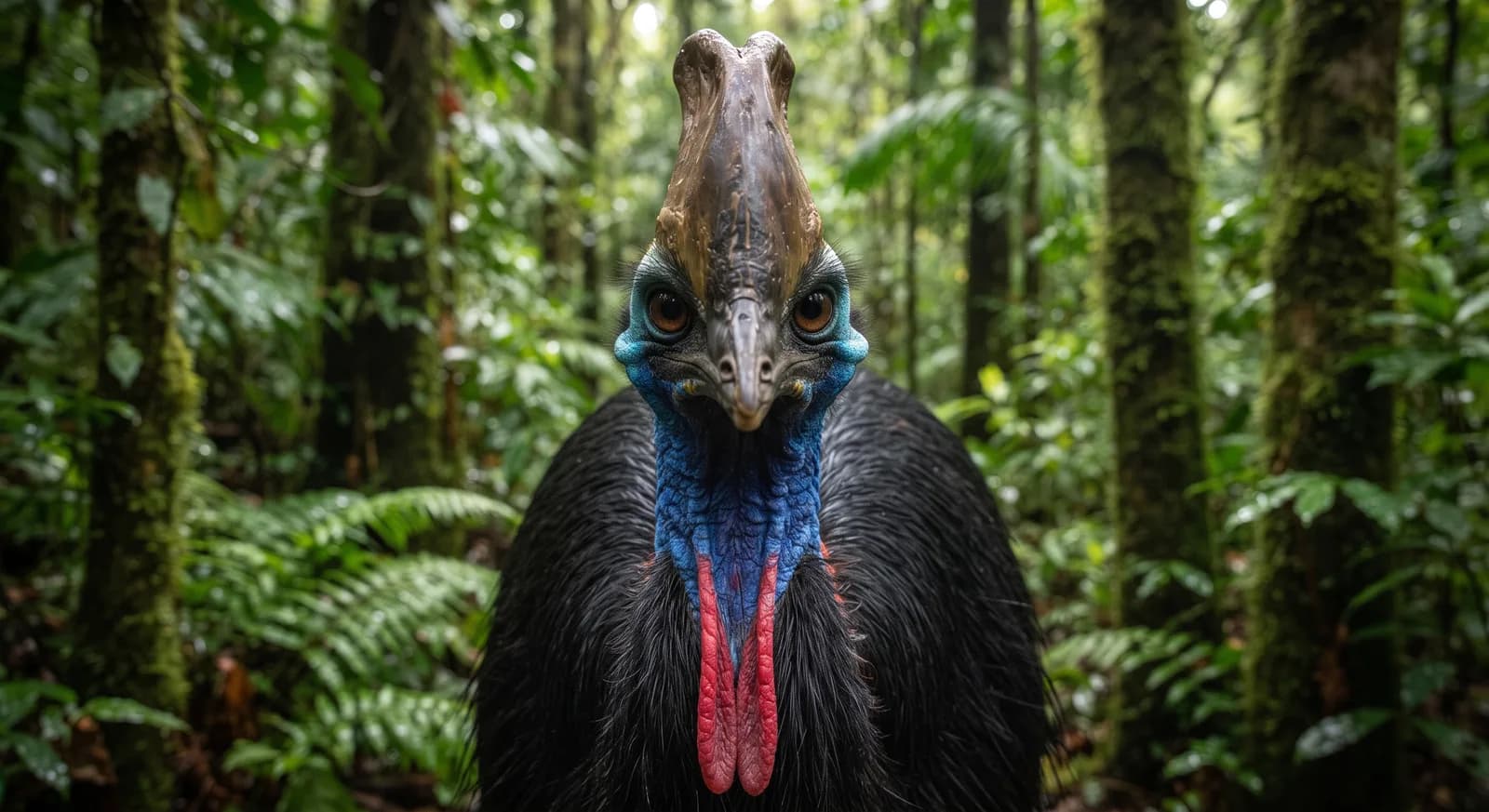
Birds · Casuariiformes · Casuariidae
Southern Cassowary
Casuarius casuarius
It faces a very high risk of extinction in the wild in the near future. See full glossary
It is regarded as the most dangerous bird in the world because of its powerful legs, armed with an inner claw up to 12 cm long.
Weight
29 kg – 76 kg
Size
1.3 m – 1.7 m
Lifespan
19 years
Diet
Omnivore
Combines animal and plant food depending on availability.
Activity
Diurnal
Active mainly during the day.
Social structure
Solitary
Lives and hunts alone, joining others only to breed.
Sighting difficulty
Hard
Fun facts
- It is regarded as the most dangerous bird in the world, with an inner claw up to 12 cm long.
- Unlike most birds, it is the male that incubates alone and raises the chicks.
- The polyandrous female mates with several males and lays in different nests.
- defensaIt is considered one of the most dangerous birds in the world because of its powerful legs and dagger-like claws.
- reproducciónIt is one of the few birds in which the male takes on the incubation and the later care of the chicks entirely, with no part played by the female.
Life cycle & biology
- Skeleton type
- Vertebrate - non-pneumatised bony skeleton, flightless bird (ratite)
- Habitat & environment
- Tropical rainforest of the coastal forests of New Guinea and north-eastern Australia (Queensland)
- Birth weight
- A large egg; no precise figure found for the chick's weight on hatching
- Size at birth
- Precocial, covered in brown and buff striped down, with no casque yet on hatching
- Sexual maturity
- 2-3 years
- Gestation / incubation
- 47-61 days, incubated by the male alone
- Litter / clutch size
- 3 to 8 bright green eggs per clutch (though each nest's male incubates only some of them)
- Lifespan in captivity
- Documented record of more than 30-40 years in captivity
Sources consulted: AnAge (genomics.senescence.info); Animal Diversity Web; Planet of Birds; Animalia.bio; Encyclopedia.com; Smithsonian National Zoo; JRank Articles; SDZWA Library Fact Sheet
Where to watch it
Parks and dive sites where this species has been documented.
Related species
Other species in the catalogue with the most in common with Southern Cassowary — same habitat, park, country, tags or family.
Dwarf Cassowary
Casuarius bennetti
Queen Alexandra's Birdwing
Ornithoptera alexandrae
Australian Brushturkey
Alectura lathami
Greater Bird-of-Paradise
Paradisaea apoda
Common Bluetongue
Tiliqua scincoides
Satin Bowerbird
Ptilonorhynchus violaceus
How to help
The southern cassowary is classified as endangered. Organizations such as UICN, WWF y Wildlife Conservation Society work specifically on its conservation and that of its habitat; looking into their programs is a good starting point if you want to get involved.
It's documented in 3 real protected areas — part of why protecting these places matters for its conservation.
Keep exploring
Based on what we already know about southern cassowary.
Comments
Share an experience, a fun fact or a tip for seeing the southern cassowary.
Be the first to comment.