One of the 5 swans on WAnimals
Birds · Anseriformes · Anatidae
Trumpeter Swan
Cygnus buccinator
The species is abundant and widely distributed; it faces no significant short-term risk. See full glossary
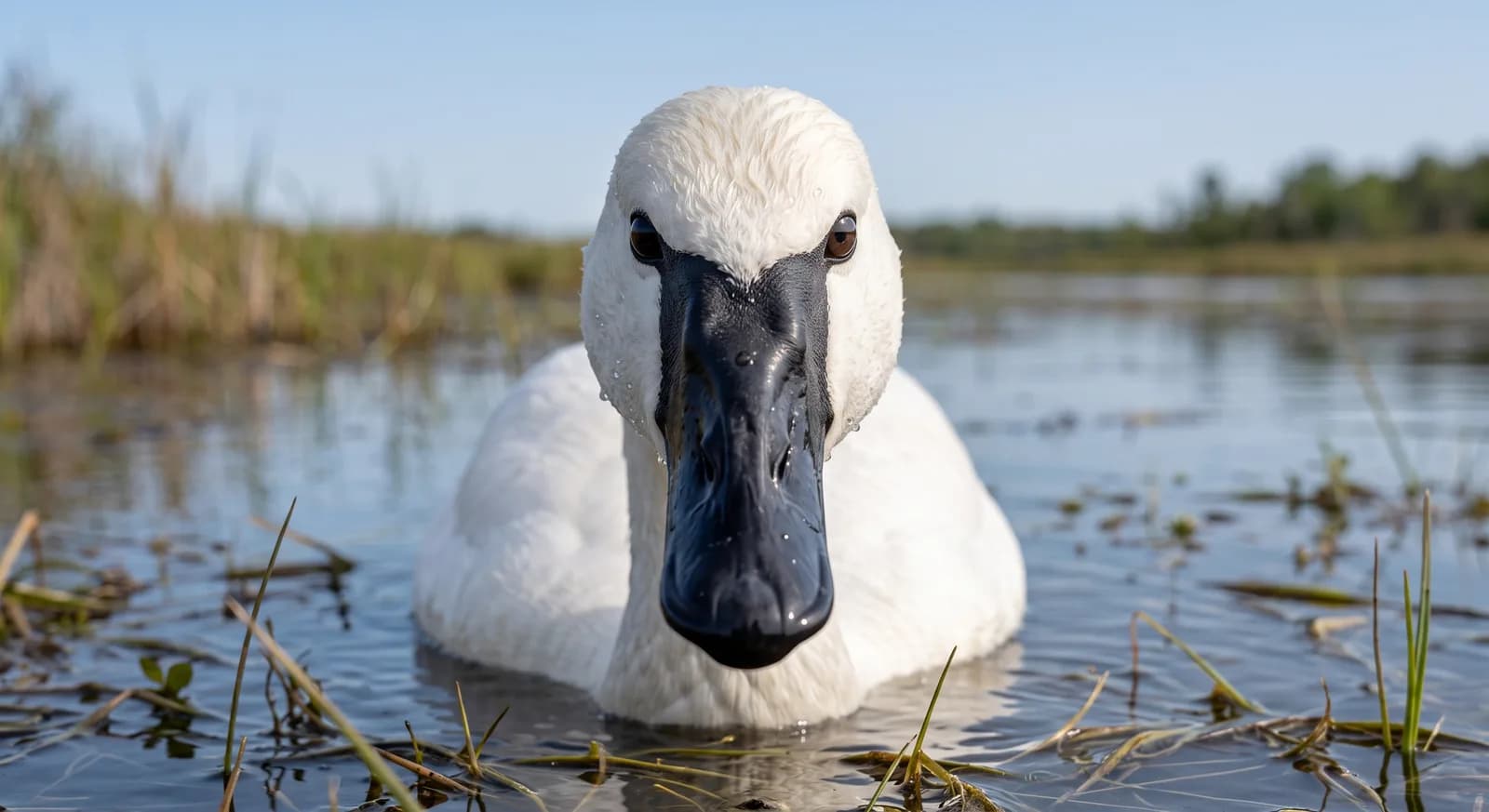
The largest swan species in the world, with a wingspan of some 3 m. Entirely white plumage in adults, with no colour difference between the sexes. It is told from the other white swans by its completely black bill, with no yellow or orange at all, as well as by its size.
Weight
9.4 kg – 12.5 kg
Diet
Herbivore
Feeds mainly on plants.
Activity
Diurnal
Active mainly during the day.
Social structure
In pairs
Usually lives in pairs, sometimes for life.
Sighting difficulty
Easy
Estimated population
Only two main populations remain: the Pacific one, which breeds in Alaska and British Columbia, and the continental one, which nests in Alberta, British Columbia, Yukon, the Northwest Territories, Saskatchewan and Greater Yellowstone
Fun facts
- Overhunting destroyed its traditional southward migration routes, and today almost the whole continental population winters in Greater Yellowstone regardless of where it breeds in summer.
- It has been translocated from the Red Rock Lakes refuge in Montana to other national refuges to restore its historic distribution.
- It has no recognised subspecies.
Life cycle & biology
- Skeleton type
- Vertebrate - internal bony skeleton (bird)
- Habitat & environment
- Wetlands, lakes and rivers of subarctic North America. Pairs nest alone, well away from one another
- Sexual maturity
- 2 years
- Gestation / incubation
- 35 days
- Litter / clutch size
- 5
Sources consulted: IUCN Red List; Wikipedia (Cygnus buccinator); Tesky 1993, Fire Effects Information System (USDA Forest Service); Richardson 1831
Where to find it
See its range on the interactive mapBest time: Winter in the Greater Yellowstone ecosystem, where practically the whole continental population gathers
Where to watch it
Parks and dive sites where this species has been documented.
Related species
Other species in the catalogue with the most in common with Trumpeter Swan — same habitat, park, country, tags or family.
Canada Goose
Branta canadensis
Common Goldeneye
Bucephala clangula
Ruddy Duck
Oxyura jamaicensis
Mourning Dove
Zenaida macroura
Brown-headed Cowbird
Molothrus ater
Bohemian Waxwing
Bombycilla garrulus
Keep exploring
Based on what we already know about trumpeter swan.
Comments
Share an experience, a fun fact or a tip for seeing the trumpeter swan.
Be the first to comment.