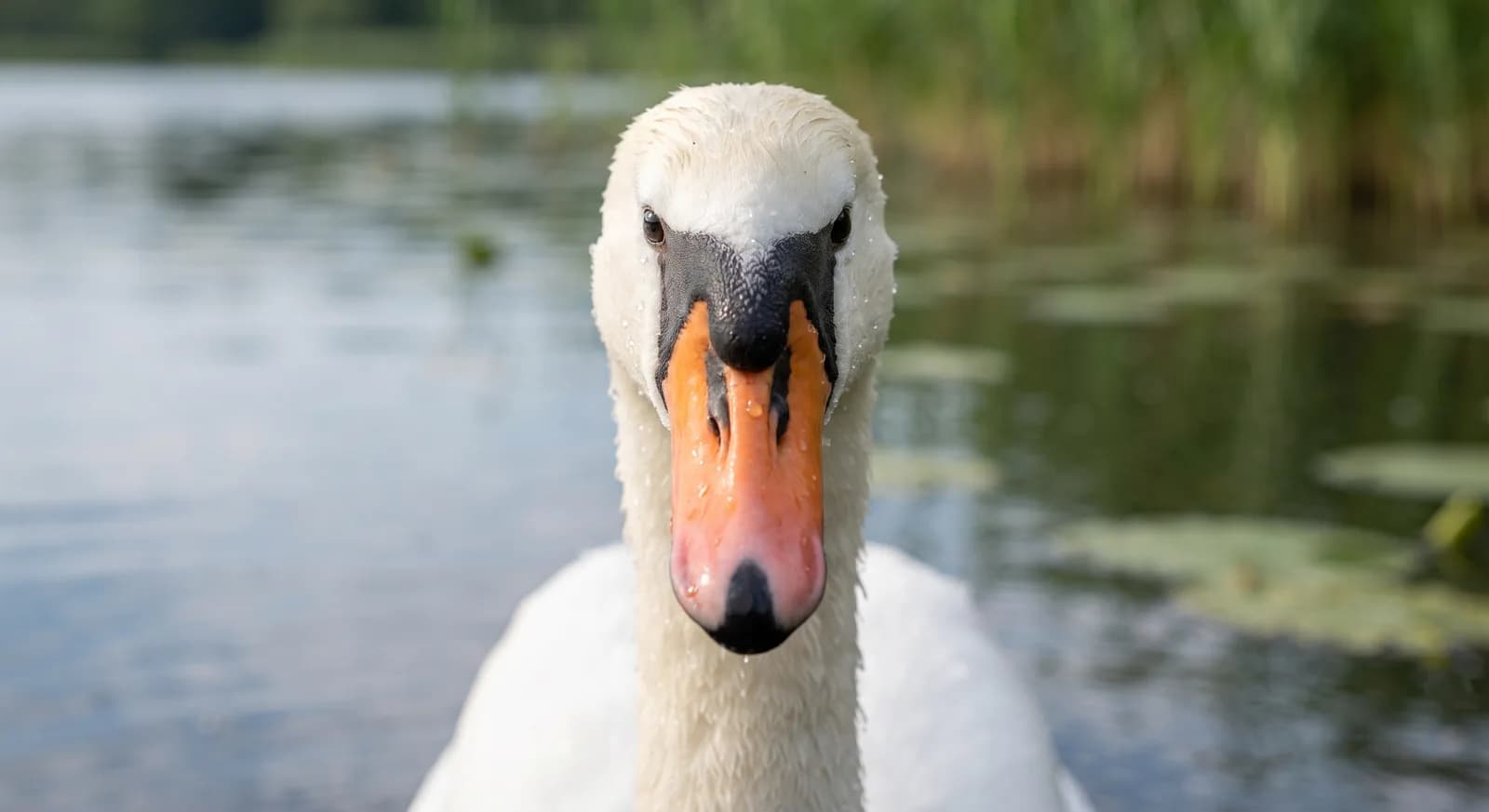
One of the 3 black geese on WAnimals
Birds · Anseriformes · Anatidae
Canada Goose
Branta canadensis
The species is abundant and widely distributed; it faces no significant short-term risk. See full glossary
It pairs for life, and if one of a pair dies the survivor usually finds a new mate the same season. It flies in its characteristic V formation to save energy.
Weight
3 kg – 10.9 kg
Size
76 cm – 1.1 m
Lifespan
17 years
Diet
Herbivore
Feeds mainly on plants.
Activity
Diurnal
Active mainly during the day.
Social structure
Herd
Lives in large groups as a strategy against predators.
Sighting difficulty
Easy
Estimated population
Some 60,000 individuals in Great Britain, the largest introduced European population. In Spain there is a breeding group of about 15 individuals in the wetlands of Madrigalejo (Cáceres) and Navalvillar de Pela (Badajoz), probably of captive origin
Fun facts
- It pairs for life and flies in its characteristic V formation.
- There is a marked variation in size across its 7 recognised subspecies.
- One documented bird reached 42 years.
- It can cover up to 2,400 km in a single day of flight, using the V formation.
- That ability creates a practical management problem: in Spain it is impossible to know whether an individual comes from the introduced populations of central Europe or is a natural vagrant arrived from North America.
- In the areas where it settles it behaves aggressively towards moorhens and coots, which it drives out of their territories and whose young it will even prey on.
Life cycle & biology
- Skeleton type
- Vertebrate - pneumatised bony skeleton (bird)
- Habitat & environment
- A wide range of open habitats near water in North America, widely introduced to Europe, Australia and New Zealand
- Birth weight
- 85.5 grams
- Size at birth
- Precocial, covered in yellow down with a grey-green head, able to walk, swim and feed itself soon after hatching
- Sexual maturity
- 2-3 years
- Gestation / incubation
- 25-30 days
- Litter / clutch size
- 2 to 10 eggs per clutch (most commonly 4-5)
- Lifespan in captivity
- A documented record of up to 42 years (with an unconfirmed anecdotal report of 80)
Sources consulted: AnAge (genomics.senescence.info); Alaska Dept. of Fish and Game; Animal Diversity Web; Internet Center for Wildlife Damage Management; Wildlife Conflicts Indiana; Cornell Lab All About Birds; Wikipedia (Vancouver Canada goose)
Where to find it
See its range on the interactive mapBest time: In winter, when the odd individual turns up mixed in with flocks of greylag geese
Where to watch it
Parques y spots de buceo donde se ha documentado esta especie — se muestran 10 de 40 documentados.
Related species
Other species in the catalogue with the most in common with Canada Goose — same habitat, park, country, tags or family.
Eurasian Wigeon
Mareca penelope
Gadwall
Mareca strepera
Whooper Swan
Cygnus cygnus
Tufted Duck
Aythya fuligula
Red-crested Pochard
Netta rufina
 Least Concern
Mute Swan
Cygnus olor
Keep exploring
Based on what we already know about canada goose.
Comments
Share an experience, a fun fact or a tip for seeing the canada goose.
Be the first to comment.