One of the 10 ducks on WAnimals
Birds · Anseriformes · Anatidae
Red-crested Pochard
Netta rufina
The species is abundant and widely distributed; it faces no significant short-term risk. See full glossary
A large diving duck with a reddish, bulky head in the male and an intensely red bill. Its scientific name combines the Greek netta, duck, and the Latin rufina, golden red. Unlike other diving ducks, the Netta are reluctant to dive and feed more like dabbling ducks.
Weight
1.1 kg on average
Size
up to 57 cm
Diet
Herbivore
Feeds mainly on plants.
Activity
Diurnal
Active mainly during the day.
Social structure
Colony
Lives in large concentrations, often for breeding reasons.
Sighting difficulty
Easy
Fun facts
- It is a diving duck that hardly dives: the Netta feed more like dabbling ducks, sieving the water, and only submerge reluctantly.
- It swallows gastroliths of less than 1 mm to grind up seeds, and that preference for small stones makes it less prone to lead poisoning from shotgun pellets than the northern pintail, the mallard or the common pochard.
- After the Chernobyl accident in 1986, red-crested pochards wintering in Pakistan were found with intermediate levels of radioactivity.
- It parasitises the nests of other ducks, such as the gadwall or the common pochard, laying its eggs in them.
- It is a diving duck that only half behaves like one: it dives to pull up submerged plants, but it also gathers them from the surface like a dabbling duck.
- It is almost strictly vegetarian, something uncommon among European diving ducks, and depends on meadows of submerged macrophytes that eutrophication destroys.
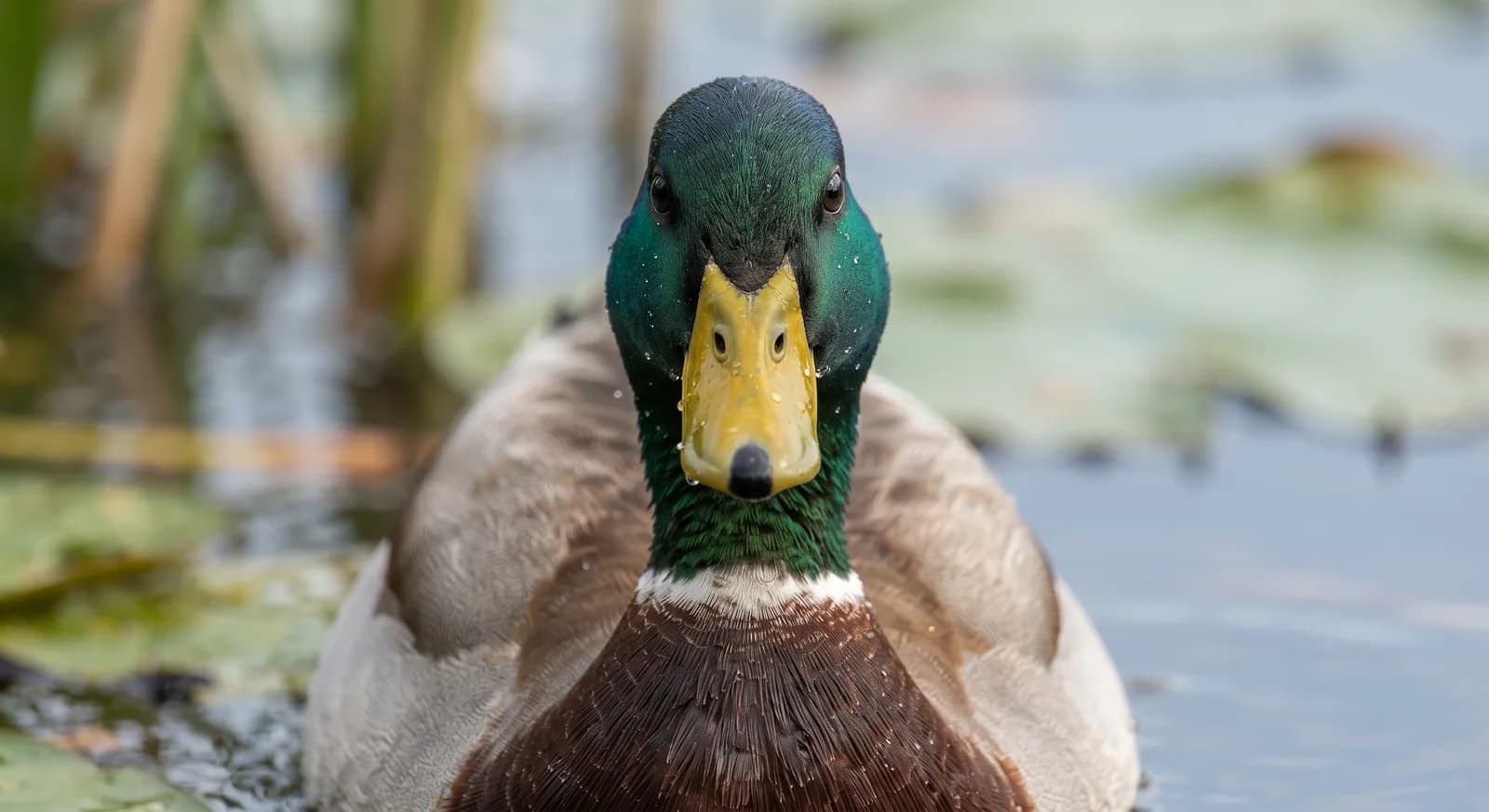
- The male is unmistakable: a reddish, puffed-up head with the look of a wig, an intense red bill and white flanks.
- It practises brood parasitism: females lay eggs in the nests of other females of their own species and of other ducks, which raise them without telling them apart.
- In Spain its populations depend on a handful of wetlands, which makes them vulnerable even though the species is globally listed as Least Concern.
Life cycle & biology
- Skeleton type
- Vertebrate - internal bony skeleton (bird)
- Habitat & environment
- Lowland marshes and lakes of southern Europe, extending across the steppe and semi-desert areas of the Black Sea to Central Asia and Mongolia. It winters on the Indian subcontinent and in Africa
- Size at birth
- Precocial chicks covered in down, which reach flying ability between 45 and 68 days
- Sexual maturity
- 12 months
- Gestation / incubation
- 26-28 days of incubation, by the female alone
- Litter / clutch size
- 6-12 pale green eggs
Sources consulted: IUCN Red List 2016 (e.T22680348A86012189); Camacho, C. y Molina, B. (Enciclopedia Virtual de los Vertebrados Españoles, MNCN-CSIC); Suárez y Uríos 1999; Mateo et al. 2000; Defos du Rau et al. 2005; Jobling 2010, The Helm Dictionary of Scientific Bird Names; Pallas 1773; Kaup 1829
Where to find it
See its range on the interactive mapBest time: All year round in the marshes and lagoons of eastern and southern Spain
Where to watch it
Parques y spots de buceo donde se ha documentado esta especie — se muestran 10 de 59 documentados.
Related species
Other species in the catalogue with the most in common with Red-crested Pochard — same habitat, park, country, tags or family.
Northern Shoveler
Spatula clypeata
Eurasian Wigeon
Mareca penelope
Gadwall
Mareca strepera
Whooper Swan
Cygnus cygnus
 Least Concern
Mallard
Anas platyrhynchos
Canada Goose
Branta canadensis
Keep exploring
Based on what we already know about red-crested pochard.
Comments
Share an experience, a fun fact or a tip for seeing the red-crested pochard.
Be the first to comment.