Birds · Anseriformes · Anatidae
Northern Shoveler
Spatula clypeata
The species is abundant and widely distributed; it faces no significant short-term risk. See full glossary
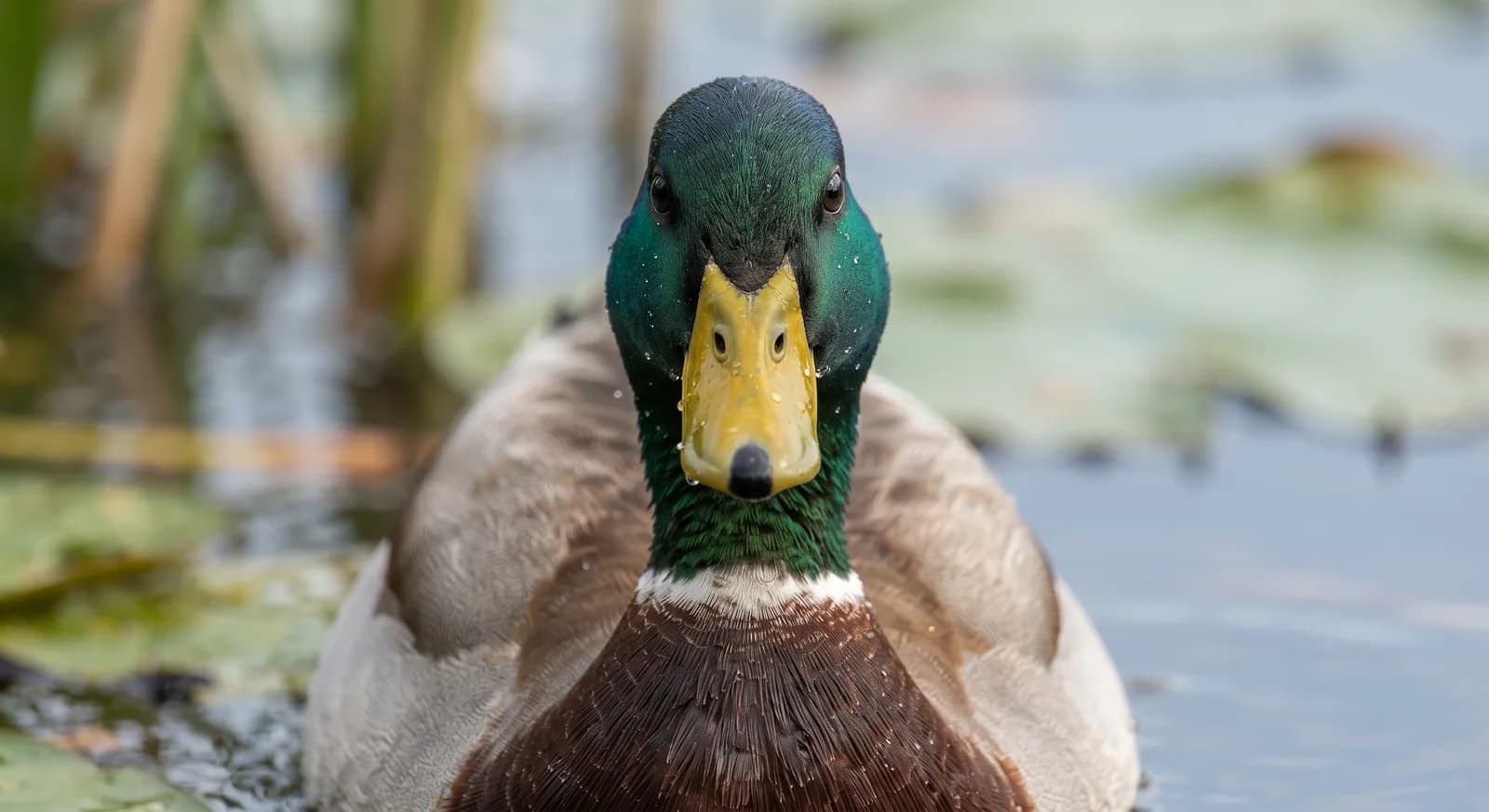
A dabbling duck, unmistakable for its enormous, flattened, spoon-shaped bill, with which it sieves food from the water. The male has an iridescent green head, a white breast, chestnut flanks and a striking blue patch on the forewing. The legs are bright orange.
Weight
613 g on average
Size
up to 52 cm
Lifespan
10 years
Diet
Omnivore
Combines animal and plant food depending on availability.
Activity
Diurnal
Active mainly during the day.
Social structure
Colony
Lives in large concentrations, often for breeding reasons.
Sighting difficulty
Easy
Fun facts
- GeneralIt filters the water through its spatulate bill, lined with lamellae like a sieve.
- Its bill is the longest and broadest of any European dabbling duck: 63 mm of total culmen and 18 mm across, against the 35 mm of the Eurasian teal.
- That bill works as a sieve: it passes it through the surface of the water and traps the food particles between extremely fine lamellae.
- Its scientific name, clypeata, means "furnished with a shield", from the shape of the bill.
- Its spatulate bill, wider at the tip than at the base, carries comb-like lamellae with which it filters the water. The ducklings hatch with an ordinary duck bill, which broadens as they grow.
- Its bill is a strainer. Wider at the tip than at the base, it carries more than a hundred lamellae along the edge, like a miniature whale's baleen, with which it filters zooplankton from the water.
- It feeds by swimming with its bill submerged, sweeping it from side to side and filtering non-stop. It is the only European duck that habitually feeds this way.
- Sometimes several individuals swim in a tight circle, creating a vortex that draws the food up towards the surface.
- It forms longer-lasting pair bonds than most dabbling ducks.
- Its scientific name comes from the Latin clypeata, shield-bearer, after the shape of its bill.
- It sat in the genus Anas until the revision of the wildfowl moved it to Spatula, alongside the garganey and the southern-hemisphere shovelers.
Life cycle & biology
- Skeleton type
- Vertebrate - internal bony skeleton (bird)
- Habitat & environment
- Shallow lagoons, saltmarsh and salt pans
- Gestation / incubation
- About 22 days of incubation, by the female alone
- Litter / clutch size
- 9-11 eggs, laid around April
Sources consulted: Frontiers in Ecology and Evolution (datos morfométricos de anátidas europeas, material suplementario); IUCN Red List; Wikipedia; Boie 1822; Linnaeus 1758
Where to find it
See its range on the interactive mapBest time: Winter, in Spanish marshes and lagoons
Where to watch it
Parques y spots de buceo donde se ha documentado esta especie — se muestran 10 de 113 documentados.
Related species
Other species in the catalogue with the most in common with Northern Shoveler — same habitat, park, country, tags or family.
Tufted Duck
Aythya fuligula
 Least Concern
Mallard
Anas platyrhynchos
Red-crested Pochard
Netta rufina
Ruddy Shelduck
Tadorna ferruginea
Common Shelduck
Tadorna tadorna
Northern Pintail
Anas acuta
Keep exploring
Based on what we already know about northern shoveler.
Comments
Share an experience, a fun fact or a tip for seeing the northern shoveler.
Be the first to comment.