Birds · Passeriformes · Meliphagidae
Red Wattlebird
Anthochaera carunculata
The species is abundant and widely distributed; it faces no significant short-term risk. See full glossary
The red wattlebird — known in Spanish as mielero barbado or mielero carunculado — is one of the largest honeyeaters in Australia, streaked brown with pink wattles hanging at the sides of its neck and yellow patches on the wings and under the tail. It feeds on the nectar of eucalypts and banksias, and is an important pollinator. It is notably aggressive: it drives other birds out of flowering trees and follows the blossom seasonally, moving hundreds of kilometres.
Weight
99 g – 114 g
Size
28 cm – 36 cm
Lifespan
13 years
Diet
Nectarivore
Feeds mainly on flower nectar.
Activity
Diurnal
Active mainly during the day.
Social structure
In pairs
Usually lives in pairs, sometimes for life.
Sighting difficulty
Easy
Fun facts
- It follows the blossom in nomadic movements: it has no fixed calendar but travels hundreds of kilometres to wherever the eucalypts are flowering, and an area can go from having none to being full of them within days.
- Its tongue ends in a brush of filaments that draws up nectar by capillary action, an adaptation shared by all the Australian honeyeaters and one that makes them the continent's chief pollinators.
Life cycle & biology
- Skeleton type
- Vertebrate - internal bony skeleton (bird)
- Habitat & environment
- Eucalypt forest, flowering heathland, parks and gardens of southern and eastern Australia
- Birth weight
- Altricial: born blind, naked or with sparse down and entirely dependent
- Size at birth
- Altricial: born blind, naked or with sparse down and entirely dependent
- Sexual maturity
- 12 months
- Gestation / incubation
- 14 days of incubation
- Litter / clutch size
- 2 eggs
Sources consulted: https://es.wikipedia.org/wiki/Anthochaera_carunculata
Where to find it
See its range on the interactive mapBest time: All year in southern Australia, by day; it gathers in flowering eucalypts and banksias, where it is highly aggressive towards other birds.
Related species
Other species in the catalogue with the most in common with Red Wattlebird — same habitat, park, country, tags or family.
Indian Peafowl
Pavo cristatus
Laughing Kookaburra
Dacelo novaeguineae
Sulphur-crested Cockatoo
Cacatua galerita
Cockatiel
Nymphicus hollandicus
Red Admiral
Vanessa atalanta
 Least Concern
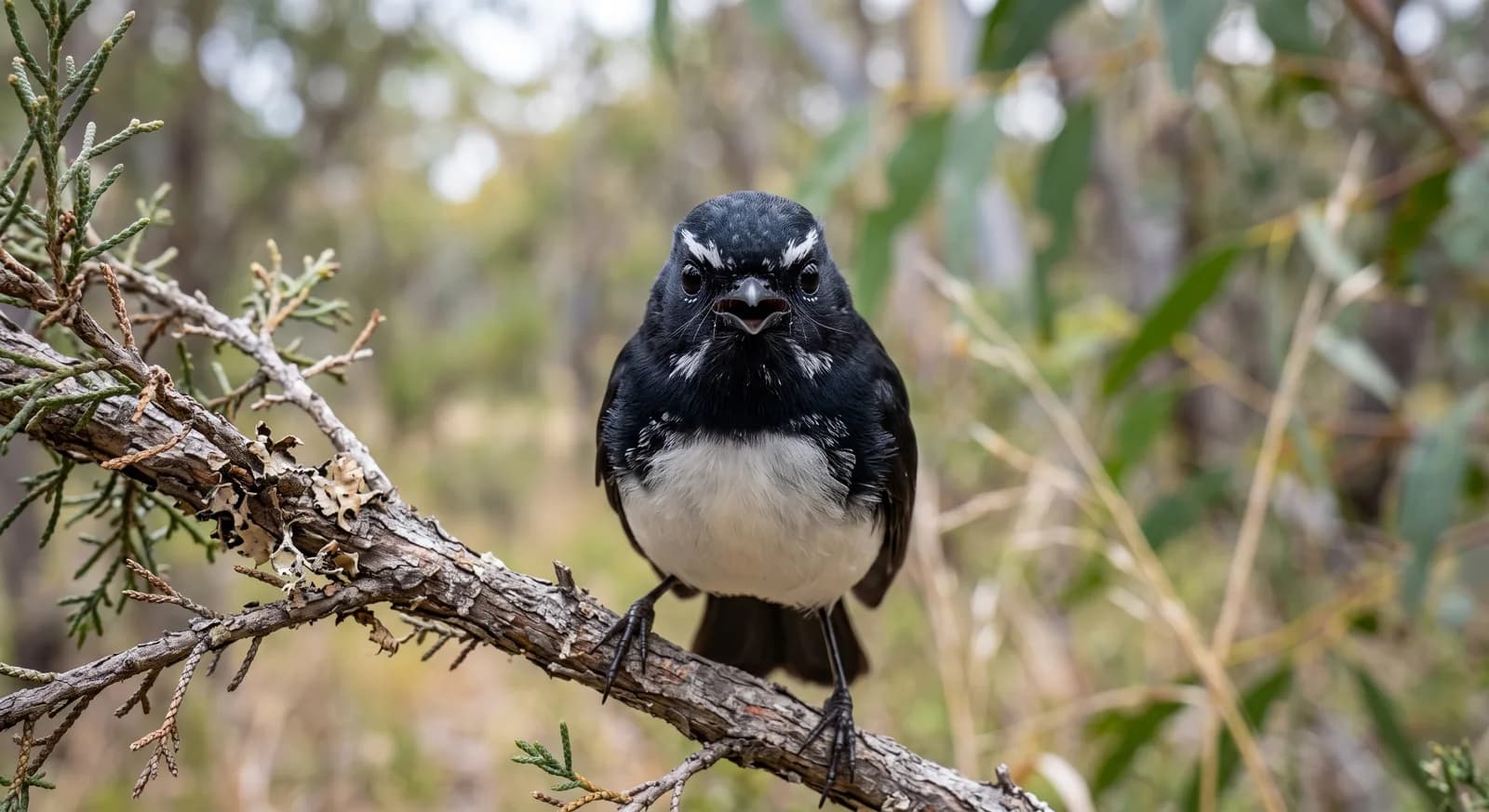
Willie Wagtail
Rhipidura leucophrys
Keep exploring
Based on what we already know about red wattlebird.
Comments
Share an experience, a fun fact or a tip for seeing the red wattlebird.
Be the first to comment.