One of the 4 peafowls on WAnimals
Birds · Galliformes · Phasianidae
Indian Peafowl
Pavo cristatus
The species is abundant and widely distributed; it faces no significant short-term risk. See full glossary
The Indian peafowl is the national bird of India and probably the best known ornamental bird on the planet. The male spreads a fan more than two metres across formed from the covert feathers of the tail, covered in iridescent eyespots. It lives in open woodland and farmland on the Indian subcontinent, where it is protected by law and by its religious role, and it has been introduced as an ornamental bird in dozens of countries.
Weight
2.7 kg – 6 kg
Size
1 m – 2.3 m
Lifespan
20 years
Diet
Omnivore
Combines animal and plant food depending on availability.
Activity
Diurnal
Active mainly during the day.
Social structure
Family group
Lives in small family groups with close bonds.
Sighting difficulty
Easy
Fun facts
- The fan is not the tail: it is made of the upper tail coverts, and the real tail is short, grey and hidden behind, holding the structure up from within.
- The eyespots are not pigment: their colour comes from microscopic photonic crystals in the barbs of the feather, and shifts in tone with the angle of the light.
- As he spreads it he makes it vibrate, producing a low-frequency sound that females sense at a distance even when they cannot see it: the display is acoustic as well as visual.
Life cycle & biology
- Skeleton type
- Vertebrate - internal bony skeleton (bird)
- Habitat & environment
- Open woodland, scrub, crops and gardens of the Indian subcontinent; introduced across half the world
- Birth weight
- Precocial: born covered in down and leaves the nest within a few hours
- Size at birth
- Precocial: born covered in down and leaves the nest within a few hours
- Sexual maturity
- 2 years
- Gestation / incubation
- 29 days
- Litter / clutch size
- 5
Sources consulted: https://es.wikipedia.org/wiki/Pavo_cristatus
Where to find it
See its range on the interactive mapBest time: From April to September in India and Sri Lanka, in the months before and during the monsoon, when the males display their trains and their call carries a long way.
Where to watch it
Parques y spots de buceo donde se ha documentado esta especie — se muestran 10 de 34 documentados.
Related species
Other species in the catalogue with the most in common with Indian Peafowl — same habitat, park, country, tags or family.
Sri Lanka Junglefowl
Gallus lafayettii
 Least Concern
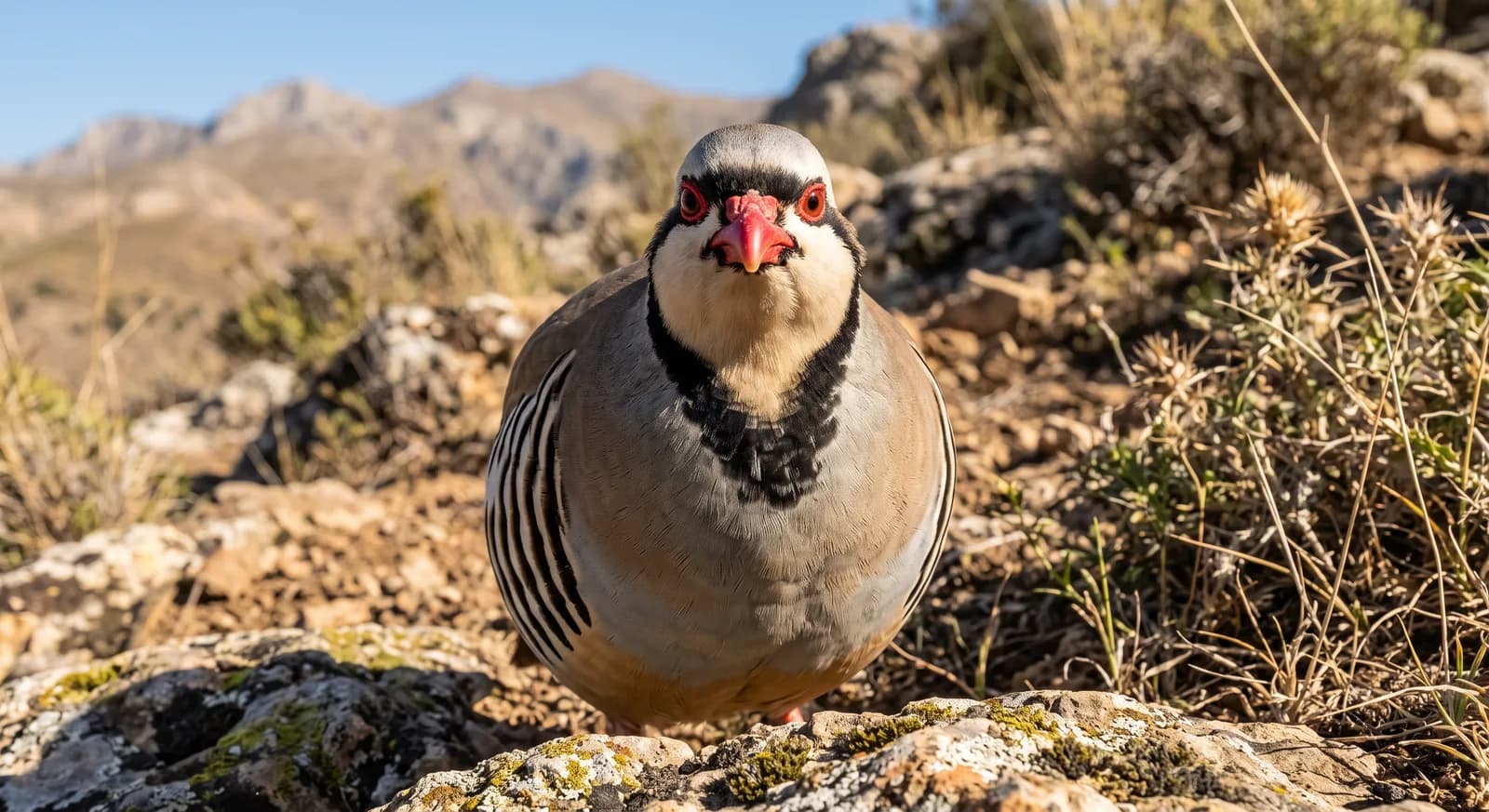
Chukar
Alectoris chukar
Golden Pheasant
Chrysolophus pictus
Wild Turkey
Meleagris gallopavo
Grey Partridge
Perdix perdix
Red Junglefowl
Gallus gallus
Keep exploring
Based on what we already know about indian peafowl.
Comments
Share an experience, a fun fact or a tip for seeing the indian peafowl.
Be the first to comment.