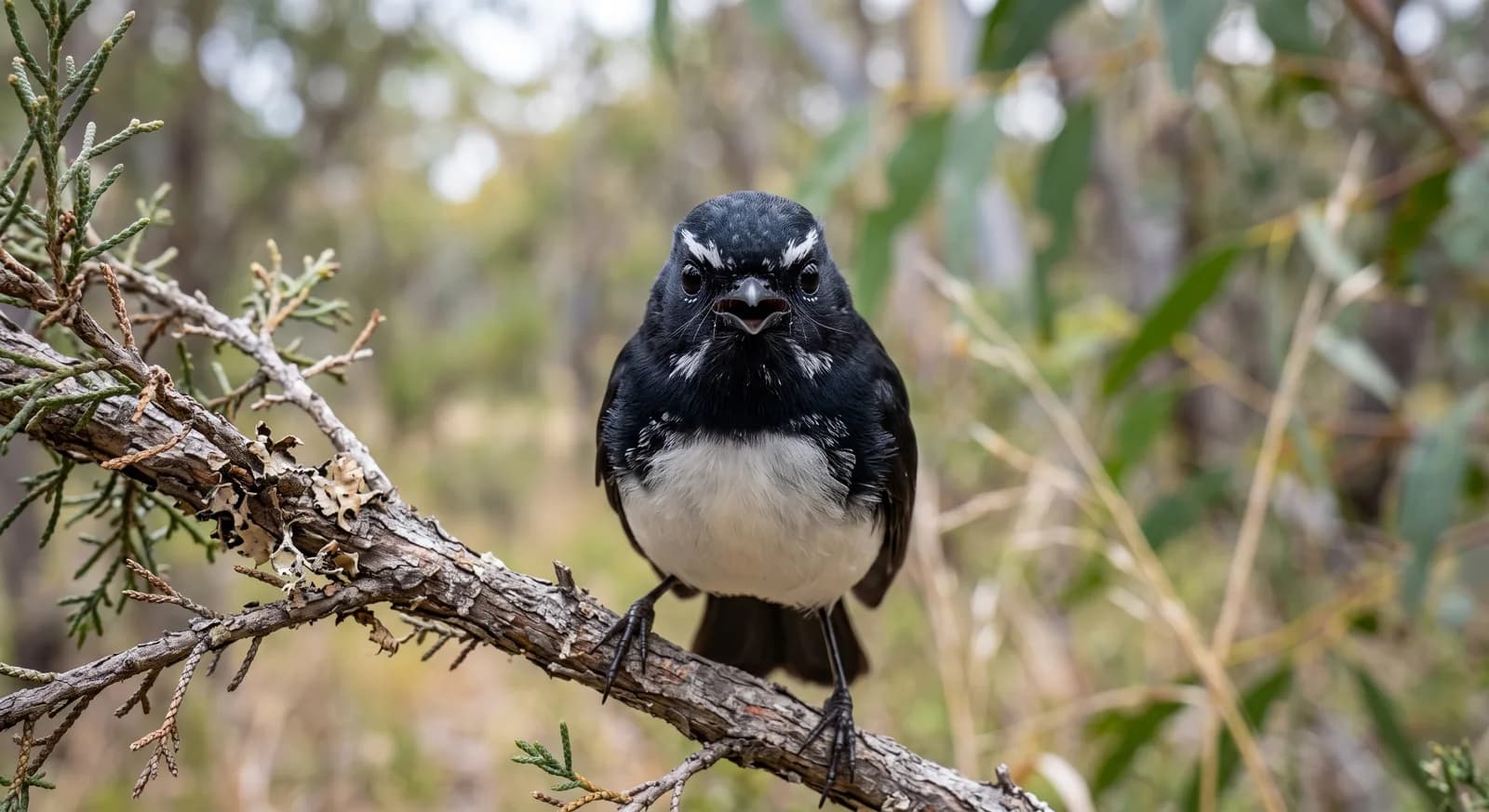
Birds · Passeriformes · Rhipiduridae
Willie Wagtail
Rhipidura leucophrys
The species is abundant and widely distributed; it faces no significant short-term risk. See full glossary
The willie wagtail (Rhipidura leucophrys) is a passerine bird of the family Rhipiduridae native to Australia, New Guinea, the Solomon Islands, the Bismarck Archipelago and eastern Indonesia. It is a very common bird within its range, living in most habitats except dense forest. It measures 19.0 to 21.5 cm long.
Weight
17 g – 25 g
Size
19 cm – 22 cm
Lifespan
12 years
Diet
Insectivore
Feeds mainly on insects and other invertebrates.
Activity
Irregular activity
Active at irregular times, by day or night depending on circumstances.
Social structure
In pairs
Usually lives in pairs, sometimes for life.
Sighting difficulty
Easy
Fun facts
- It fans its tail from side to side continuously while foraging, a movement that flushes insects from the vegetation and sends them jumping within reach of its bill.
- It sings at night, especially on moonlit nights and in spring, something uncommon among Australian birds and a source of complaint in many residential suburbs.
- In several Aboriginal Australian cultures it is regarded as a bringer of news or a gossip who should not be told secrets, and it appears in the traditional stories of numerous nations across the continent.
Life cycle & biology
- Skeleton type
- Vertebrate - internal bony skeleton (bird)
- Habitat & environment
- Open country, grassland, gardens, parks and wetland margins of Australia and New Guinea
- Sexual maturity
- 12 months
- Gestation / incubation
- 14 days of incubation
- Litter / clutch size
- 3 eggs
Sources consulted: https://es.wikipedia.org/wiki/Rhipidura_leucophrys
Where to find it
See its range on the interactive mapWhere to watch it
Parques y spots de buceo donde se ha documentado esta especie — se muestran 10 de 56 documentados.
Related species
Other species in the catalogue with the most in common with Willie Wagtail — same habitat, park, country, tags or family.
Spotted Pardalote
Pardalotus punctatus
Superb Fairywren
Malurus cyaneus
Tawny Frogmouth
Podargus strigoides
Common Myna
Acridotheres tristis
Laughing Kookaburra
Dacelo novaeguineae
Keep exploring
Based on what we already know about willie wagtail.
Comments
Share an experience, a fun fact or a tip for seeing the willie wagtail.
Be the first to comment.