One of the 4 finches on WAnimals
Birds · Passeriformes · Fringillidae
Blue Chaffinch
Fringilla teydea
It has not yet been assessed against the IUCN criteria. See full glossary
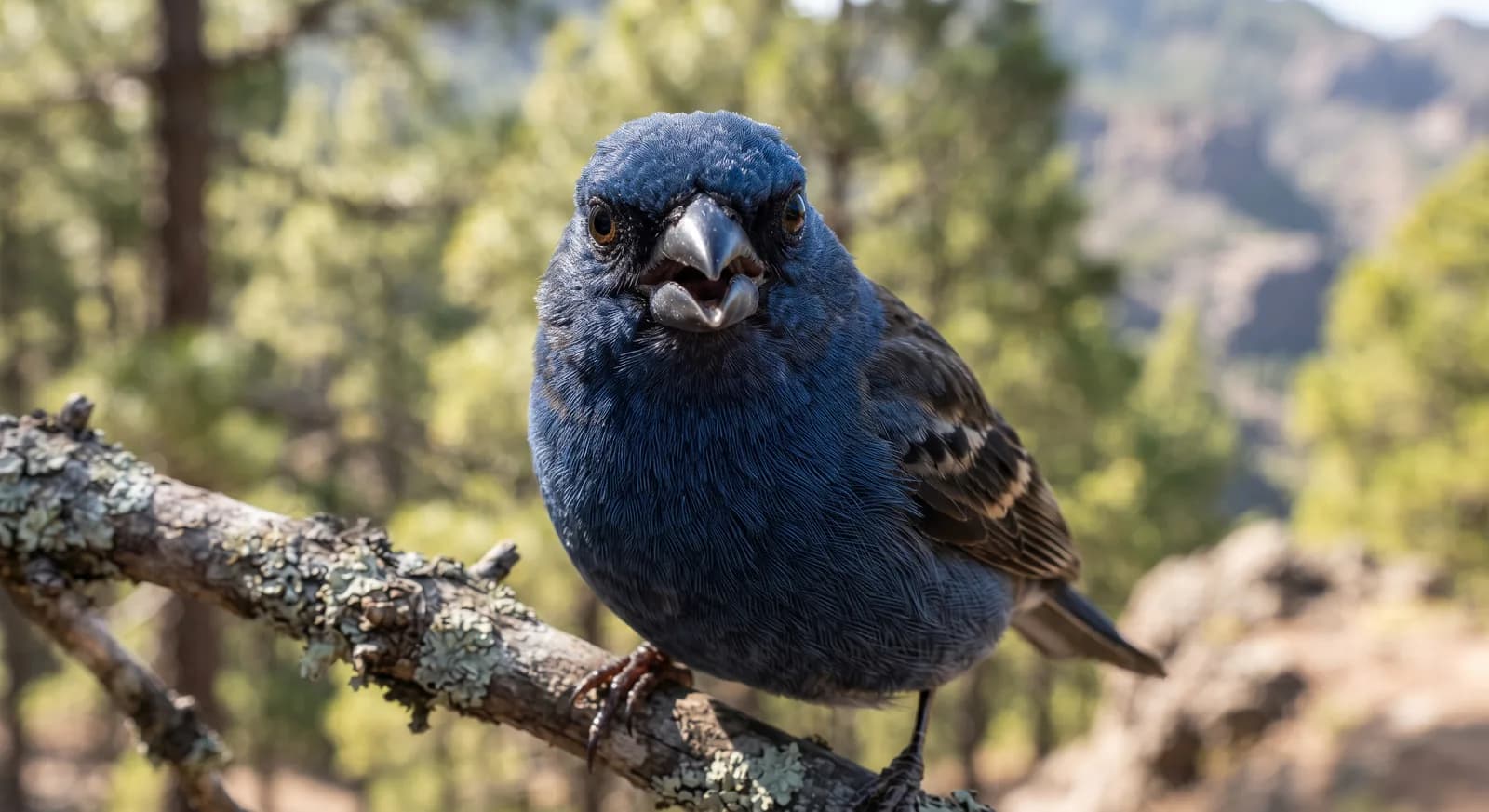
The largest finch in the world, at 16-18 cm. The adult male is a deep dark blue above and paler below, with whitish belly and undertail coverts, almost black wings and tail and a very visible broken white eye-ring. The bill is stout and grey. The female is a dull olive-brown. The black frontal band above the bill appears only in the oldest males.
Size
16 cm – 18 cm
Diet
Herbivore
Feeds mainly on plants.
Activity
Diurnal
Active mainly during the day.
Social structure
Solitary
Lives and hunts alone, joining others only to breed.
Sighting difficulty
Unknown
Estimated population
1,000-1,500 pairs for the former Fringilla teydea as a whole (Tenerife and Gran Canaria) according to BirdLife International
Fun facts
- It is the official animal symbol of the island of Tenerife by law of the Canary Islands Government, alongside the dragon tree as the plant symbol.
- Its chicks feed exclusively on insects, unlike those of other finches: the adults eat Canary Island pine seeds but do not give them to their young.
- Its probable origin is an ancient invasion of common chaffinches arriving from Africa that evolved in isolation on Tenerife.
- It is the animal symbol of the island of Tenerife by law of the Canary Islands Government, alongside the dragon tree as the plant symbol.
Life cycle & biology
- Skeleton type
- Vertebrate - internal bony skeleton (bird)
- Habitat & environment
- Natural Canary Island pine (Pinus canariensis) forest between 1,000 and 2,000 m of altitude, whether dry, humid or mixed with laurel-heath understorey. It also frequents plantations of Canary Island pine and of Pinus radiata. For nesting it selects mature pine forest with a tall, dense canopy. It is absent only from the heights of El Escobonal and Fasnia
- Litter / clutch size
- Two eggs, in a nest built in the branches of trees. It breeds from May to July
Sources consulted: IUCN Red List; SEO/BirdLife; MITECO (Inventario Nacional y Libros Rojos); Moreno et al. 2007; Martín y Lorenzo 2001; Carrascal 1987; Martín 1979 y 1987; Sangster et al. 2016; Banco de Datos de Biodiversidad de Canarias (Centinela); Webb, Berthelot y Moquin-Tandon 1842
Where to find it
See its range on the interactive mapBest time: From May to July, the breeding season, in the high pine woods
Where to watch it
Parks and dive sites where this species has been documented.
Related species
Other species in the catalogue with the most in common with Blue Chaffinch — same habitat, park, country, tags or family.
Common Chaffinch
Fringilla coelebs
Atlantic Canary
Serinus canaria
Trumpeter Finch
Bucanetes githagineus
Red Crossbill
Loxia curvirostra
Eurasian Siskin
Spinus spinus
European Greenfinch
Chloris chloris
Keep exploring
Based on what we already know about blue chaffinch.
Comments
Share an experience, a fun fact or a tip for seeing the blue chaffinch.
Be the first to comment.