National Park
Lawachara
Bangladesh
 Bangladesh
Western Hoolock Gibbon · Spectacled Langur
See parkThe largest continuous mangrove forest in the world, the last refuge of a Bengal tiger adapted to brackish water.
Area
6,017 km²
Designated in
1997
Region
South Asia
Deltaic mangrove of the Ganges-Brahmaputra
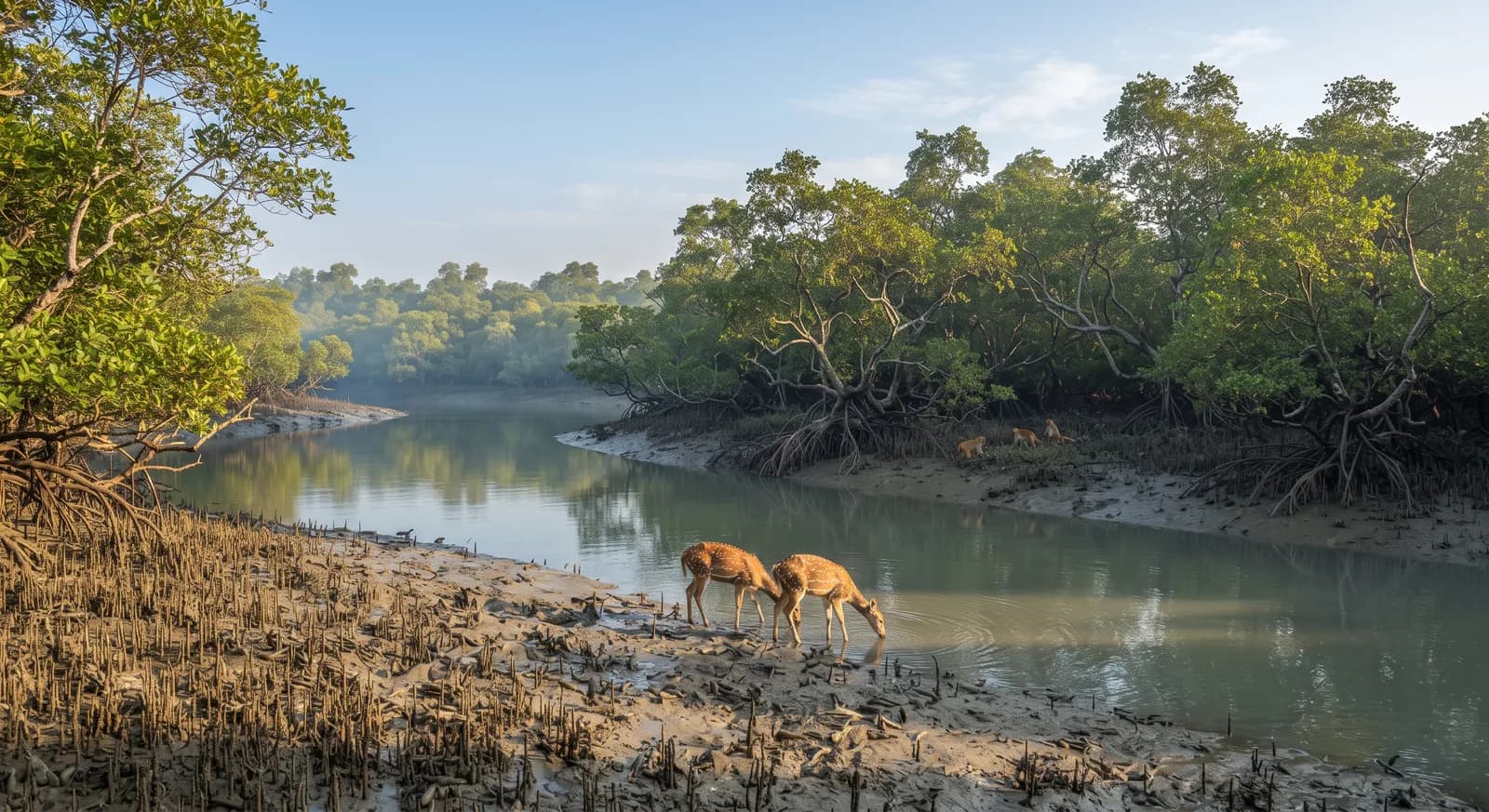
The Sundarbans stretch across the shared delta of the Ganges, the Brahmaputra and the Meghna, between Bangladesh and India, and constitute the largest continuous mangrove forest in the world. The Bangladeshi part was inscribed on the World Heritage List in 1997; the Indian part had been inscribed in 1987 as a separate property.
The landscape is a labyrinth of islands, tidal channels, mudflats and forest flooded twice a day by the brackish tide. The dominant species is the sundari, which gives the region its name, and the whole works as a natural barrier against the cyclones of the Bay of Bengal, protecting millions of people in the interior of the delta.
Its emblematic animal is the Bengal tiger, with a population that swims between islands and has developed a tolerance of brackish water uncommon in the species; it is also one of the few places in the world where regular attacks on people are documented, which shapes the relationship between the honey-gathering and fishing communities and the forest. It is also home to Ganges river dolphin, saltwater crocodile, spotted deer and an abundant birdlife. The threats are serious: reduced freshwater flow from dams upstream, which raises salinity, sea level rise, increasingly intense cyclones, and industrial activity on its fringes, including a coal-fired power station whose construction generated international controversy.
Ecosystems found in Bangladesh, where Sundarbans (Bangladesh) lies.
Which other parks are like this one?
Same country: Bangladesh
Same country: Bangladesh
Based on what we already know about this park.
Share your experience visiting Sundarbans (Bangladesh), or a tip for other travellers.
Be the first to comment.
Climate
Tropical