Mammals · Artiodactyla · Suidae
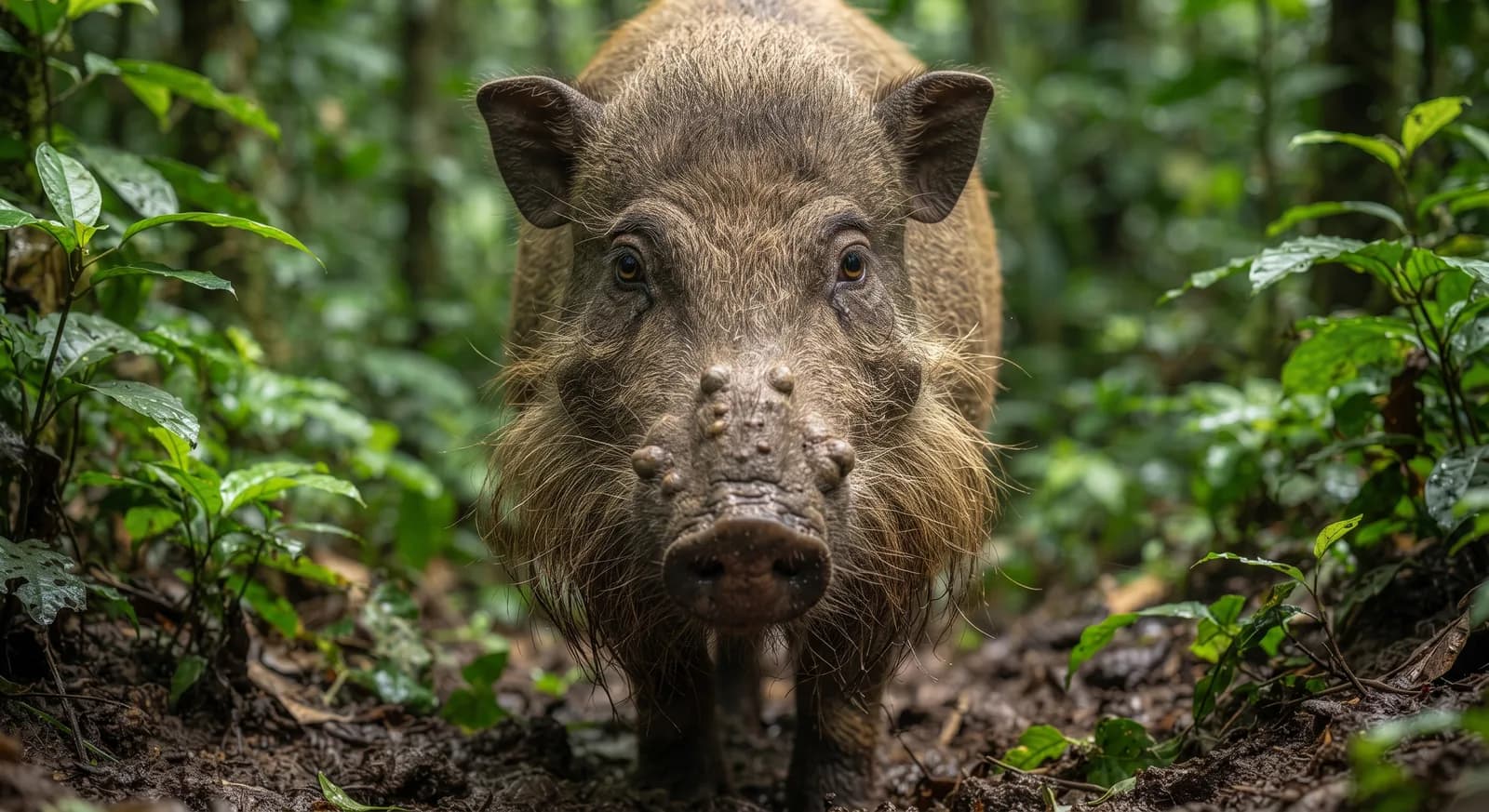
Hairy Babirusa
Babyrousa babyrussa
It faces a high risk of extinction in the wild over the medium term. See full glossary
Its name means 'pig-deer' in Indonesian, after the spectacular upper tusks of the male, which grow upwards through the snout and curve back like antlers.
Weight
43 kg – 100 kg
Size
90 cm – 1.1 m
Lifespan
10 years
Diet
Omnivore
Combines animal and plant food depending on availability.
Activity
Irregular activity
Active at irregular times, by day or night depending on circumstances.
Social structure
Solitary
Lives and hunts alone, joining others only to breed.
Sighting difficulty
Moderate
Fun facts
- The male's upper tusks grow up through the top of the snout, curving back like antlers.
- The female has only two teats, so she rarely bears more than one or two piglets.
- Its complex, ruminant-like stomach points to a diet rich in plant fibre.
- anatomíaMales grow upper tusks that curve up and back, and which can pierce their own face if they do not wear down naturally.
Life cycle & biology
- Skeleton type
- Vertebrate - internal bony skeleton (mammal)
- Habitat & environment
- Swampy and moist forest near lake and river shores on the islands of Sulawesi, Togian, Sula and Buru in Indonesia
- Birth weight
- 380 - 1,050 grams
- Size at birth
- Precocial, without the camouflage stripes most pigs have, able to eat solid food at 3-10 days
- Sexual maturity
- 5-10 months (though field studies suggest it may be delayed to 1-2 years in the wild)
- Gestation / incubation
- 150-157 days (~5 months)
- Litter / clutch size
- 1 to 2 young per litter — exceptionally few for a pig, since the female has only two teats
- Lifespan in captivity
- Documented record of up to 22.9-24 years in captivity
Sources consulted: AnAge; Animal Diversity Web; Scientific Papers USAMV; Louisville Zoo; Animalia.bio; Ultimate Ungulate; White Oak Conservation; Website of Everything; The Animal Facts
Where to find it
See its range on the interactive mapBest time: All year round on the islands of Buru and Sula, by day; it visits the salt licks deep in the forest regularly.
Where to watch it
Parks and dive sites where this species has been documented.
Related species
Other species in the catalogue with the most in common with Hairy Babirusa — same habitat, park, country, tags or family.
 Vulnerable
Bearded Pig
Sus barbatus
Lowland Anoa
Bubalus depressicornis
Spectral Tarsier
Tarsius tarsier
Western Hooded Pitta
Pitta sordida
Common House Gecko
Hemidactylus frenatus
Common Water Monitor
Varanus salvator
How to help
The hairy babirusa is classified as vulnerable. Organizations such as UICN, WWF y Wildlife Conservation Society work specifically on its conservation and that of its habitat; looking into their programs is a good starting point if you want to get involved.
It's documented in 1 real protected area — part of why protecting these places matters for its conservation.
Keep exploring
Based on what we already know about hairy babirusa.
Comments
Share an experience, a fun fact or a tip for seeing the hairy babirusa.
Be the first to comment.