One of the 6 chameleons on WAnimals
Reptiles · Squamata · Chamaeleonidae
Panther Chameleon
Furcifer pardalis
The species is abundant and widely distributed; it faces no significant short-term risk. See full glossary
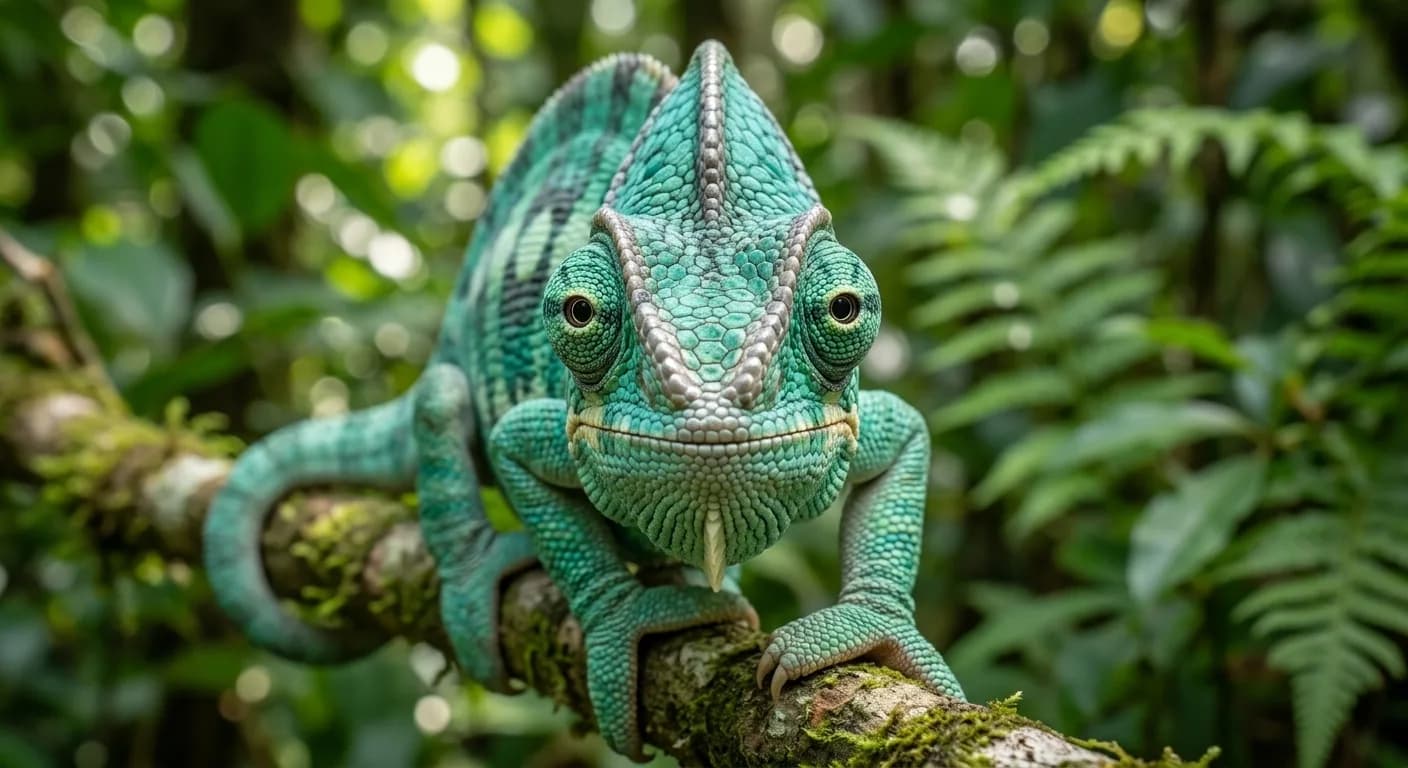
The panther chameleon is probably the most colourful chameleon in the world, and its most notable feature is that each Madagascan population has its own palette: the males from Nosy Be are turquoise blue, those from Ambilobe red and green with bands, those from Ankaramy pink. Those local forms are known in the terrarium world as locales and are genetically distinct.
Weight
140 g – 180 g
Size
35 cm – 52 cm
Lifespan
7 years
Diet
Insectivore
Feeds mainly on insects and other invertebrates.
Activity
Diurnal
Active mainly during the day.
Social structure
Solitary
Lives and hunts alone, joining others only to breed.
Sighting difficulty
Easy
Fun facts
- comunicaciónIt changes colour not only to hide but mainly as a social signal, tied to mood, temperature and territorial dealings with other males.
- Each population on the island has its own recognisable colour palette: genetic studies in 2015 revealed that those local forms are so distinct that they probably make up several different species under a single name.
- It does not change colour to camouflage itself, as is usually believed: it does so to communicate mood, dominance and readiness to breed, and to regulate its temperature by darkening in the sun.
- The colour does not come from pigments moving about: chameleons adjust the spacing between guanine nanocrystals in the skin, changing which wavelength they reflect, a mechanism only described in 2015.
Life cycle & biology
- Skeleton type
- Vertebrate - internal bony skeleton (reptile)
- Habitat & environment
- Secondary forest, coastal scrub, plantations and gardens of northern and eastern Madagascar
- Sexual maturity
- 9 months
- Gestation / incubation
- 240 days of incubation
- Litter / clutch size
- 30 eggs
Sources consulted: https://es.wikipedia.org/wiki/Furcifer_pardalis
Where to watch it
Parks and dive sites where this species has been documented.
Related species
Other species in the catalogue with the most in common with Panther Chameleon — same habitat, park, country, tags or family.
Leaf Chameleon
Brookesia micra
 Near Threatened
Parson's Chameleon
Calumma parsonii
Madagascar Day Gecko
Phelsuma madagascariensis
Common Flat-tail Gecko
Uroplatus fimbriatus
Madagascar Tree Boa
Sanzinia madagascariensis
Keep exploring
Based on what we already know about panther chameleon.
Comments
Share an experience, a fun fact or a tip for seeing the panther chameleon.
Be the first to comment.