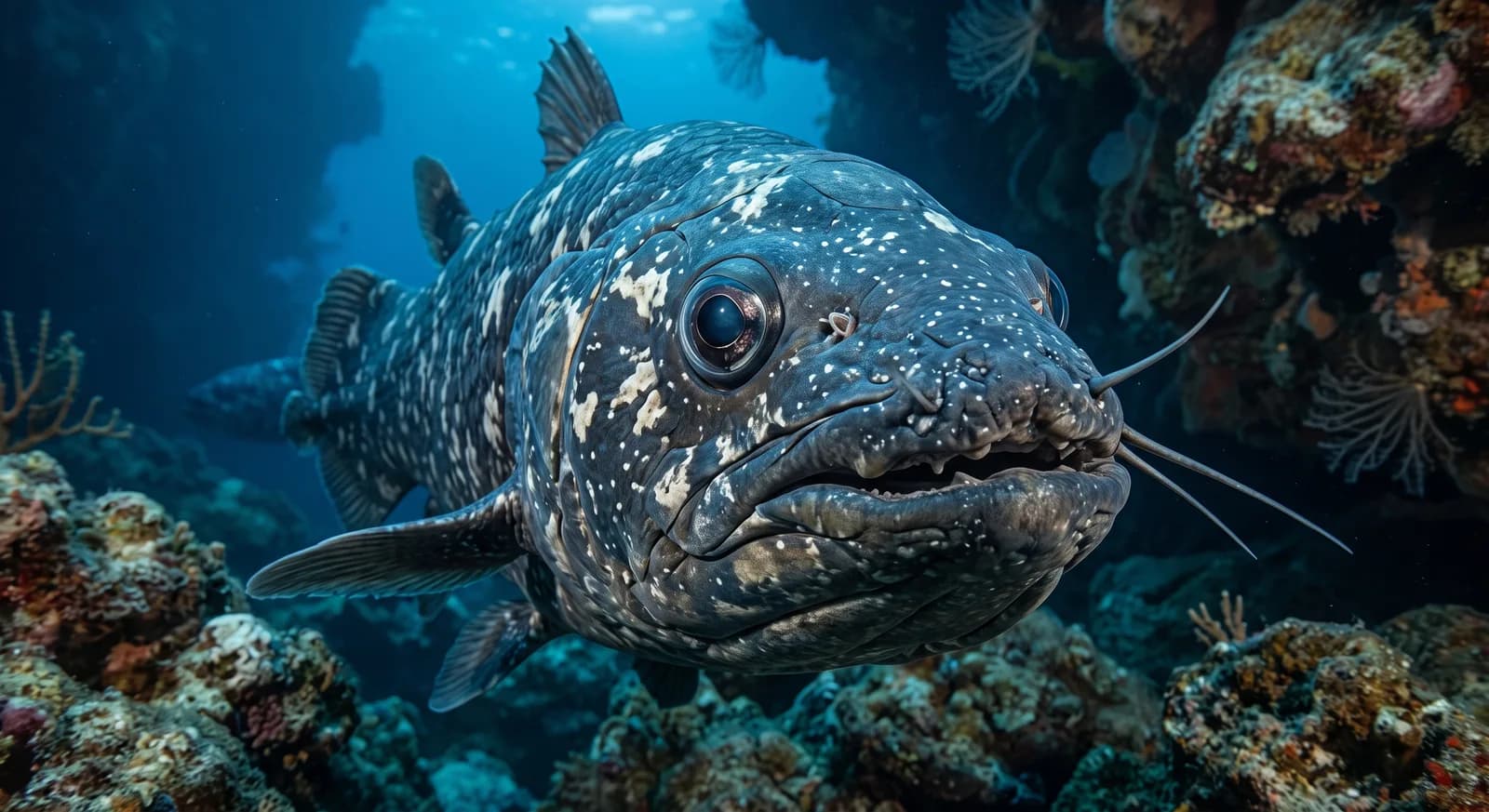
Coelacanths · Coelacanthiformes · Latimeriidae
Coelacanth
Latimeria chalumnae
It faces an extremely high risk of imminent extinction in the wild. See full glossary
It is regarded as a 'living fossil': it was believed to have died out 65 million years ago until it was found alive in 1938 off the coast of South Africa.
Weight
up to 105 kg
Size
up to 2 m
Lifespan
80 years
Diet
Carnivore
Feeds mainly on other animals.
Activity
Nocturnal
Active mainly at night.
Social structure
Solitary
Lives and hunts alone, joining others only to breed.
Sighting difficulty
Very hard
Estimated population
A few hundred individuals in the Comoros archipelago, the best-known population of the species.
Fun facts
- It was believed to have died out 65 million years ago until it was rediscovered alive in 1938.
- A 2021 study found its lifespan had been underestimated fivefold, reaching around 100 years.
- It has the longest gestation known in any vertebrate, of roughly five years.
- historia naturalIt was believed to have died out some 66 million years ago until a live specimen was caught in 1938 off the coast of South Africa.
Life cycle & biology
- Skeleton type
- Vertebrate - partly cartilaginous internal skeleton with primitive bony elements (lobe-finned fish)
- Habitat & environment
- Deep submarine caves (100-700 m) in the warm waters of the western Indian Ocean, mainly around the Comoros
- Birth weight
- 31-38 cm long at birth (the young already well developed)
- Size at birth
- 31 - 38 cm long at birth
- Sexual maturity
- Reassessed in 2021 at between 40 and 69 years (an earlier study suggested 20-plus; it is now known to be far later)
- Gestation / incubation
- Roughly 5 years, the longest gestation known in any vertebrate
- Litter / clutch size
- 5 to 29 live young per litter (an ovoviviparous species)
Sources consulted: Sci-News.com (Current Biology study); NOAA Fisheries; Animal Diversity Web; FishBase; ResearchGate (growth study); EarthDate; ScienceDirect
Where to find it
See its range on the interactive mapBest time: All year round in the volcanic caves of the Comoros and South Africa, between 150 and 250 m deep, at night; it can only be seen from submersibles.
Where to watch it
Parks and dive sites where this species has been documented.
Related species
Other species in the catalogue with the most in common with Coelacanth — same habitat, park, country, tags or family.
Blacktip Reef Shark
Carcharhinus melanopterus
Red Lionfish
Pterois volitans
White-spotted Puffer
Arothron hispidus
Spot-fin Porcupinefish
Diodon hystrix
Clown Triggerfish
Balistoides conspicillum
Geography Cone
Conus geographus
How to help
The coelacanth is classified as critically endangered. Organizations such as UICN, WWF y Wildlife Conservation Society work specifically on its conservation and that of its habitat; looking into their programs is a good starting point if you want to get involved.
It's documented in 2 real protected areas — part of why protecting these places matters for its conservation.
Keep exploring
Based on what we already know about coelacanth.
Comments
Share an experience, a fun fact or a tip for seeing the coelacanth.
Be the first to comment.