One of the 6 macaws on WAnimals
Birds · Psittaciformes · Psittacidae
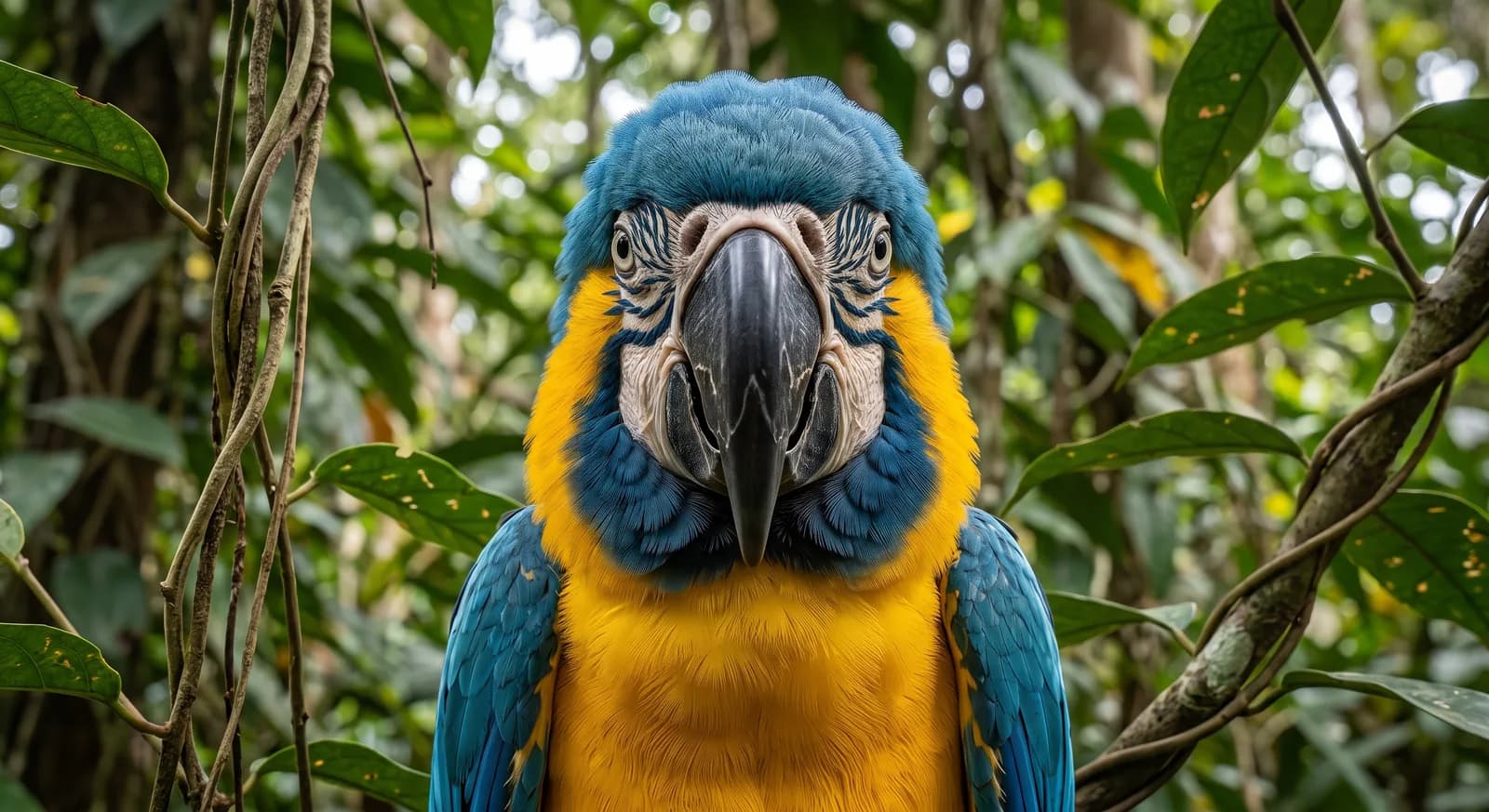
Spix's Macaw
Cyanopsitta spixii
It survives only in captivity or through populations reintroduced outside its historical range. See full glossary
Spix's macaw is a psittaciform bird of the family Psittacidae and the only species in the genus Cyanopsitta. It was first described by the German naturalist Georg Marcgraf, while he was working in the state of Pernambuco, Brazil, in 1638, and its name is a tribute to another German, Johann Baptist von Spix, who obtained a specimen in 1819 on the bank of the São Francisco river in Bahia.
Weight
290 g – 400 g
Size
55 cm – 57 cm
Lifespan
30 years
Diet
Herbivore
Feeds mainly on plants.
Activity
Diurnal
Active mainly during the day.
Social structure
In pairs
Usually lives in pairs, sometimes for life.
Sighting difficulty
In captivity only
Estimated population
Around 300 individuals in captivity and a few dozen reintroduced in Brazil
Fun facts
- GeneralExtinct in the wild by 2000 and reintroduced in 2022; it inspired the film Rio.
- Its story inspired the film Rio: the hero is a Spix's macaw who believes himself the last of his kind, a premise that in 2000 was literally true.
- The entire world population descends from a handful of birds that were in private collections when the species vanished from the wild, and the recovery programme had to negotiate with collectors for years to bring them together.
- It is one of very few species classified by the IUCN as Extinct in the Wild that has since had birds flying free in its original habitat again.
Life cycle & biology
- Skeleton type
- Vertebrate - internal bony skeleton (bird)
- Habitat & environment
- Caraibeira gallery woodland in the caatinga of north-eastern Brazil, along the São Francisco river
- Sexual maturity
- 7 years
- Gestation / incubation
- 26 days of incubation
- Litter / clutch size
- 3 eggs
Sources consulted: https://es.wikipedia.org/wiki/Cyanopsitta_spixii
Related species
Other species in the catalogue with the most in common with Spix's Macaw — same habitat, park, country, tags or family.
Turquoise-fronted Amazon
Amazona aestiva
Monk Parakeet
Myiopsitta monachus
Burrowing Parrot
Cyanoliseus patagonus
 Least Concern
Blue-And-Yellow Macaw
Ara ararauna
Yellow-Crowned Amazon
Amazona ochrocephala
Hyacinth Macaw
Anodorhynchus hyacinthinus
Keep exploring
Based on what we already know about spix's macaw.
Comments
Share an experience, a fun fact or a tip for seeing the spix's macaw.
Be the first to comment.