Arachnids · Thelyphonida · Thelyphonidae
Giant Vinegaroon
Mastigoproctus giganteus
It has not yet been assessed against the IUCN criteria. See full glossary
The giant vinegaroon is an arachnid of the order Uropygi (the whip scorpions). It has no sting; it does, however, have very powerful pedipalps. At dusk it hunts small insects, which it seizes with its pedipalps after locating them with its first pair of legs, which are long and serve as sensory organs. If threatened, it responds by squirting an acidic fluid from its anal glands, composed mainly of acetic acid (vinegar), hence its Spanish common name, vinagrillo. It grows to as much as 12 cm long and its range is North America. Despite its threatening appearance, it is entirely harmless to humans, since it has no venom.
Size
up to 6 cm
Diet
Carnivore
Feeds mainly on other animals.
Activity
Nocturnal
Active mainly at night.
Social structure
Solitary
Lives and hunts alone, joining others only to breed.
Sighting difficulty
Unknown
Fun facts
- GeneralIt fires a jet of concentrated acetic acid from its tail that smells strongly of vinegar.
- It has neither venom nor sting, despite its looks. Its defence is a jet of 85 % acetic acid, fired with good aim from glands at the base of the tail, that smells strongly of vinegar. Hence the name vinegaroon.
- The spray also contains substances that lower the surface tension of the attacker's cuticle, so that the acid spreads and penetrates better. The animal itself is immune to its own shot.
- The long, thin tail is not a sting but a sensory organ, the flagellum.
- It walks on six legs: the very long first pair serves as feelers for probing and picking up vibrations. It has eight eyes, but sees dreadfully and navigates by touch.
- A 2018 study at the American Museum of Natural History split what had been called Mastigoproctus giganteus into several species: the Arizona population became M. tohono and the Florida one M. floridanus.
Life cycle & biology
- Skeleton type
- Invertebrate - chitin exoskeleton (arachnid)
- Habitat & environment
- Desert, arid scrub and under stones
Sources consulted: https://es.wikipedia.org/wiki/Mastigoproctus_giganteus
Where to watch it
Parques y spots de buceo donde se ha documentado esta especie — se muestran 10 de 33 documentados.
Related species
Other species in the catalogue with the most in common with Giant Vinegaroon — same habitat, park, country, tags or family.
Great Horned Owl
Bubo virginianus
 Near Threatened
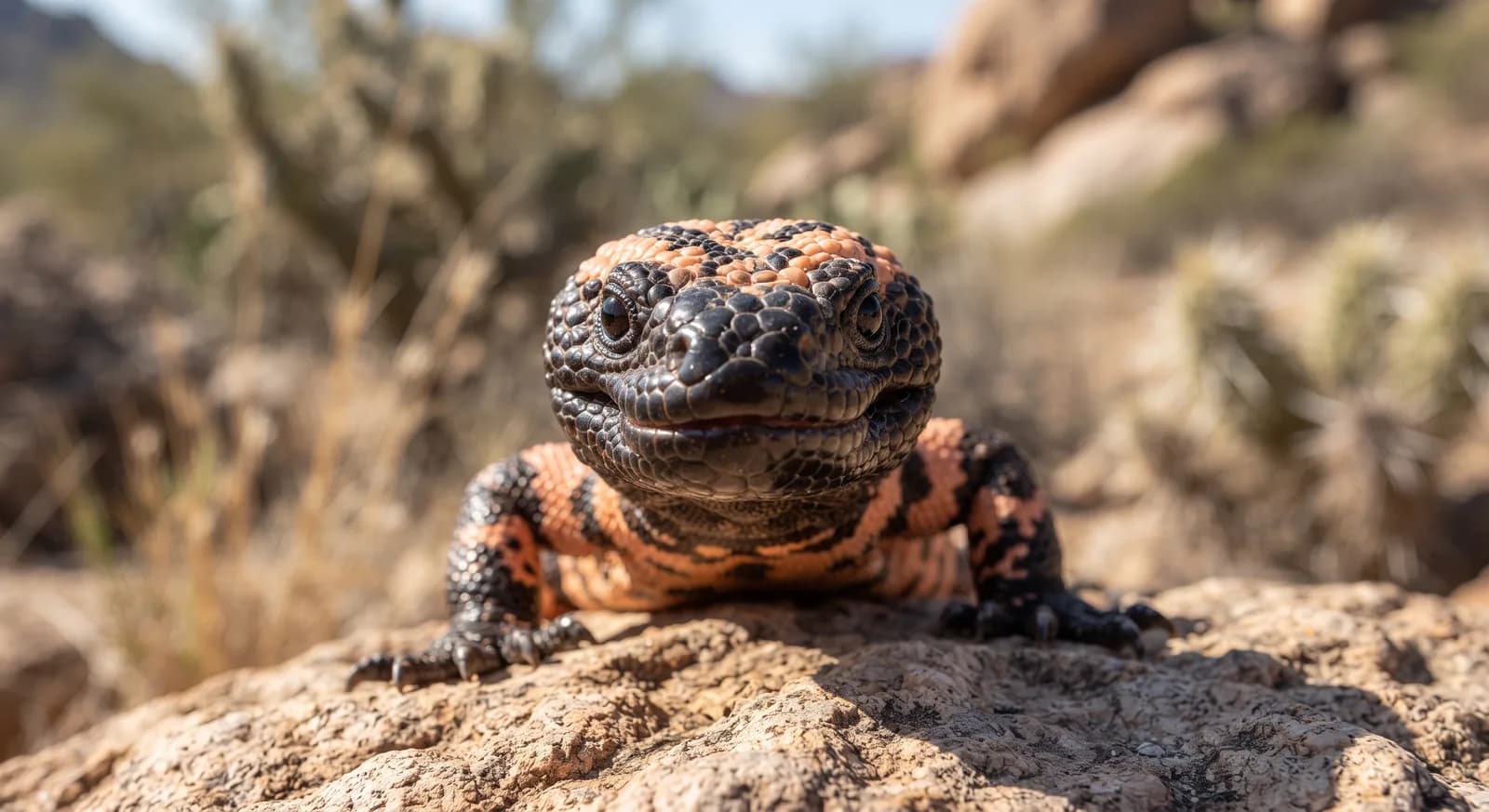
Gila Monster
Heloderma suspectum
Mexican Beaded Lizard
Heloderma horridum
Sonoran Desert Toad
Incilius alvarius
Mexican Orangeknee
Brachypelma smithi
Keep exploring
Based on what we already know about giant vinegaroon.
Comments
Share an experience, a fun fact or a tip for seeing the giant vinegaroon.
Be the first to comment.