Reptiles · Squamata · Helodermatidae
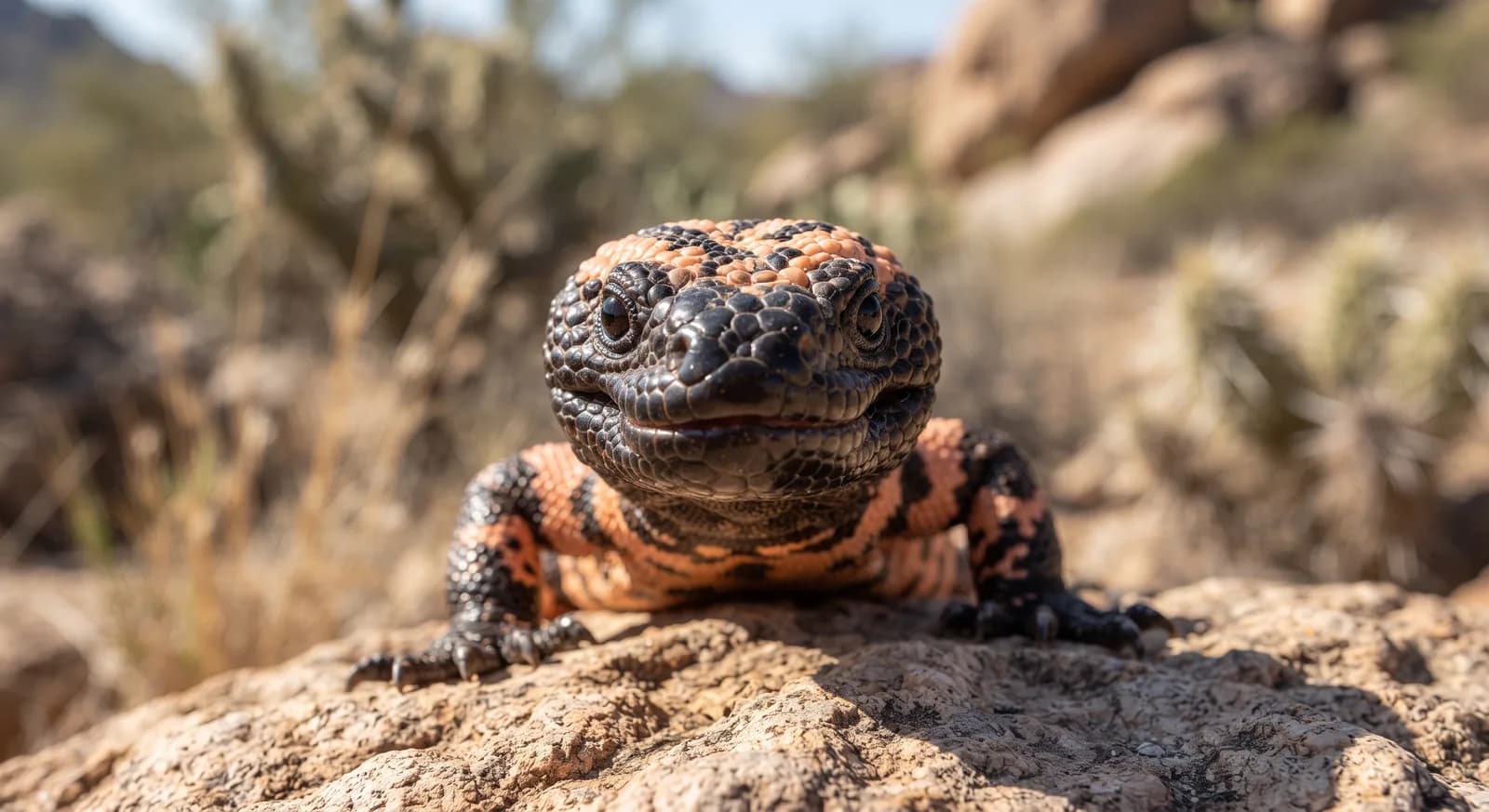
Gila Monster
Heloderma suspectum
It could become endangered in the near future if current threats go unchecked. See full glossary
It is one of only two venomous lizards in the world, alongside the Mexican beaded lizard. Its venom has been central to developing drugs for type 2 diabetes.
Weight
350 g – 2.3 kg
Size
15 cm – 56 cm
Lifespan
25 years
Diet
Carnivore
Feeds mainly on other animals.
Activity
Nocturnal
Active mainly at night.
Social structure
Solitary
Lives and hunts alone, joining others only to breed.
Sighting difficulty
Moderate
Fun facts
- It is one of only two venomous lizards in the world.
- It works its venom in by chewing, rather than through hollow fangs as snakes do.
- Its venom has been central to developing modern drugs for type 2 diabetes.
- fisiologíaIt is one of the few venomous lizards, and its saliva contains a toxin that inspired a drug now used against type 2 diabetes.
Life cycle & biology
- Skeleton type
- Vertebrate - internal bony skeleton covered in osteoderms (reptile)
- Habitat & environment
- Rocky desert and arid scrub of the south-western United States and north-western Mexico
- Birth weight
- The newly hatched young ~15-16 cm long; no precise weight found
- Size at birth
- 15 - 16 cm long at hatching
- Sexual maturity
- 3-5 years
- Gestation / incubation
- 9-10 months (some sources give a full year from fertilisation to emergence)
- Litter / clutch size
- 1 to 12 eggs per clutch (average 2-30 depending on the source)
- Lifespan in captivity
- Documented record of 28.9 years in captivity
Sources consulted: AnAge (genomics.senescence.info); Animalia.bio; Animal-pedia.org; AnimalSpot; Elmwood Park Zoo; Nevada Department of Wildlife; Animal Diversity Web; San Diego Zoo
Where to watch it
Parks and dive sites where this species has been documented.
Related species
Other species in the catalogue with the most in common with Gila Monster — same habitat, park, country, tags or family.
Mexican Beaded Lizard
Heloderma horridum
Mexican Orangeknee
Brachypelma smithi
Great Horned Owl
Bubo virginianus
Sonoran Desert Toad
Incilius alvarius
Bark Scorpion
Centruroides sculpturatus
Keep exploring
Based on what we already know about gila monster.
Comments
Share an experience, a fun fact or a tip for seeing the gila monster.
Be the first to comment.