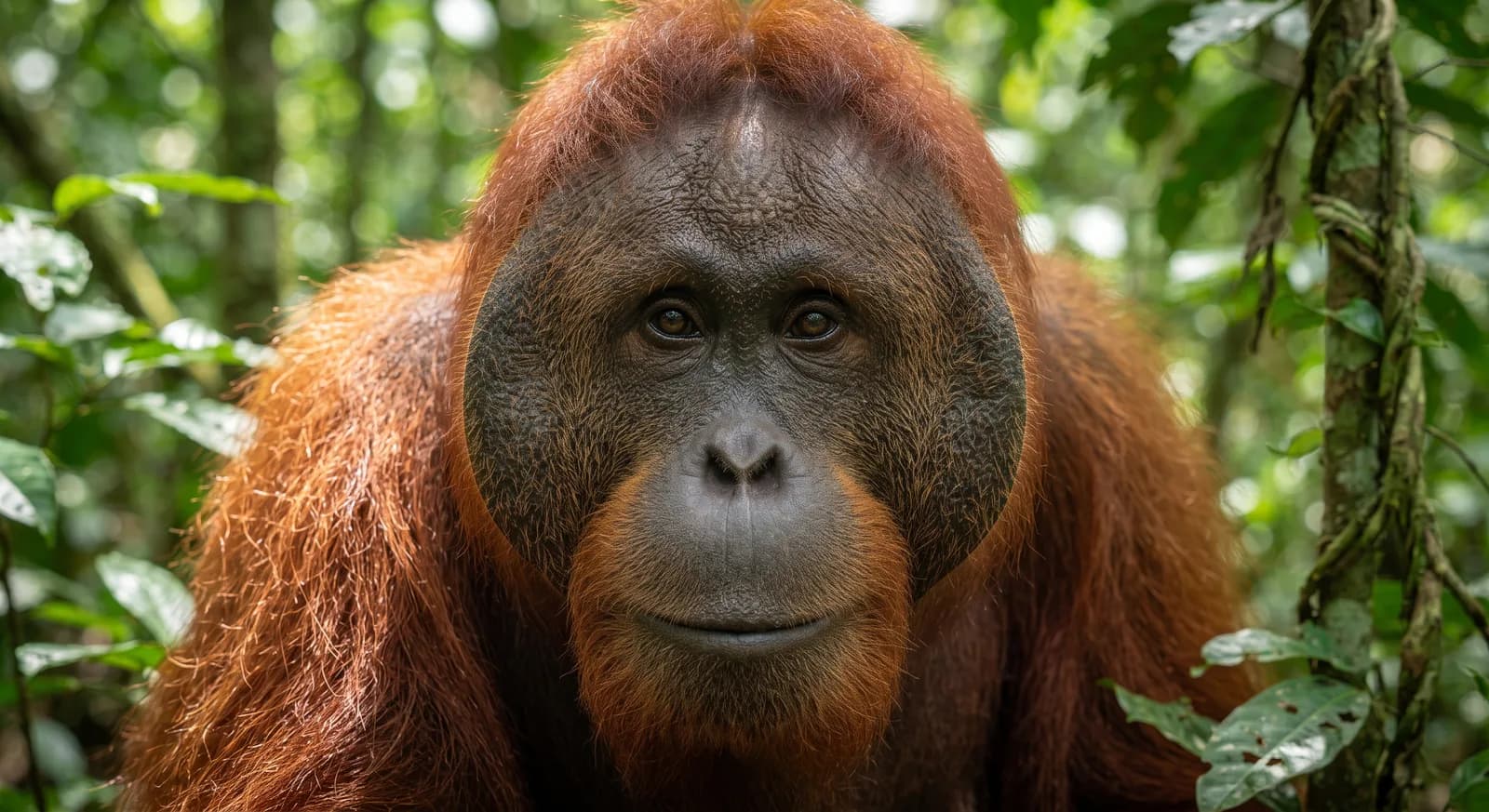
A large arboreal ape with reddish hair, it spends almost its whole life among the trees of the Bornean rainforest.
Weight
30 kg – 90 kg
Size
1 m – 1.4 m
Life expectancy
40 years
Diet
Omnivore
Combines animal and plant food depending on availability.
Activity
Diurnal
Active mainly during the day.
Social structure
Solitary
Lives and hunts alone, joining others only to breed.
Sighting difficulty
Very hard
Estimated population
104,700 animals according to the 2016 assessment, against some 230,000 a decade earlier and more than 300,000 in the 1970s; projections pointed to around 47,000 by 2025
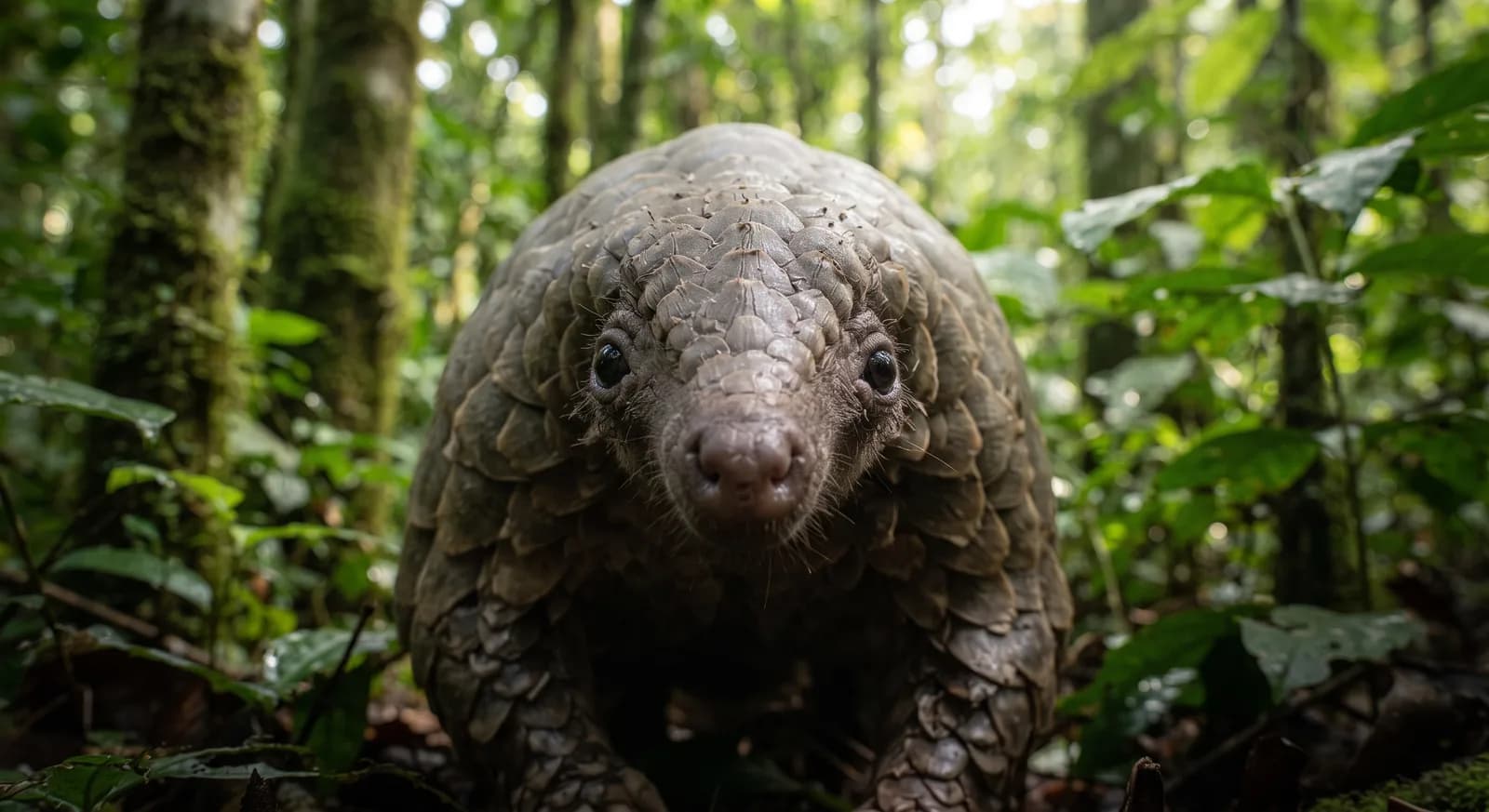
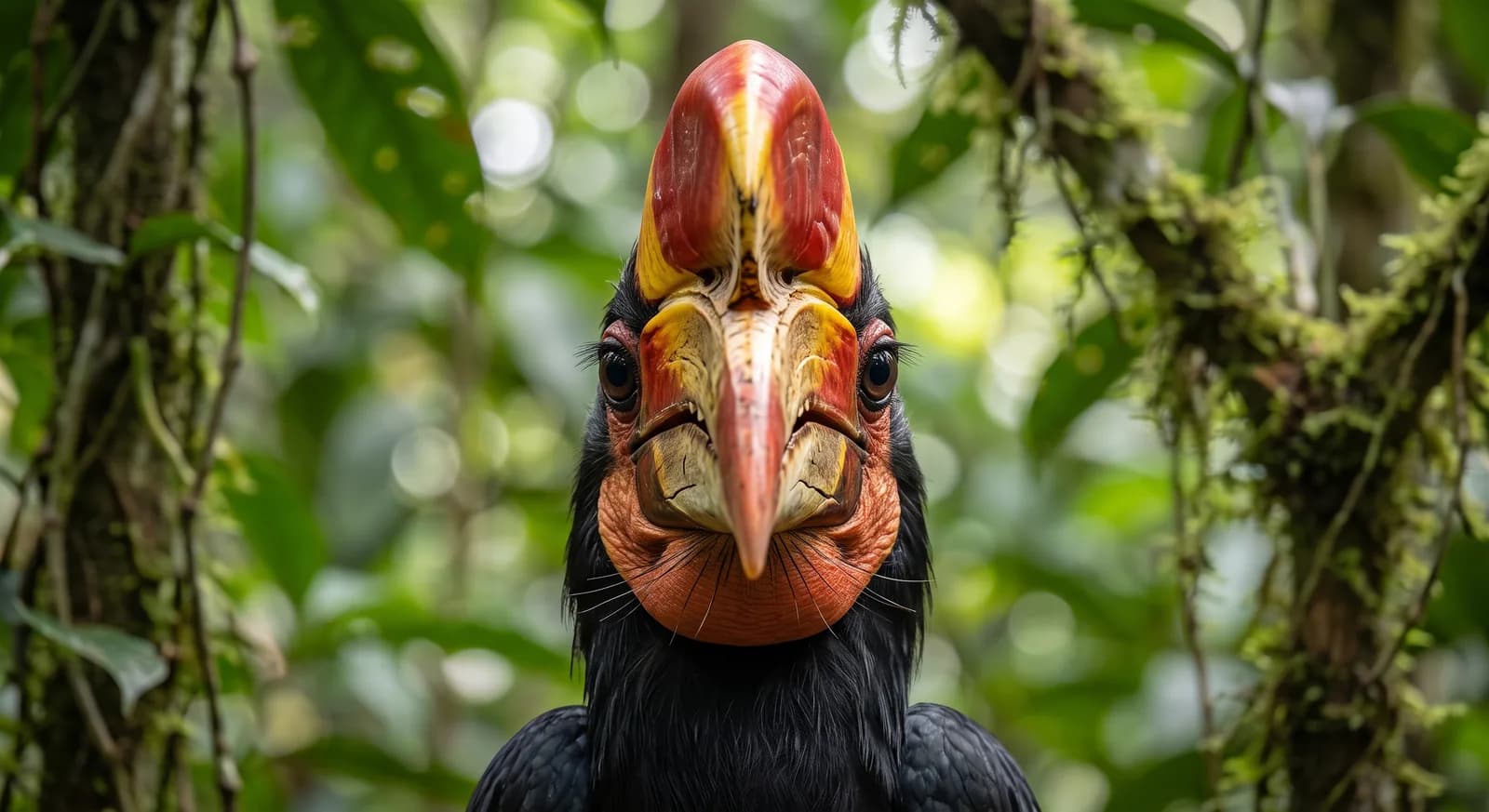
AI-generated images: illustrations, not photographs.
Fun facts
"Orangutan" means "person of the forest" in Malay.
It builds a fresh nest to sleep in every night.
It can use simple tools to get at food.
Life cycle and biology
Skeleton type
Vertebrate - internal bony skeleton (mammal)
Habitat and environment
Lowland and hill tropical forest of the island of Borneo, up to 800 metres above sea level
Birth weight
Weight at birth not found as a precise figure
Size at birth
Wholly dependent, clinging to its mother from birth
Sexual maturity
Male: variable, 7-15 years depending on how the facial flanges develop | Female: a first birth at ~15 years
Gestation / incubation
~245 days (8-9 months)
Litter / clutch size
1 young (twins rare), with 6-8 years between births, among the longest intervals of any mammal
Life expectancy in captivity
50-60 years in captivity
Sources consulted: Dimensions.com; New England Primate Conservancy; AboutAnimals; A-Z Animals; Animal Diversity Web; AnAge (genomics.senescence.info); OVAID; PMC (reproductive success study); Ancrenaz et al. 2016, IUCN Red List: recatalogado de En peligro a En peligro crítico por un declive proyectado del 86 % entre 1950 y 2025 (tres generaciones) || IUCN Red List, evaluación de Pongo pygmaeus de 2016 (Ancrenaz et al.)
Where to find it
Best time: April to October
Loading map…
The pins mark the parks where its presence is documented.
Where to see it
Parks and dive sites where this species has been documented.
Related species
Other species in the catalogue with the most in common with Bornean Orangutan — same habitat, park, country, tags or family.
Same taxonomic family
Same taxonomic family
Shares a park
Shares a park
Shares a park
Shares a park
How to help
The bornean orangutan is classified as critically endangered. Organisations such as Borneo Orangutan Survival Foundation (BOS) work specifically on its conservation and that of its habitat; looking into their programmes is a good starting point if you want to get involved.
It's documented in 5 protected areas — one reason why protecting these places matters for its conservation.
Keep exploring
Based on what we already know about bornean orangutan.
Comments
Share an experience, a fun fact or a tip for seeing the bornean orangutan.