Skip to content
WAnimals
  • Map
  • Species
  • Parks
  • Diving
Log inCreate account
WAnimals

The guide for travellers and animal lovers: discover, plan and share your wild adventures around the world.

Discover wildlife

  • Species
  • Ecosystems
  • Glossary
  • Tags

Explore places

  • Map
  • Countries
  • Parks
  • Diving

Plan experiences

  • Guides

Learn

  • Blog

Resources

  • Help centre
  • Contact
  • Install the app

Follow us

Account

  • Log in
  • Create account

© 2026 WAnimals. All rights reserved.

About usHow we build our profilesTerms of servicePrivacyLegal notice
MapSpeciesParksDiving
  1. Home
  2. Species
  3. Tapanuli Orangutan

One of the 3 orangutans on WAnimals

Mammals · Primates · Hominidae

Tapanuli Orangutan

Pongo tapanuliensis

Critically Endangered

At extremely high risk of imminent extinction in the wild.

Spotted something wrong?

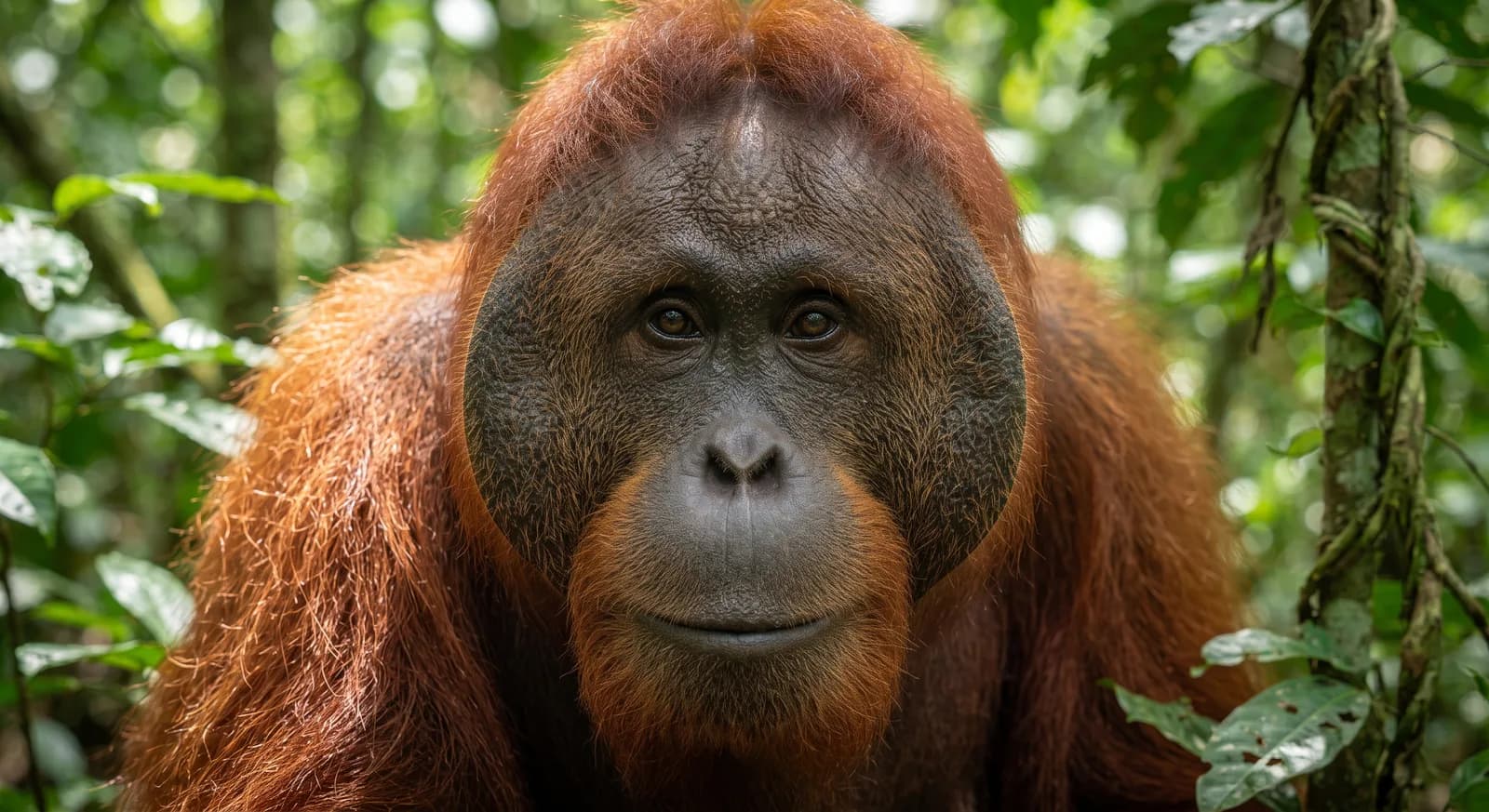
The Tapanuli orangutan was described as a species in its own right in 2017, becoming the seventh known great ape and, immediately, the most threatened on the planet. The entire population, of fewer than 800 animals, survives in some 1,100 square kilometres of forest in the Batang Toru ecosystem, in northern Sumatra. It is told apart from the Sumatran orangutan by a smaller skull, curlier, cinnamon-coloured hair, and a long call of higher pitch and longer duration. Adult males develop large flat cheek pads.

Weight

35 kg – 90 kg

Size

1.2 m – 1.5 m

Life expectancy

45 years

Diet

Omnivore

Combines animal and plant food depending on availability.

Activity

Diurnal

Active mainly during the day.

Social structure

Solitary

Lives and hunts alone, joining others only to breed.

Sighting difficulty

Very hard

Estimated population

Fewer than 800 individuals

RainforestMountain
1countries7same family

Fun facts

  • taxonomíaFormally described in 2017, it is the most recently identified great ape and one of the most threatened on the planet.
  • It is the most threatened great ape in the world: its entire population would fit into a small village.
  • Genetic analyses indicate that its lineage separated from that of the Bornean and Sumatran orangutans more than three million years ago, although it was not recognised as a species until 2017.

Life cycle and biology

Skeleton type
Vertebrate - internal bony skeleton (mammal)
Habitat and environment
Montane tropical forest of the Batang Toru ecosystem, in Sumatra, between 300 and 1,300 m
Sexual maturity
15 years
Gestation / incubation
8.5 months
Litter / clutch size
1

Sources consulted: https://es.wikipedia.org/wiki/Pongo_tapanuliensis

Where to find it

Loading map…

Related species

Other species in the catalogue with the most in common with Tapanuli Orangutan — same habitat, park, country, tags or family.

Same taxonomic family

How to help

The tapanuli orangutan is classified as critically endangered. Organisations such as the IUCN, WWF and the Wildlife Conservation Society work specifically on its conservation and that of its habitat; looking into their programmes is a good starting point if you want to get involved.

Keep exploring

Based on what we already know about tapanuli orangutan.

Comments

Share an experience, a fun fact or a tip for seeing the tapanuli orangutan.

Be the first to comment.
See full glossary
This page in other languages: Español · Deutsch · Français · Português · Italiano
See its range on the interactive map→
Bornean OrangutanCritically Endangered

Bornean Orangutan

Pongo pygmaeus

Critically Endangered

Sumatran Orangutan

Pongo abelii

Western GorillaCritically Endangered

Western Gorilla

Gorilla gorilla

Eastern GorillaCritically Endangered

Eastern Gorilla

Gorilla beringei

Endangered

Bonobo

Pan paniscus

Least Concern

Human

Homo sapiens

CountriesIndonesia
TagsOmnivore
Omnivore
Diurnal
Solitary
Critically Endangered
Rainforest
Mountain
Mammal
Indonesia