Skip to content
WAnimals
  • Map
  • Species
  • Parks
  • Diving
Log inCreate account
WAnimals

The guide for travellers and animal lovers: discover, plan and share your wild adventures around the world.

Discover wildlife

  • Species
  • Ecosystems
  • Glossary
  • Tags

Explore places

  • Map
  • Countries
  • Parks
  • Diving

Plan experiences

  • Guides

Learn

  • Blog

Resources

  • Help centre
  • Contact
  • Install the app

Follow us

Account

  • Log in
  • Create account

© 2026 WAnimals. All rights reserved.

About usHow we build our profilesTerms of servicePrivacyLegal notice
MapSpeciesParksDiving
  1. Home
  2. Species
  3. Common Leopard Gecko

One of the 6 geckos on WAnimals

Reptiles · Squamata · Eublepharidae

Common Leopard Gecko

Eublepharis macularius

Least Concern

The species is abundant and widely distributed; it faces no significant short-term risk.

Spotted something wrong?

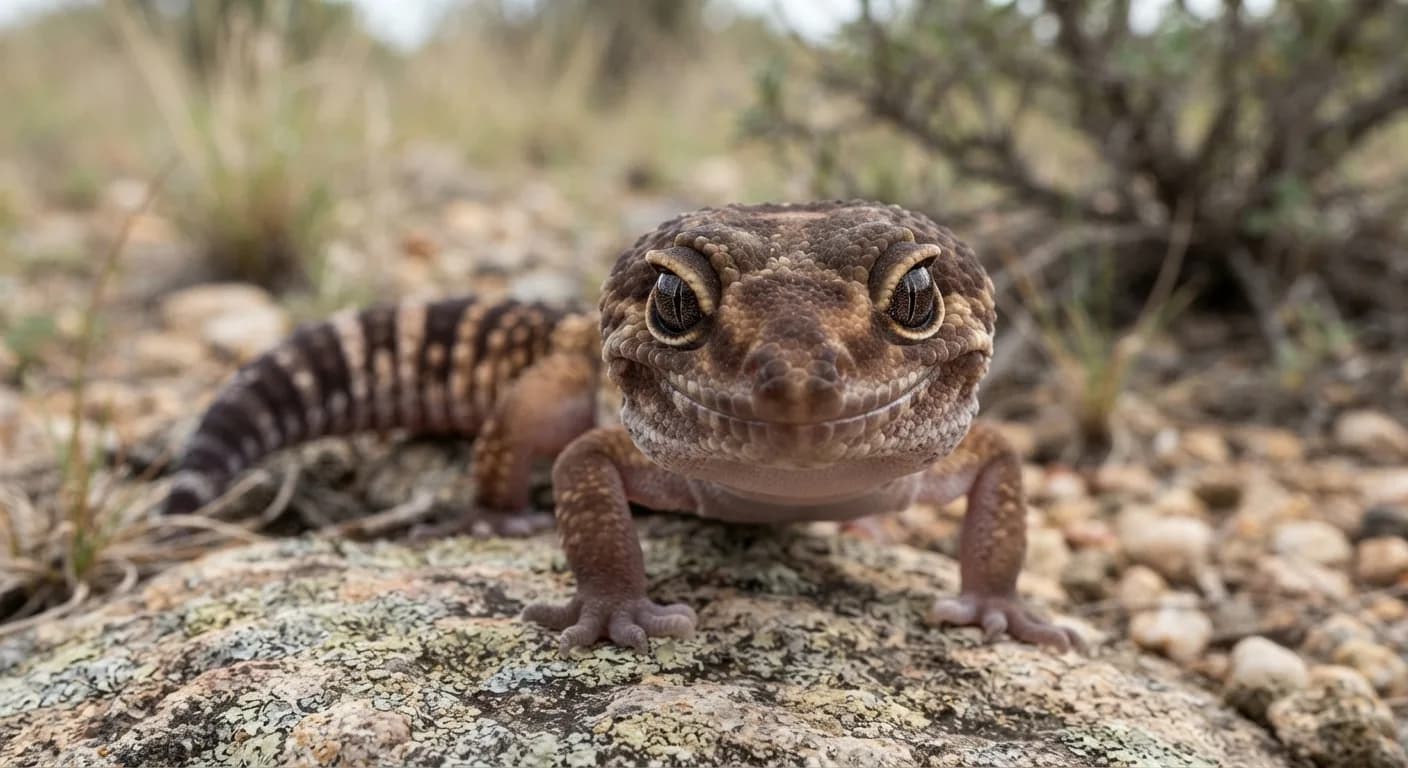
The leopard gecko is one of the most widespread terrarium reptiles in the world and, unlike most geckos, it has movable eyelids and lacks the adhesive lamellae that allow climbing up glass. It lives on stony plains in southern Asia, is nocturnal and stores fat in its tail, which thickens noticeably in times of plenty.

Weight

45 g – 90 g

Size

20 cm – 28 cm

Life expectancy

20 years

Diet

Insectivore

Feeds mainly on insects and other invertebrates.

Activity

Nocturnal

Active mainly at night.

Social structure

Solitary

Lives and hunts alone, joining others only to breed.

Sighting difficulty

Easy

DesertMountainGrassland
5countries1same family

Fun facts

  • GeneralOne of the most popular vivarium reptiles; unlike other geckos it has movable eyelids.
  • anatomíaUnlike most geckos it has working movable eyelids, and it can shed its tail voluntarily to escape a predator, growing it partly back afterwards.
  • The sex of the young is determined by incubation temperature, not by chromosomes: below 28 degrees almost all are female, around 32 almost all male, and in the middle range the ratio evens out.
  • Unlike almost all geckos it has movable eyelids and can blink, and it has no adhesive lamellae on its toes: it cannot climb smooth surfaces.
  • Its tail is a larder: it builds up fat until it thickens noticeably, and if it loses it to a predator it grows a new, shorter one of a different shape, losing its reserves with it.

Life cycle and biology

Skeleton type
Vertebrate - internal bony skeleton (reptile)
Habitat and environment
Arid stony plains, dry scrub and rocky slopes of Pakistan, Afghanistan, India and Iran
Sexual maturity
13.1 months
Gestation / incubation
55 days
Litter / clutch size
2

Sources consulted: https://www.iucnredlist.org/ | https://animaldiversity.org/ | https://es.wikipedia.org/

Where to find it

Loading map…

Related species

Other species in the catalogue with the most in common with Common Leopard Gecko — same habitat, park, country, tags or family.

Same taxonomic family
Related to
Related to
Related to
Related to
Related to

Keep exploring

Based on what we already know about common leopard gecko.

Comments

Share an experience, a fun fact or a tip for seeing the common leopard gecko.

Be the first to comment.
See full glossary
This page in other languages: Español · Deutsch · Français · Português · Italiano
See its range on the interactive map→
Fat-tail GeckoLeast Concern

Fat-tail Gecko

Hemitheconyx caudicinctus

Least Concern

Banded Krait

Bungarus fasciatus

Least Concern

Brahminy Blindsnake

Indotyphlops braminus

Least Concern

Common House Gecko

Hemidactylus frenatus

Malaysian Narrowmouth ToadLeast Concern

Malaysian Narrowmouth Toad

Kaloula pulchra

Least Concern

Java Whipping Frog

Polypedates leucomystax

CountriesAfghanistan
TagsInsectivore
Insectivore
Nocturnal
Solitary
Reptile
Desert
Mountain
Grassland
Afghanistan
India
Iran
Nepal
Pakistan