Skip to content
WAnimals
  • Map
  • Species
  • Parks
  • Diving
Log inCreate account
WAnimals

The guide for travellers and animal lovers: discover, plan and share your wild adventures around the world.

Discover wildlife

  • Species
  • Ecosystems
  • Glossary
  • Tags

Explore places

  • Map
  • Countries
  • Parks
  • Diving

Plan experiences

  • Guides

Learn

  • Blog

Resources

  • Help centre
  • Contact
  • Install the app

Follow us

Account

  • Log in
  • Create account

© 2026 WAnimals. All rights reserved.

About usHow we build our profilesTerms of servicePrivacyLegal notice
MapSpeciesParksDiving
  1. Home
  2. Species
  3. Banded Krait

One of the 2 kraits on WAnimals

Reptiles · Squamata · Elapidae

Banded Krait

Bungarus fasciatus

Least Concern

The species is abundant and widely distributed; it faces no significant short-term risk.

Spotted something wrong?

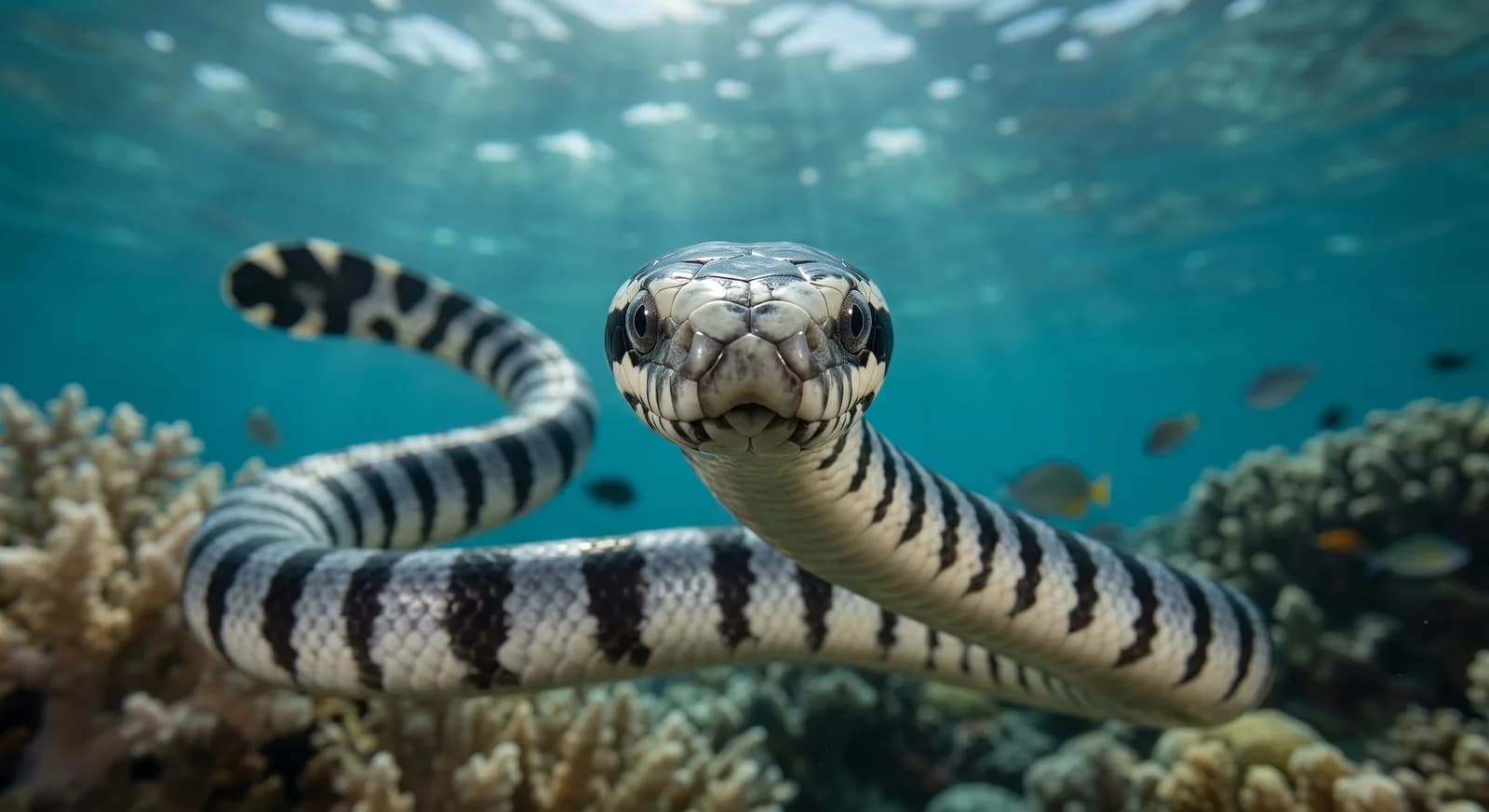
The banded krait is unmistakable for its alternating black and yellow rings and for a vertebral ridge that gives its back a triangular cross-section. It is a highly venomous elapid but notably listless by day: it will let itself be handled with barely a reaction, and practically all accidents happen at night, when it becomes active.

Weight

3.1 kg on average

Size

1 m – 2.1 m

Life expectancy

15 years

Diet

Carnivore

Feeds mainly on other animals.

Activity

Nocturnal

Active mainly at night.

Social structure

Solitary

Lives and hunts alone, joining others only to breed.

Sighting difficulty

Easy

RainforestFreshwaterGrassland
16countries19parks17same family

Fun facts

  • By day it is almost inert: it lets itself be handled with barely a reaction and hides its head under the coils of its body, a daytime torpor so marked that for a long time it was considered harmless. At night it changes completely.
  • Its back has a prominent vertebral ridge that gives the body a triangular cross-section, an anatomical feature that tells it apart from any other banded snake in its range.
  • It eats mainly other snakes, and its diet includes venomous species to whose venom it has some resistance.

Life cycle and biology

Skeleton type
Vertebrate - internal bony skeleton (reptile)
Habitat and environment
Rainforest, rice fields, wetland margins and farmland of South-East Asia
Sexual maturity
2 years
Gestation / incubation
60 days of incubation
Litter / clutch size
8 eggs

Sources consulted: https://es.wikipedia.org/wiki/Bungarus_fasciatus

Where to find it

Loading map…

The pins mark the parks where its presence is documented.

Where to see it

Parks and dive sites where this species has been documented — showing 10 of 19.

Related species

Other species in the catalogue with the most in common with Banded Krait — same habitat, park, country, tags or family.

Same taxonomic family
Shares a park

Keep exploring

Based on what we already know about banded krait.

Comments

Share an experience, a fun fact or a tip for seeing the banded krait.

Be the first to comment.
See full glossary
This page in other languages: Español · Deutsch · Français · Português · Italiano
See its range on the interactive map→
KazirangaIndia
Gunung LeuserIndonesia
Khao YaiThailand
Bukit Timah Nature ReserveSingapore
ManasIndia
NamdaphaIndia
Taman NegaraMalaysia
Kaeng KrachanThailand
Cat TienVietnam
Ba BeVietnam
See all 19 parks
Monocled CobraLeast Concern

Monocled Cobra

Naja kaouthia

Yellow-lipped Sea KraitLeast Concern

Yellow-lipped Sea Krait

Laticauda colubrina

King CobraVulnerable

King Cobra

Ophiophagus hannah

Least Concern

Eastern Brown Snake

Pseudonaja textilis

Least Concern

Common Krait

Bungarus caeruleus

Least Concern

Greater False Vampire

Megaderma lyra

CountriesVietnam
ParksKazirangaIndia
TagsCarnivore
Carnivore
Nocturnal
Solitary
Reptile
Rainforest
Freshwater
Grassland
Vietnam
China
India
Thailand
Bangladesh
Indonesia
Bangladesh
Brunei
Cambodia
China
India
Indonesia
Laos
Malaysia
Myanmar
Nepal
Philippines
Singapore
Taiwan
Thailand
Timor-Leste
Vietnam