Skip to content
WAnimals
  • Map
  • Species
  • Parks
  • Diving
Log inCreate account
WAnimals

The guide for travellers and animal lovers: discover, plan and share your wild adventures around the world.

Discover wildlife

  • Species
  • Ecosystems
  • Glossary
  • Tags

Explore places

  • Map
  • Countries
  • Parks
  • Diving

Plan experiences

  • Guides

Learn

  • Blog

Resources

  • About us
  • How we build our profiles
  • Help centre
  • Contact
  • Install the app

Follow us

Account

  • Log in
  • Create account

© 2026 WAnimals. All rights reserved.

Terms of servicePrivacyCookiesLegal notice
MapSpeciesParksDiving
  1. Home
  2. Species
  3. Yellow-lipped Sea Krait

One of the 26 snakes on WAnimals
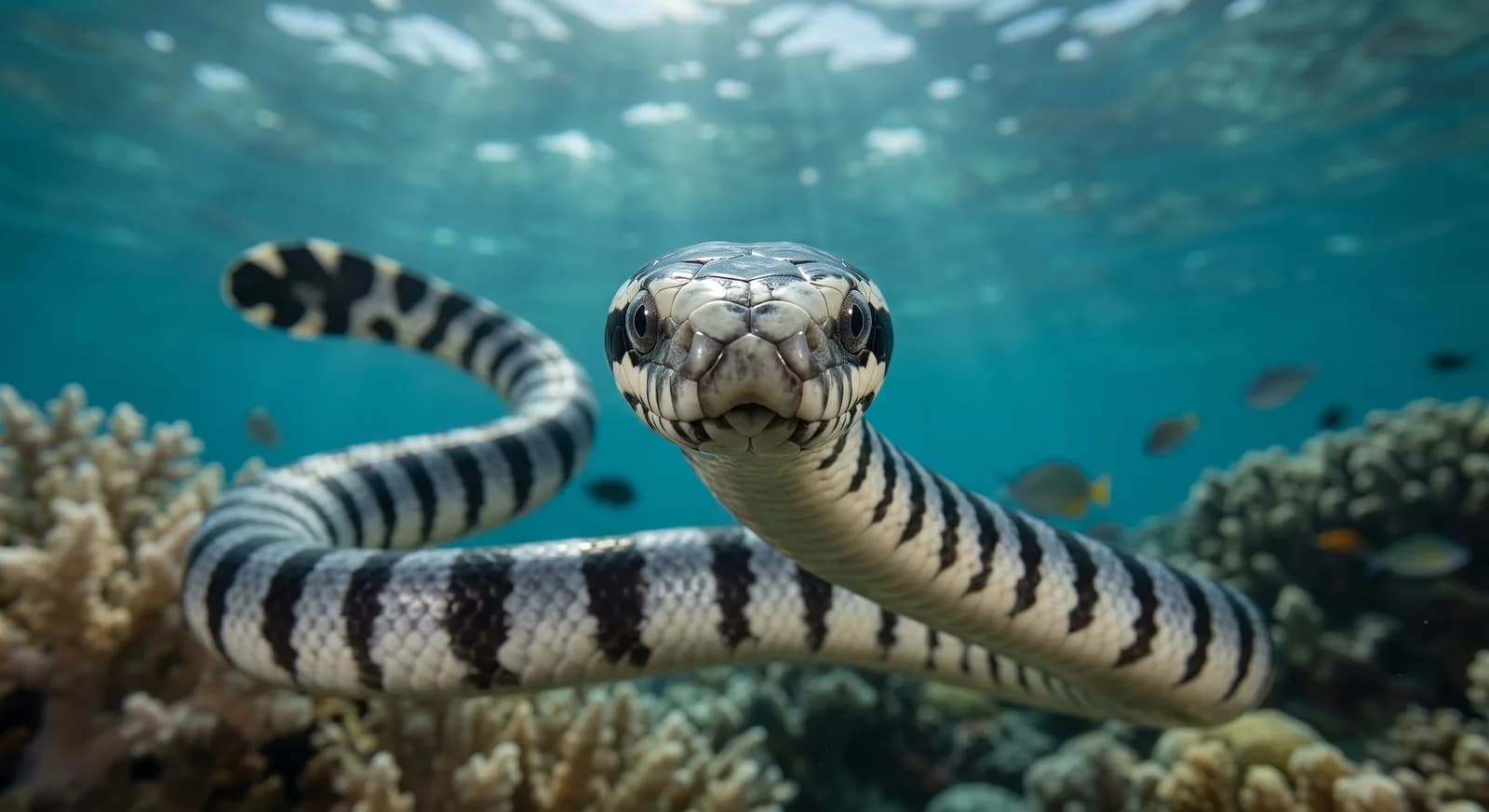
Yellow-lipped Sea Krait (Laticauda colubrina)

Reptiles · Squamata · Elapidae

Yellow-lipped Sea Krait

Laticauda colubrina

Least Concern

The species is abundant and widely distributed; it faces no significant short-term risk.

Spotted something wrong?

The yellow-lipped sea krait or banded sea krait is a snake banded in black and greyish blue that lives among the reefs of the Indo-Pacific. Unlike the true sea snakes it retains its belly scales and can move on land: it comes out of the water to rest, digest and lay its eggs in caves and crevices along the shore. Its venom is extremely potent but it is notably docile.

Size

90 cm – 1.5 m

Life expectancy

15 years

Diet

Carnivore

Feeds mainly on other animals.
Activity

Nocturnal

Active mainly at night.

Social structure

Solitary

Lives and hunts alone, joining others only to breed.

OceanIslands
10countries21parks94dive sites17same family

AI-generated images: illustrations, not photographs.

Fun facts

  • It is genuinely amphibious: it hunts eels on the reef but comes ashore to digest, shed its skin and lay its eggs, something the true sea snakes cannot do because they have lost their belly scales.
  • Its venom is several times more potent than a cobra's, but it is so docile and its mouth so small that fishermen in the Philippines and Fiji routinely handle it by hand.
  • It hunts in partnership with groupers and goatfish: the snake goes into the crevices of the reef and the fish wait outside for the prey that flee, an association documented between very different species.
  • It is genuinely amphibious: unlike the true sea snakes, which never leave the water, this one returns to land to digest, shed its skin, mate and lay its eggs.
  • Its venom is among the most potent in existence, many times more toxic than a cobra's, but it is docile and very rarely bites; fishermen handle it with their bare hands.
  • It hunts mainly eels and morays, poking its head into crevices in the reef. Males and females hunt different prey at different depths, which reduces competition between the sexes.
  • The tail is flat and broad, paddle-shaped, and provides the propulsion; on land it moves clumsily but can climb over rocks.
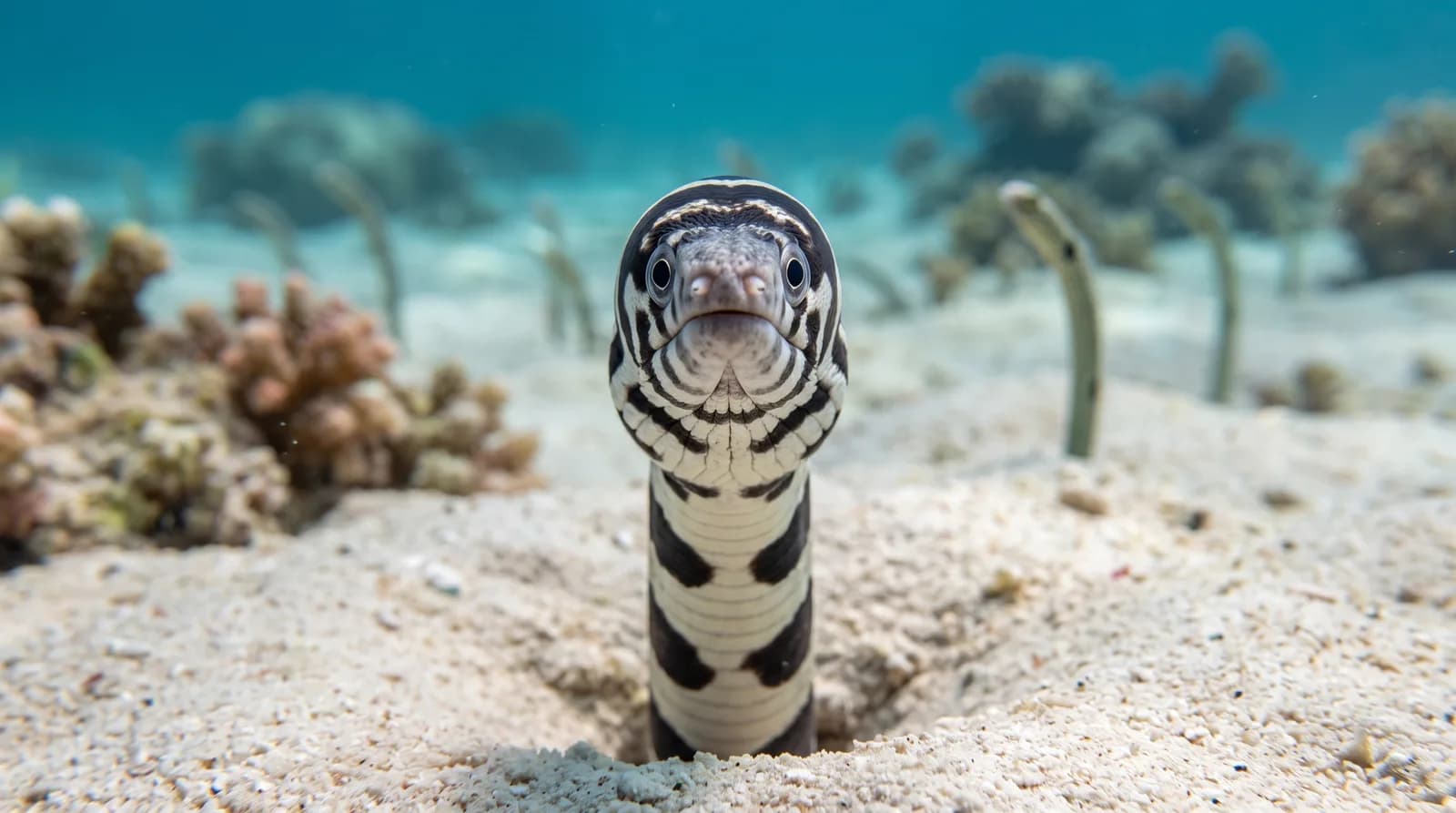
  • Its pattern of black rings on a pale background and its yellow snout make it unmistakable, and they are precisely the traits copied by the harlequin snake eel.

Life cycle and biology

Skeleton type
Vertebrate - internal bony skeleton (reptile)
Habitat and environment
Coral reefs and rocky shores of the Indo-Pacific; rests and lays its eggs on land
Sexual maturity
3 years
Gestation / incubation
120 days of incubation
Litter / clutch size
6 eggs

Sources consulted: Wikipedia (en): Yellow-lipped sea krait

Where to find it

Loading map…

Where to see it

Parks and dive sites where this species has been documented — showing 20 of 115.

Related species

Other species in the catalogue with the most in common with Yellow-lipped Sea Krait — same habitat, park, country, tags or family.

Shares a park
Shares a park
Shares a park
Shares a park
Shares a park
Same taxonomic family

Keep exploring

Based on what we already know about yellow-lipped sea krait.

Share an experience, a fun fact or a tip for seeing the yellow-lipped sea krait.
See full glossary
This page in other languages: Español · Deutsch · Français · Português · Italiano

The pins mark the parks and dive sites where its presence is documented.

See its range on the interactive map→
KomodoIndonesia
YakushimaJapan
Great Barrier ReefAustralia
NingalooAustralia
Puerto Princesa Subterranean RiverPhilippines
Cape RangeAustralia
Ogasawara IslandsJapan
Similan IslandsThailand
Gulf of Kutch Marine ParkIndia
Amami GuntoJapan
Raja AmpatIndonesia
Komodo National ParkIndonesia
Bunaken Marine ParkIndonesia
USAT Liberty (Tulamben)Indonesia
Amed and Jemeluk BayIndonesia
Menjangan Island (Bali Barat)Indonesia
Nusa Penida (Manta Point / Crystal Bay)Indonesia
Lembeh StraitIndonesia
Wakatobi National ParkIndonesia
Banda IslandsIndonesia
See all 21 parks
See all 94 dive sites
Least Concern

Yellow-bellied Sea Snake

Hydrophis platurus

Red LionfishLeast Concern

Red Lionfish

Pterois volitans

Spot-fin PorcupinefishLeast Concern

Spot-fin Porcupinefish

Diodon hystrix

Geography ConeLeast Concern

Geography Cone

Conus geographus

Harlequin Snake EelLeast Concern

Harlequin Snake Eel

Myrichthys colubrinus

Least Concern

Banded Krait

Bungarus fasciatus

CountriesIndonesia
ParksKomodoIndonesia
TagsCarnivore
Carnivore
Nocturnal
Solitary
Reptile
Ocean
Islands

Asia7

Oceania3

Indonesia
Philippines
Fiji
Malaysia
Thailand
Japan
India
Indonesia
Japan
Malaysia
Philippines
Thailand
Vietnam
Australia
Fiji
Papua New Guinea