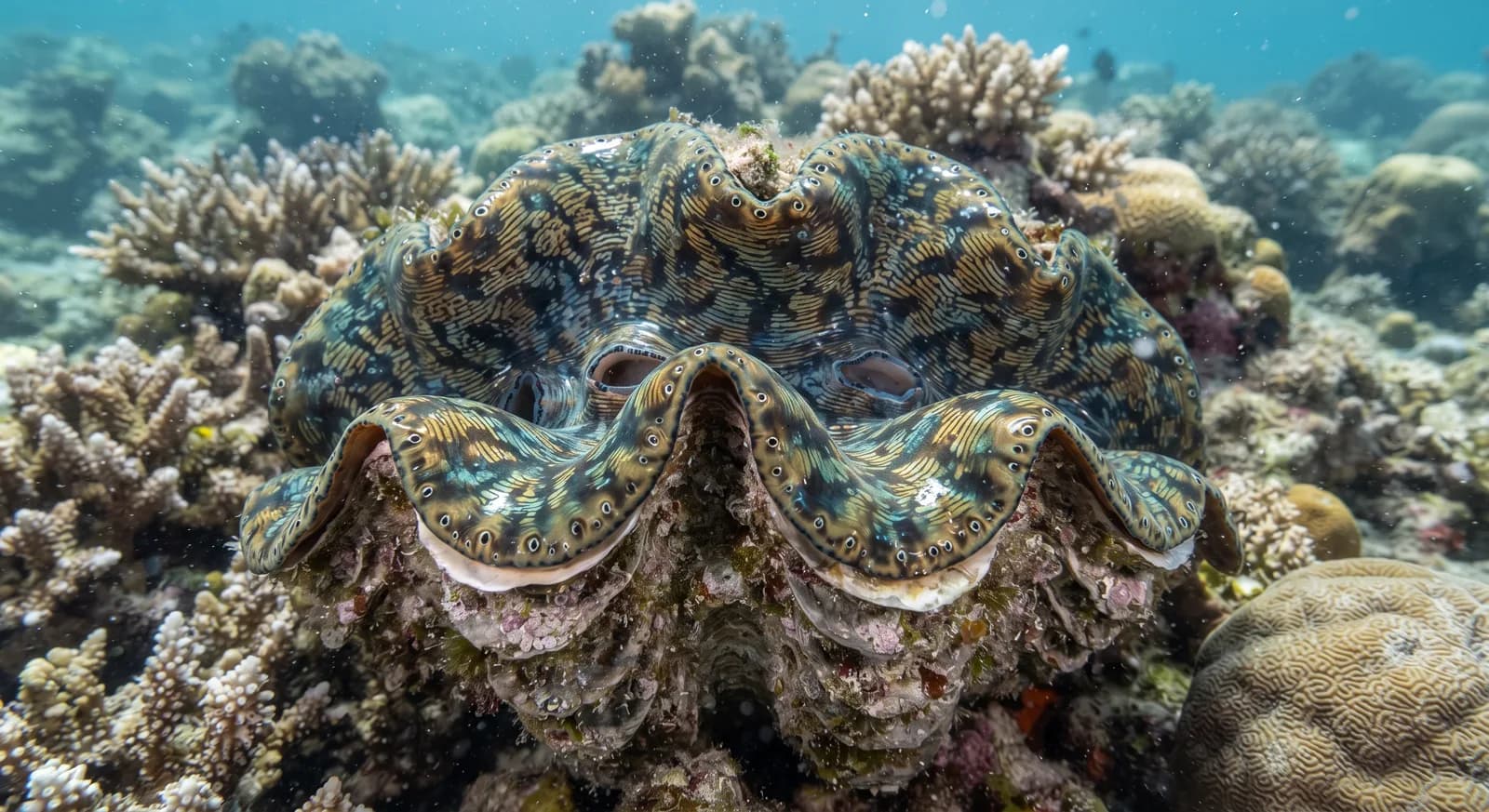
 Critically Endangered
Giant Clam
Tridacna gigas
Asia
China stretches from the Siberian taiga of the northeast to tropical forests in Yunnan and Hainan, and takes in the Tibetan plateau, the largest highland in the world, where Asia's great rivers rise and where the wild yak, the Tibetan antelope and the snow leopard live. The Hengduan Mountains, in the southwest, form one of the richest biodiversity hotspots on the planet, with deep valleys and a diversity of plants that stocked the gardens of half the world. To the south lies the karst of Guangxi and Guizhou, with limestone towers, caves and underground rivers. The Yangtze and the Yellow River organise densely populated plains where nature has been reduced to fragments, and the coast provides marshes crucial to the bird migration of the Yellow Sea.
National animal: The giant panda, the national animal and the emblem of conservation worldwide
The giant panda is a carnivore by anatomy and by digestive system that has given up meat entirely: it spends up to fourteen hours a day eating bamboo and needs between twelve and thirty-eight kilos daily because it barely digests it. To handle the stems it has developed a false thumb that is not a finger but a wrist bone, elongated and opposed to the others, an improvised evolutionary solution that lets it grip the canes precisely.
The Yangtze river dolphin, or baiji, was declared functionally extinct in 2006 after an expedition failed to find a single animal: it was the first cetacean lost to human causes. The giant panda, by contrast, moved from Endangered to Vulnerable in 2016 thanks to the network of bamboo reserves.
Sichuan between March and May for pandas and mountain birds. Zhalong in winter for red-crowned cranes. Sanjiangyuan in summer for Tibetan antelope and snow leopard.
Where else might I want to travel?
Same region: East Asia
Same region: East Asia
Same region: East Asia
Same region: East Asia
479 species found
Based on what we already know about China.