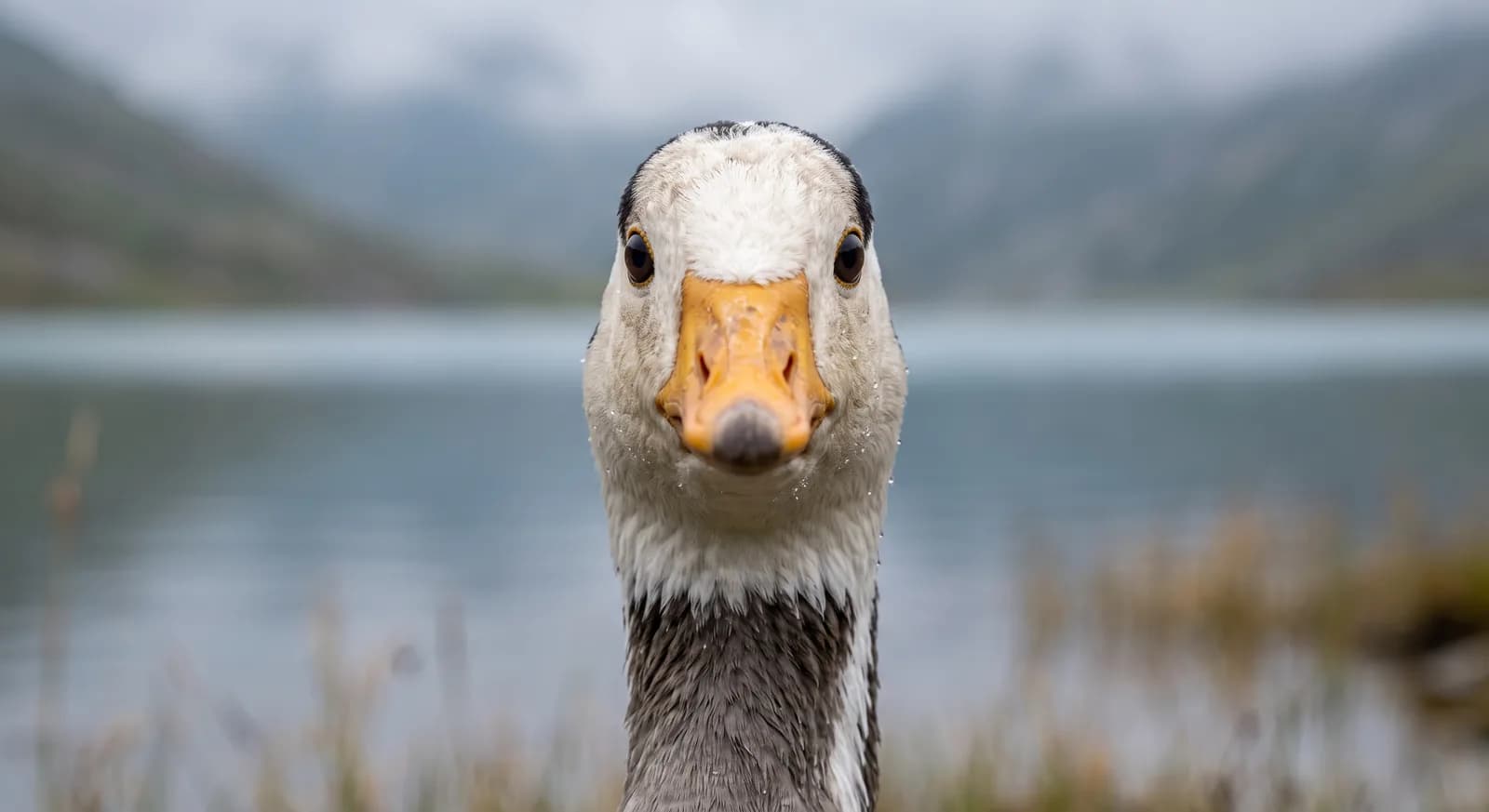
 Least Concern
Bar-Headed Goose
Anser indicus
The "water tower of Asia": the headwaters of the Yangtze, the Yellow River and the Mekong on the Tibetan Plateau, China's largest national park.
Area
190,700 km²
Designated in
2021
Region
East Asia
Headwaters of Asia's three great rivers
Sanjiangyuan, "the source of the three rivers", occupies the interior of the Qinghai-Tibet Plateau, in Qinghai province and part of the Tibet Autonomous Region, and is by some way the largest of China's national parks. Three of Asia's great rivers rise within its territory: the Yangtze, the Yellow River and the Lancang, which downstream becomes the Mekong. Hence the region is known as Asia's water tower, since the water supply of hundreds of millions of people in China and South-East Asia depends on it.
The landscape combines glaciers and snow-covered mountains, high-altitude wetlands, cold desert, alpine grassland and mountain meadows, all above 4,000 metres. It is an extremely fragile ecosystem, sensitive to global warming and to the degradation of the permafrost, and its conservation has a dimension that reaches far beyond the local. The emblematic fauna comprises the Tibetan antelope, the wild yak, the snow leopard, the kiang or Tibetan wild ass and Przewalski's gazelle, alongside hundreds of species under state protection.
The park was officially established on 12 October 2021, when President Xi Jinping announced by video link to the leaders' summit of COP15 of the Convention on Biological Diversity the creation of the first group of five Chinese national parks, which together cover some 230,000 km² and hold close to 30% of the country's key terrestrial wildlife species. Before that the area functioned as a national nature reserve and as a national park pilot project. The results in the case of the Tibetan antelope are notable: from fewer than 20,000 animals in the 1990s the figure has risen to more than 70,000.
Ecosystems found in China, where Sanjiangyuan lies.
Which other parks are like this one?
Same country: China
Same country: China
Same country: China
Same country: China
Based on what we already know about this park.
Climate
Tropical, Arid / desert, Temperate, Polar / cold, Mountain
Best season
March to May



 China