Bony fish · Anguilliformes · Ophichthidae
King Snake Eel
Ophichthus rex
The species is abundant and widely distributed; it faces no significant short-term risk. See full glossary
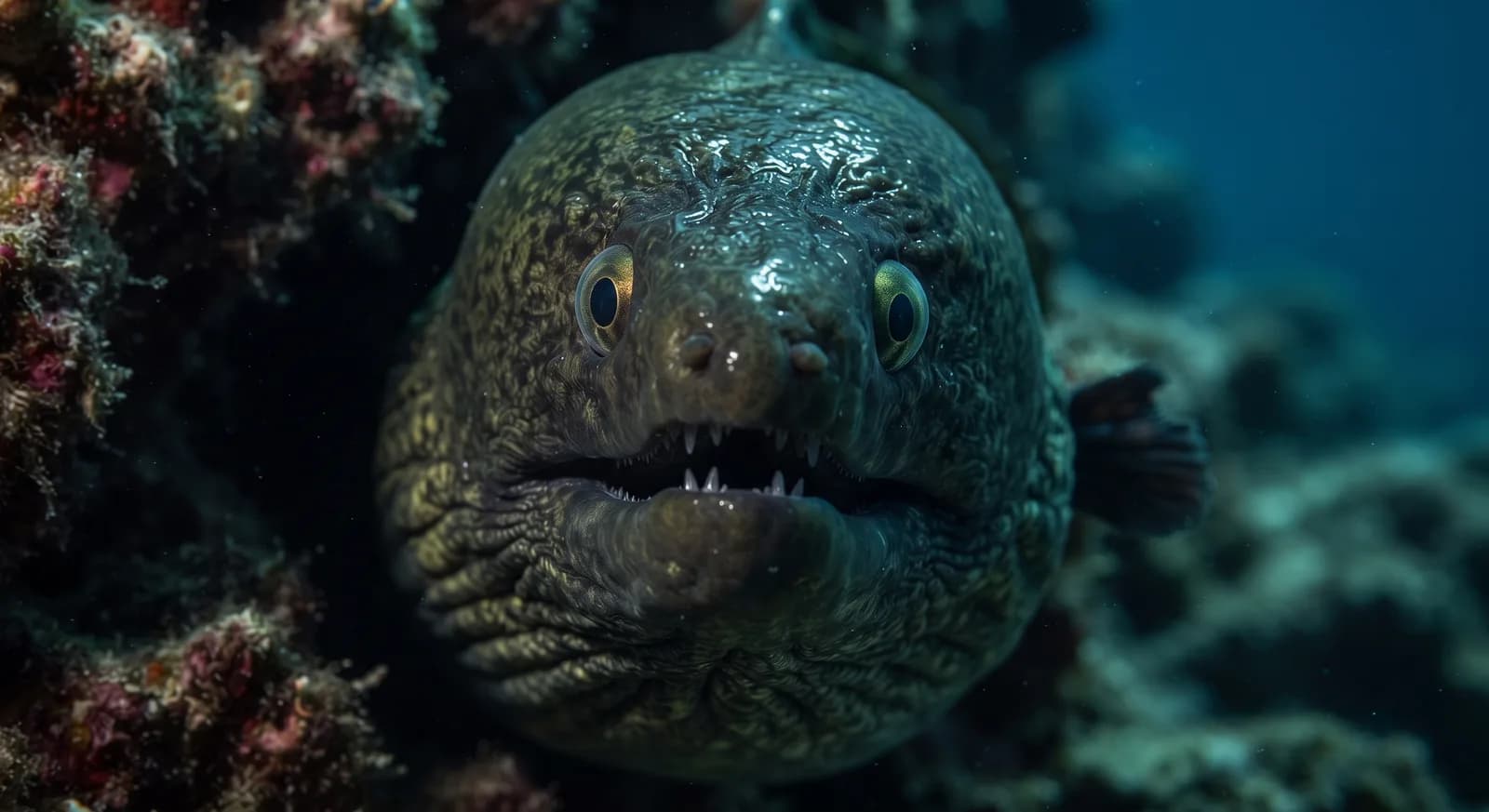
The largest of the snake eels, with individuals exceeding two metres, endemic to the Gulf of Mexico and the northern Caribbean. It lives buried in muddy and sandy bottoms, emerging at night to hunt crabs and fish.
Size
1 m – 2.1 m
Diet
Carnivore
Feeds mainly on other animals.
Activity
Nocturnal
Active mainly at night.
Social structure
Solitary
Lives and hunts alone, joining others only to breed.
Sighting difficulty
Easy
Fun facts
- It is caught occasionally in the shrimp trawl fisheries of the Gulf of Mexico, and much of what is known about it comes from that bycatch.
- Like the rest of the snake eels, it has a hard, pointed tail tip, which it uses to back into and bury itself in the sediment.
- It is the world's largest snake eel: it exceeds two metres and can top 10 kg.
- It digs backwards with its tail, which ends in a hard, finless point, and spends the day buried in the mud with only its head showing.
- Its specific name, rex, refers precisely to its size: it is the king of its family.
- It is caught mainly as bycatch in the Gulf of Mexico shrimp fishery, and its size and strength make it troublesome to handle on board.
- Despite being a large, striking species, very little is known of its reproductive biology.
Life cycle & biology
- Skeleton type
- Vertebrate - internal bony skeleton (fish)
- Habitat & environment
- Soft bottoms of the Gulf of Mexico, between 20 and 350 m
Sources consulted: https://en.wikipedia.org/wiki/King_snake_eel
Where to watch it
Parks and dive sites where this species has been documented.
Related species
Other species in the catalogue with the most in common with King Snake Eel — same habitat, park, country, tags or family.
 Least Concern
Green Moray
Gymnothorax funebris
Red Lionfish
Pterois volitans
Spot-fin Porcupinefish
Diodon hystrix
Grey Snapper
Lutjanus griseus
Cobia
Rachycentron canadum
Spotted Eagle Ray
Aetobatus narinari
Keep exploring
Based on what we already know about king snake eel.
Comments
Share an experience, a fun fact or a tip for seeing the king snake eel.
Be the first to comment.