One of the 2 morays on WAnimals
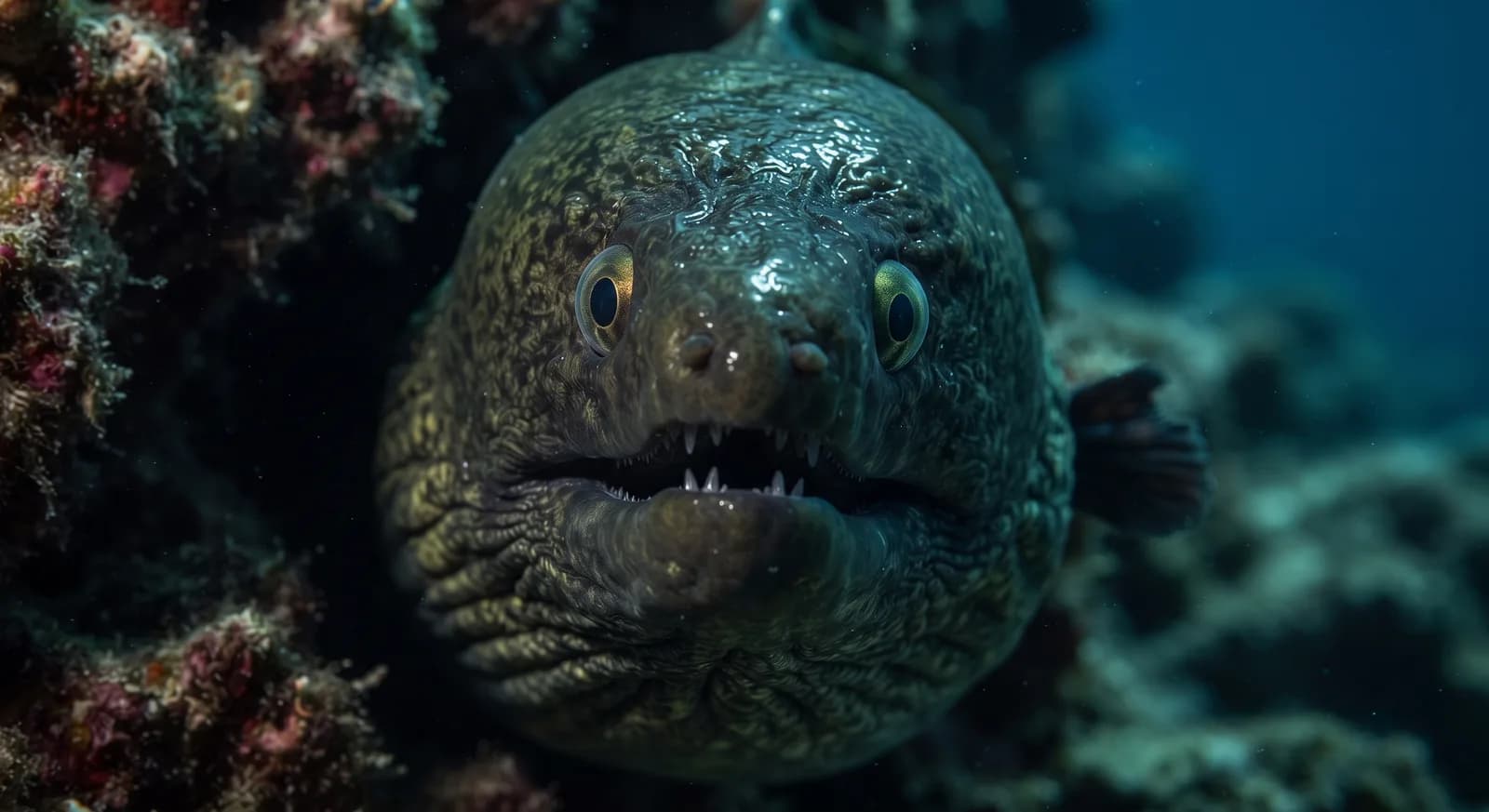
Bony fish · Anguilliformes · Muraenidae
Green Moray
Gymnothorax funebris
The species is abundant and widely distributed; it faces no significant short-term risk. See full glossary
Weight
up to 29 kg
Size
up to 2.5 m
Diet
Carnivore
Feeds mainly on other animals.
Activity
Nocturnal
Active mainly at night.
Social structure
Solitary
Lives and hunts alone, joining others only to breed.
Sighting difficulty
Easy
Fun facts
- It is the largest moray in the tropical Atlantic, with records of 2.5 m and 29 kg.
- It is not green: the skin is greyish brown and the colour comes from a yellowish mucus that coats it and protects it from parasites and bacteria.
- Acoustic tracking off Santa Cruz showed that most are nocturnal, with a mean home range of about 5.8 hectares.
- Large individuals accumulate ciguatoxin.
Life cycle & biology
- Skeleton type
- Vertebrate - internal bony skeleton (bony fish)
- Habitat & environment
- Rocky shores, reefs, mangroves and seagrass beds of the western Atlantic, between 1 and 50 m and almost always above 30 m; it shelters in crevices and small caves
Sources consulted: https://es.wikipedia.org/wiki/Gymnothorax_funebris
Where to find it
See its range on the interactive mapWhere to watch it
Parques y spots de buceo donde se ha documentado esta especie — se muestran 20 de 134 documentados.
Related species
Other species in the catalogue with the most in common with Green Moray — same habitat, park, country, tags or family.
Red Lionfish
Pterois volitans
Spot-fin Porcupinefish
Diodon hystrix
Grey Snapper
Lutjanus griseus
Black Angler
Antennarius pictus
Man-of-war Fish
Nomeus gronovii
Cobia
Rachycentron canadum
Keep exploring
Based on what we already know about green moray.
Comments
Share an experience, a fun fact or a tip for seeing the green moray.
Be the first to comment.