One of the 4 pipits on WAnimals
Birds · Passeriformes · Motacillidae
Berthelot's Pipit
Anthus berthelotii
The species is abundant and widely distributed; it faces no significant short-term risk. See full glossary
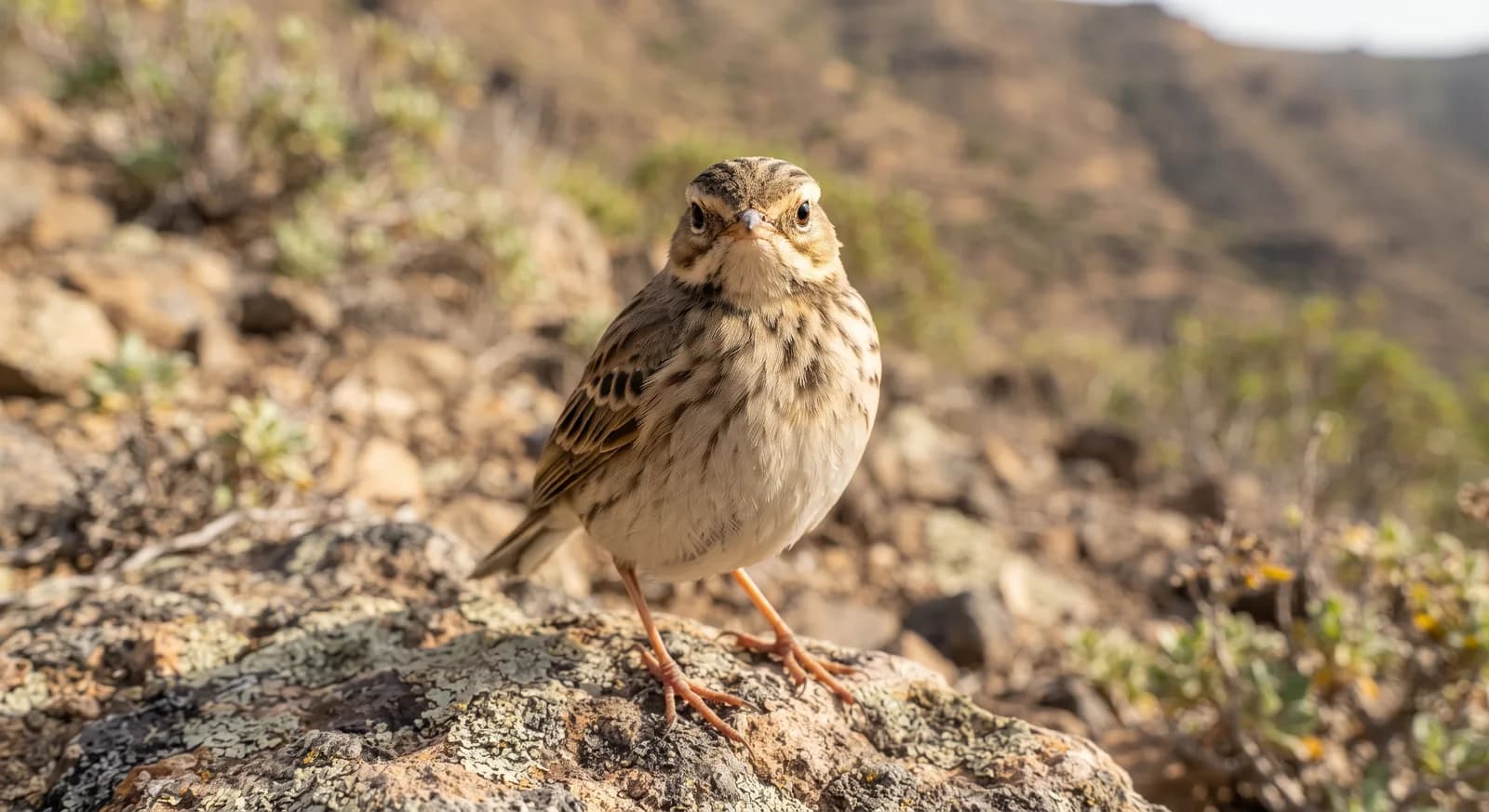
A small pipit, deliberately nondescript on the ground: grey above and whitish below, with some streaking on the breast. Like all members of the genus it is slender, cryptically plumaged and has a long tail that it wags compulsively in the manner of a wagtail.
Size
13 cm – 14 cm
Lifespan
3 years
Diet
Insectivore
Feeds mainly on insects and other invertebrates.
Activity
Diurnal
Active mainly during the day.
Social structure
In pairs
Usually lives in pairs, sometimes for life.
Sighting difficulty
Easy
Estimated population
30,000-150,000 breeding pairs in the EU-27, over a breeding area of 12,800 km²
Fun facts
- It is endemic to the Canaries and Madeira: it lives nowhere else in the world.
- Its Spanish name refers to its habit of moving along tracks and paths, where it is very easy to see despite its unobtrusive plumage.
- It was described in 1862 by the German naturalist Carl Bolle, who dedicated it to Sabin Berthelot, the French naturalist settled on Tenerife and co-author of the Histoire Naturelle des Îles Canaries.
Life cycle & biology
- Skeleton type
- Vertebrate - internal bony skeleton (bird)
- Habitat & environment
- Open country, from sea level to over 2,000 m, in every habitat except dense woodland and wetlands. In the eastern Canaries it occupies semi-desert areas of volcanic rock with sparse vegetation and other open ground such as tracks and paths; in the western islands, mountainous areas and rocky slopes. On Madeira it is found mainly in the high sierras, and also on cliffs and in fields near the sea
- Birth weight
- Altricial: born blind, naked or with sparse down and entirely dependent
- Size at birth
- Altricial: born blind, naked or with sparse down and entirely dependent
- Sexual maturity
- 1 year
- Gestation / incubation
- 13-14 days of incubation
- Litter / clutch size
- 3-5 eggs, in a nest placed on the ground
Sources consulted: IUCN Red List 2016 (e.T22718508A88185452); Informe Art. 12 de la Directiva Aves (Agencia Europea de Medio Ambiente); European Red List of Birds 2015; Palomino y Carrascal 2012; Bolle 1862, Journal für Ornithologie 10; Bernis et al. (nombres castellanos, Ardeola)
Where to find it
See its range on the interactive mapBest time: All year round: it is resident in both archipelagos
Where to watch it
Parks and dive sites where this species has been documented.
Related species
Other species in the catalogue with the most in common with Berthelot's Pipit — same habitat, park, country, tags or family.
Great Skua
Stercorarius skua
Trumpeter Finch
Bucanetes githagineus
African Blue Tit
Cyanistes teneriffae
White Wagtail
Motacilla alba
Grey Wagtail
Motacilla cinerea
Keep exploring
Based on what we already know about berthelot's pipit.
Comments
Share an experience, a fun fact or a tip for seeing the berthelot's pipit.
Be the first to comment.