Birds · Casuariiformes · Dromaiidae
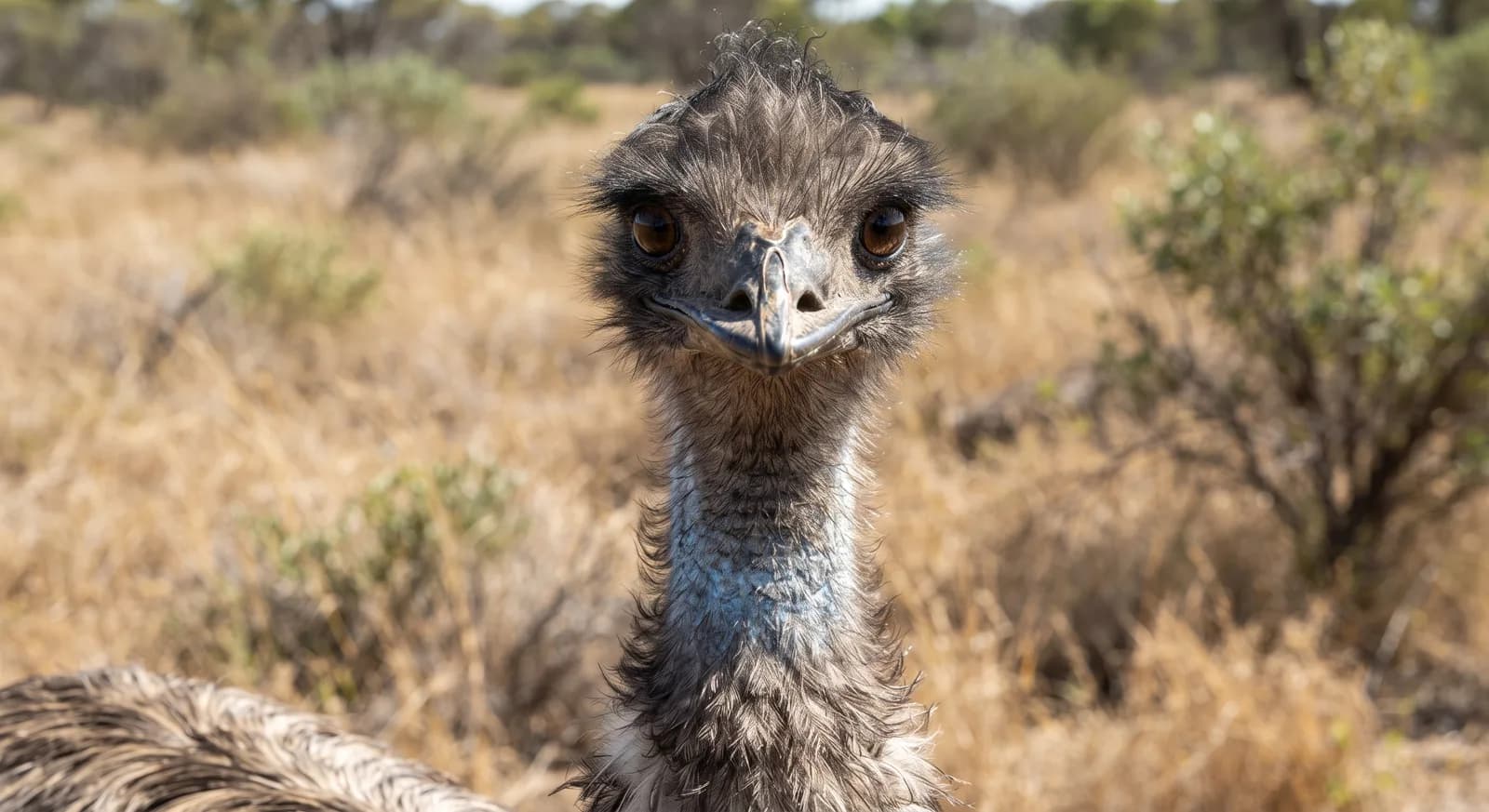
Emu
Dromaius novaehollandiae
The species is abundant and widely distributed; it faces no significant short-term risk. See full glossary
It is the second tallest bird in the world after the ostrich and one of the oldest lineages on the planet, going back 80 million years.
Weight
18 kg – 60 kg
Size
1.4 m – 1.9 m
Lifespan
7 years
Diet
Omnivore
Combines animal and plant food depending on availability.
Activity
Diurnal
Active mainly during the day.
Social structure
In pairs
Usually lives in pairs, sometimes for life.
Sighting difficulty
Easy
Fun facts
- It is the second tallest bird in the world after the ostrich.
- The male incubates the eggs alone, neither eating, drinking nor defecating throughout.
- During the 'Emu War' of 1932, the Australian army turned machine guns on flocks that were wrecking crops.
Life cycle & biology
- Skeleton type
- Vertebrate - non-pneumatised bony skeleton, flightless bird (ratite)
- Habitat & environment
- A wide range of Australian habitats: savannah, scrub, open woodland and semi-desert, avoiding dense forest and humid coasts
- Birth weight
- No precise figure for hatching weight; it multiplies its body weight some 80 times in its first 18 months
- Size at birth
- Precocial, able to walk within its first day, with the characteristic striped down
- Sexual maturity
- 2-3 years
- Gestation / incubation
- 56-60 days, incubated by the male alone, who neither eats, drinks nor defecates throughout
- Litter / clutch size
- 5 to 15 dark green eggs per clutch
- Lifespan in captivity
- Documented record of up to 35 years in captivity
Sources consulted: ScienceDirect Topics; ResearchGate (emu biology review); Encyclopedia.com; Animal Diversity Web; A-Z Animals; Animalia.bio; Wildlife Explained; PMC (pelvic limb musculature study)
Where to watch it
Parques y spots de buceo donde se ha documentado esta especie — se muestran 10 de 14 documentados.
Related species
Other species in the catalogue with the most in common with Emu — same habitat, park, country, tags or family.
Galah
Eolophus roseicapilla
Wedge-tailed Eagle
Aquila audax
Sulphur-crested Cockatoo
Cacatua galerita
Gouldian Finch
Chloebia gouldiae
Blue-winged Kookaburra
Dacelo leachii
Keep exploring
Based on what we already know about emu.
Comments
Share an experience, a fun fact or a tip for seeing the emu.
Be the first to comment.