Tardigrades · Parachela · Hypsibiidae
Freshwater Tardigrade
Hypsibius exemplaris
It has not yet been assessed against the IUCN criteria. See full glossary
A freshwater tardigrade, a microscopic animal with a plump body and eight clawed legs, which walks slowly among the particles of the sediment and pierces algal cells to suck out their contents. It is the tardigrade species most used in the laboratory.
Size
2 cm – 6 cm
Diet
Herbivore
Feeds mainly on plants.
Social structure
Solitary
Lives and hunts alone, joining others only to breed.
Sighting difficulty
Unknown
Fun facts
- Faced with drying out it enters cryptobiosis: it expels almost all its water, contracts into a tun and shuts down its metabolism, a state it can come out of years later on rehydration.
- In that state tardigrades withstand extreme temperatures, immense pressures and doses of radiation lethal to any other animal, and in 2007 several individuals survived direct exposure to the vacuum and radiation of space in an orbital experiment.
- That resilience is not a permanent superpower: an active, hydrated tardigrade is as fragile as any other microscopic animal.
- On losing water it contracts into a compact form called a tun, drops its metabolism to almost zero and can stay that way for years. This is cryptobiosis, and it is what allows it to survive almost anything.
- In that state it withstands temperatures from minus 272 to over 150 degrees, pressures of up to 7.5 gigapascals — those found 180 km down inside the Earth — and the vacuum of space.
- In 2007 the European Space Agency exposed tardigrades to vacuum and solar radiation in low orbit for ten days. Some survived: they were the first animals to withstand direct exposure to space.
- It withstands about 4,000 grays of ionising radiation. The dose that kills half the people exposed is 5.
- A 2024 study showed that this species survives not merely by shielding its DNA but by ramping up the expression of repair genes after irradiation.
- It measures about 300 micrometres and is transparent, yet it has a brain, an ovary, a gut, salivary glands and eight clawed legs.
Life cycle & biology
- Habitat & environment
- Films of water in mosses, lichens, sediments and ponds
Sources consulted: Gąsiorek et al. (2018); Jönsson et al. (2008), Current Biology; Clark-Hachtel et al. (2024), Current Biology; Hashimoto et al. (2016), Nature Communications
Related species
Other species in the catalogue with the most in common with Freshwater Tardigrade — same habitat, park, country, tags or family.
West Indian Manatee
Trichechus manatus
 Vulnerable
Amazonian Manatee
Trichechus inunguis
 Vulnerable
African Manatee
Trichechus senegalensis
 Vulnerable
Greater One-horned Rhino
Rhinoceros unicornis
 Vulnerable
Lowland Tapir
Tapirus terrestris
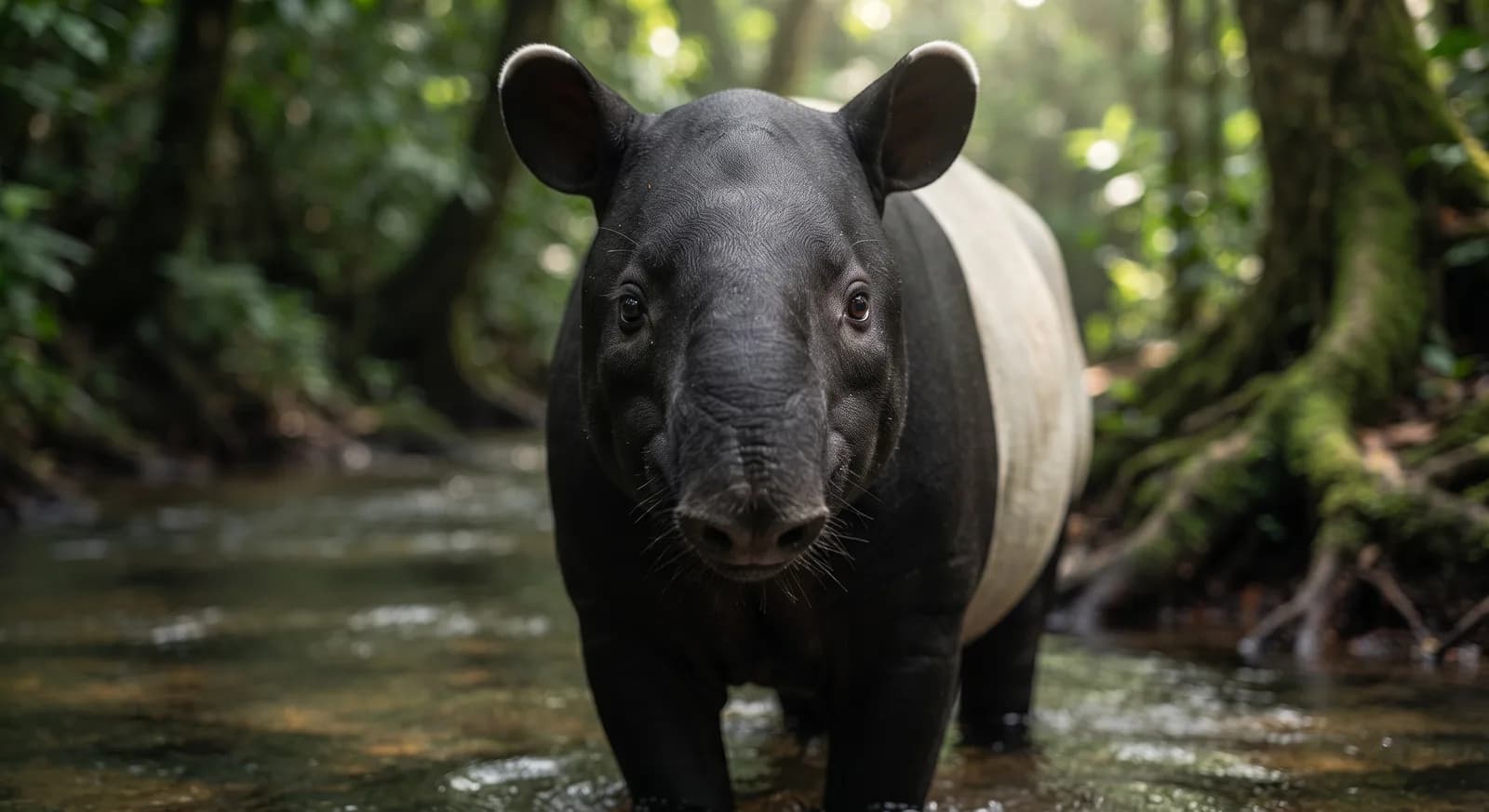 Endangered
Malayan Tapir
Tapirus indicus
Keep exploring
Based on what we already know about freshwater tardigrade.
Comments
Share an experience, a fun fact or a tip for seeing the freshwater tardigrade.
Be the first to comment.