One of the 4 manatees on WAnimals
Mammals · Sirenia · Trichechidae
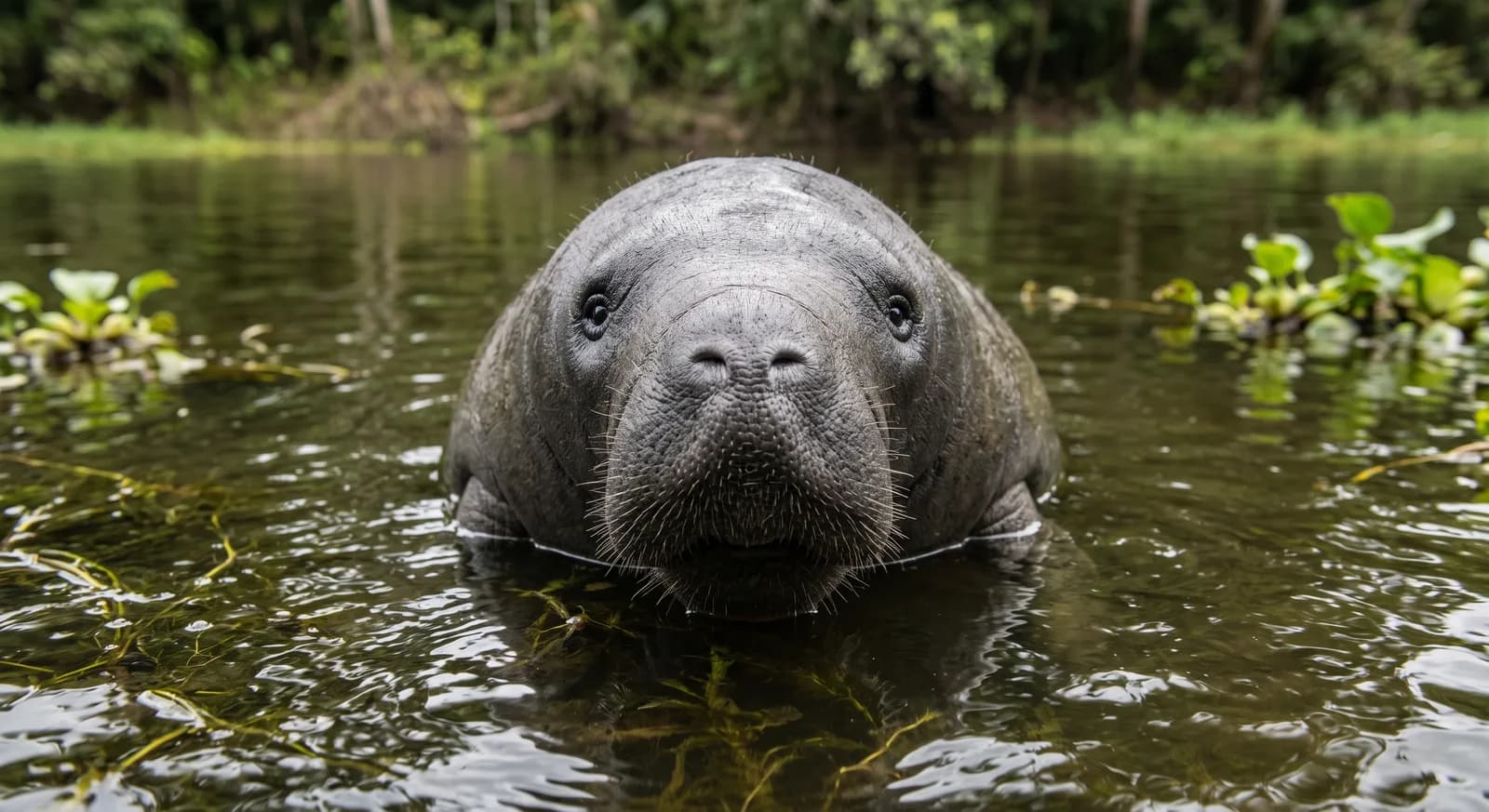
Amazonian Manatee
Trichechus inunguis
It faces a high risk of extinction in the wild over the medium term. See full glossary
The Amazonian manatee is the only sirenian that lives exclusively in fresh water and the smallest of the manatees. It is told apart by a white or pink patch on the chest and by the absence of nails on its flippers. It feeds on the aquatic plants of the flooded forests during the high-water season, and when the waters drop it is confined to deep lakes where it sometimes spends months with almost nothing to eat, living off its fat reserves. Hunting and accidental capture in nets have decimated it.
Weight
120 kg – 420 kg
Size
2.5 m – 3 m
Lifespan
30 years
Diet
Herbivore
Feeds mainly on plants.
Activity
Nocturnal
Active mainly at night.
Social structure
Solitary
Lives and hunts alone, joining others only to breed.
Sighting difficulty
Moderate
Fun facts
- distribuciónIt is the only sirenian that lives entirely in fresh water all its life, never entering the sea.
- It is the only sirenian that never enters the sea: its whole life is spent in the fresh waters of the Amazon basin.
- During the dry season it can go weeks or months with hardly any food, trapped in lakes where no vegetation is left, surviving thanks to an extremely slow metabolism and the fat built up during the floods.
Life cycle & biology
- Skeleton type
- Vertebrate - internal bony skeleton (mammal)
- Habitat & environment
- Rivers, lakes and flooded blackwater and whitewater forests of the Amazon basin
- Sexual maturity
- 3 years
- Gestation / incubation
- 10.8 months
- Litter / clutch size
- 1
Sources consulted: https://es.wikipedia.org/wiki/Trichechus_inunguis
Where to find it
See its range on the interactive mapWhere to watch it
Parks and dive sites where this species has been documented.
Related species
Other species in the catalogue with the most in common with Amazonian Manatee — same habitat, park, country, tags or family.
West Indian Manatee
Trichechus manatus
White Bald-headed Uakari
Cacajao calvus
 Vulnerable
Lowland Tapir
Tapirus terrestris
Northern Pygmy Marmoset
Cebuella pygmaea
Red-Footed Tortoise
Chelonoidis carbonarius
South American Bushmaster
Lachesis muta
How to help
The amazonian manatee is classified as vulnerable. Organizations such as UICN, WWF y Wildlife Conservation Society work specifically on its conservation and that of its habitat; looking into their programs is a good starting point if you want to get involved.
It's documented in 4 real protected areas — part of why protecting these places matters for its conservation.
Keep exploring
Based on what we already know about amazonian manatee.
Comments
Share an experience, a fun fact or a tip for seeing the amazonian manatee.
Be the first to comment.