Lagos de Ounianga
Chad · Central AfricaEighteen interconnected lakes in the middle of the Sahara, fed by a fossil aquifer and barely evaporating.
Area
628.08 km²
Declared in
2012
Region
Central Africa
Climate
Tropical, Árido / desértico
Highlight
Permanent lakes in the hyper-arid desert, fed by fossil water
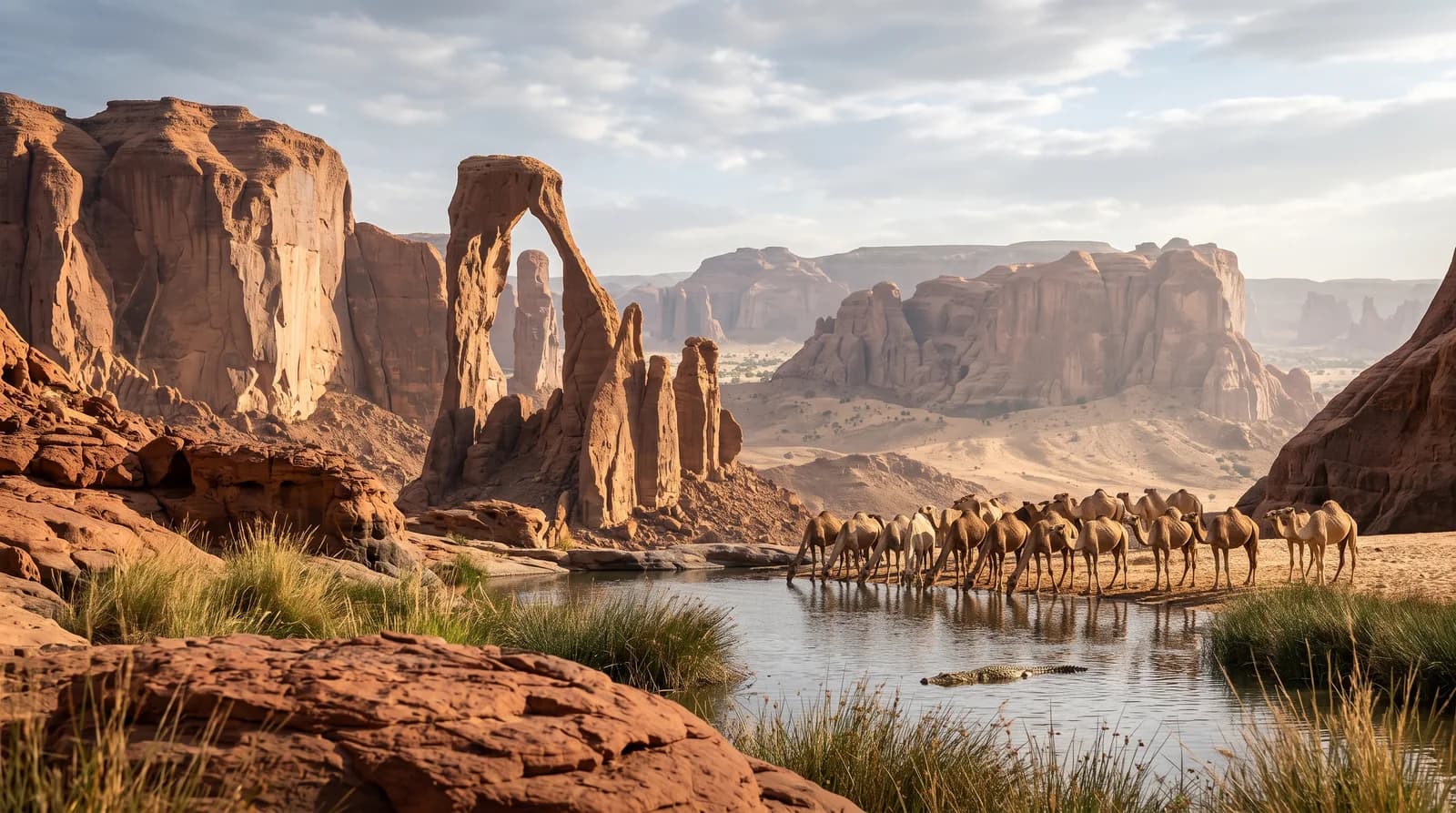
The Lakes of Ounianga were inscribed on the World Heritage List in 2012 and lie in north-eastern Chad, in the Ennedi region, deep in the Sahara.
They are eighteen permanent lakes in two groups, Ounianga Kebir and Ounianga Serir, in one of the most arid zones on the planet, with less than two millimetres of rainfall a year. Their existence is explained by a fossil aquifer: water that soaked in millennia ago, when the Sahara was green, which surfaces in these depressions and is replenished from below.
What is exceptional is how they persist. At Ounianga Serir the lakes are separated by dune ridges and connected underground, and a dense cover of reeds blankets much of the surface of some of them, drastically reducing evaporation. The result is a system in which some lakes are fresh and others hypersaline, with colours running from blue to green and red according to salinity and algae, all within a few hundred metres of one another. It is the largest system of permanent freshwater lakes in the desert and a palaeoclimatic archive of the first order on the drying of the Sahara.
Location
See on the interactive map7 species documented in Lagos de Ounianga
Cobra egipcia
Naja haje
Corredor sahariano
Cursorius cursor
Escorpión gordo de cola fina
Androctonus australis
Garcilla bueyera
Bubulcus ibis
Jerbo del desierto
Jaculus jaculus
Langosta del desierto
Schistocerca gregaria
Langosta migratoria
Locusta migratoria
Flora and ecosystems
Ecosystems found in Chad, where Lagos de Ounianga lies.
Experiences in this park
Similar parks
Which other parks are like this one?
 UNESCO
Macizo de Ennedi
Chad
Nile crocodile (a relict population in desert pools) · Barbary sheep
View parkMismo país: Chad
Península Valdés
Argentina
Southern Right Whale · Killer Whale
Octubre a marzo
View parkMismo tipo de espacio: World Heritage Site (Natural)
Reservas del Bosque Atlántico de la Costa del Descubrimiento
Brazil
Northern Muriqui · Golden-headed Lion Tamarin
Junio a octubre
View parkMismo tipo de espacio: World Heritage Site (Natural)
Keep exploring
Based on what we already know about Lagos de Ounianga.
Your rating
How many stars would you give Lagos de Ounianga?
Comments
Share your experience visiting Lagos de Ounianga, or a tip for other travellers.
Be the first to comment.