One of the 2 locusts on WAnimals
Insects · Orthoptera · Acrididae
Desert Locust
Schistocerca gregaria
It has not yet been assessed against the IUCN criteria. See full glossary
The desert locust is a caeliferan orthopteran whose plagues have threatened agricultural production in Africa, the Middle East and Asia for centuries. The quality of life of at least a tenth of the world's population is affected by this insect plague.
Size
up to 7.5 cm
Diet
Herbivore
Feeds mainly on plants.
Activity
Diurnal
Active mainly during the day.
Social structure
Colony
Lives in large concentrations, often for breeding reasons.
Sighting difficulty
Unknown
Fun facts
- The switch from the solitary to the gregarious phase is triggered by repeated physical contact on the hind legs, which sets off a surge of serotonin in the nervous system and completely changes the animal's behaviour within hours.
- A swarm can cover hundreds of square kilometres, travel more than a hundred kilometres a day and eat as much food in one day as tens of thousands of people.
- Its plagues are described in texts more than three thousand years old and still cause food emergencies in the Horn of Africa.
- It changes personality. Under normal conditions it is solitary, green and elusive; when rain concentrates the vegetation and individuals brush against one another, it transforms into the gregarious phase: it changes colour to yellow and black, becomes more active, eats more and seeks company instead of avoiding it.
- The trigger has been pinpointed precisely: repeated rubbing of the hind legs sets off a serotonin cascade that brings on the transformation in a matter of hours.
- A swarm can cover hundreds of square kilometres and contain tens of billions of individuals; a swarm of one square kilometre eats as much in a day as 35,000 people.
- The 2019-2021 plague in the Horn of Africa was the worst in decades and affected the food security of millions of people.
- They travel up to 150 km a day riding the winds, and plagues are now tracked with satellites and weather models coordinated by the FAO.
- It appears in the Book of Exodus as the eighth plague of Egypt, and locust invasions have been documented for millennia.
Life cycle & biology
- Skeleton type
- Invertebrate - chitin exoskeleton (insect)
- Habitat & environment
- Arid and semi-arid areas of Africa, the Middle East and southern Asia
Sources consulted: https://es.wikipedia.org/wiki/Schistocerca_gregaria
Where to find it
See its range on the interactive mapWhere to watch it
Parques y spots de buceo donde se ha documentado esta especie — se muestran 10 de 29 documentados.
Related species
Other species in the catalogue with the most in common with Desert Locust — same habitat, park, country, tags or family.
Migratory Locust
Locusta migratoria
Bush Hyrax
Heterohyrax brucei
Barbary Ground Squirrel
Atlantoxerus getulus
Field Grasshopper
Chorthippus brunneus
Naked Mole Rat
Heterocephalus glaber
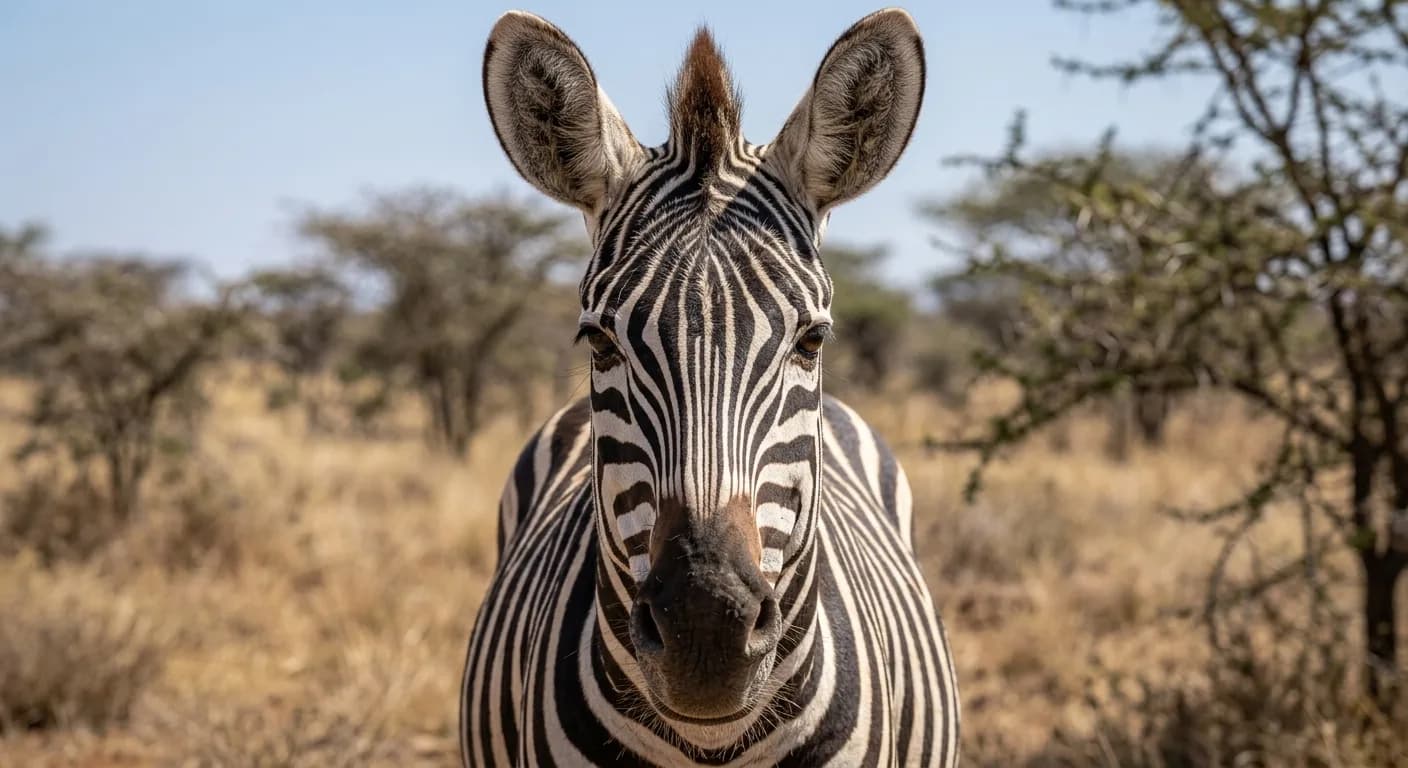 Endangered
Grevy's Zebra
Equus grevyi
Keep exploring
Based on what we already know about desert locust.
Comments
Share an experience, a fun fact or a tip for seeing the desert locust.
Be the first to comment.