Skip to content
WAnimals
  • Map
  • Species
  • Parks
  • Diving
Log inCreate account
WAnimals

The guide for travellers and animal lovers: discover, plan and share your wild adventures around the world.

Discover wildlife

  • Species
  • Ecosystems
  • Glossary
  • Tags

Explore places

  • Map
  • Countries
  • Parks
  • Diving

Plan experiences

  • Guides

Learn

  • Blog

Resources

  • About us
  • How we build our profiles
  • Help centre
  • Contact
  • Install the app

Follow us

Account

  • Log in
  • Create account

© 2026 WAnimals. All rights reserved.

Terms of servicePrivacyCookiesLegal notice
MapSpeciesParksDiving
  1. Home
  2. Species
  3. Blue Emperor

One of the 15 butterflies on WAnimals
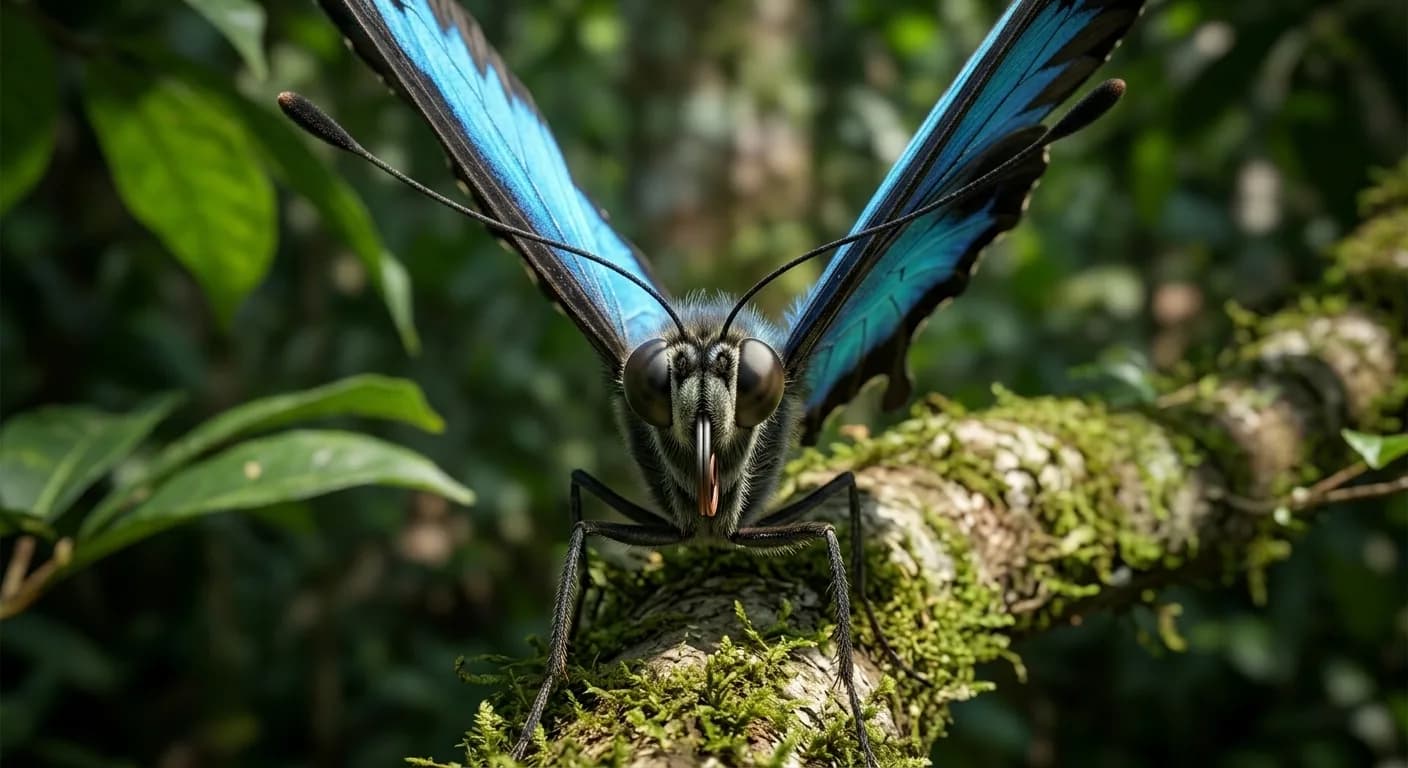
Blue Emperor (Papilio ulysses)

Insects · Lepidoptera · Papilionidae

Blue Emperor

Papilio ulysses

Not Evaluated

It has not yet been assessed against the IUCN criteria.

Spotted something wrong?

The blue emperor, also known as the Ulysses butterfly or the blue mountain butterfly, is a ditrysian lepidopteran of the family Papilionidae native to north-eastern Australia, New Guinea, the Moluccas and nearby islands. This butterfly is the tourism emblem of Queensland.

Size

10 cm – 14 cm

Life expectancy

1 year

Diet

Herbivore

Feeds mainly on plants.
Activity

Diurnal

Active mainly during the day.

Social structure

Solitary

Lives and hunts alone, joining others only to breed.

Rainforest
4countries12parks5same family

AI-generated images: illustrations, not photographs.

Fun facts

  • GeneralIts deep blue shows from 30 m away; it is a tourist emblem of Queensland.
  • The electric blue is not a pigment: it is produced by the microstructure of the scales, a structural colour. At rest, with its wings closed, it shows only the dull brown of the underside and vanishes into the landscape.
  • Males are territorial and are drawn to blue: they fly at blue objects, including tourists' T-shirts and caps, mistaking them for rivals or females.
  • The female is told apart by blue lunules on the trailing edge of the hindwings, where the male has only black.
  • The caterpillar has an osmeterium, a retractable orange organ behind the head that it everts to release a repellent smell.
  • Systematic replanting of Melicope elleryana in Australia helped its populations recover; it is protected in Queensland, where it is used as a tourism emblem.

Life cycle and biology

Skeleton type
Invertebrate - chitin exoskeleton (insect)
Habitat and environment
Tropical rainforest and coastal gardens
Size at birth
Spherical egg of about 1 mm across, which darkens before hatching
Sexual maturity
The males patrol sunlit clearings and forest edges and defend particular perches; the iridescent blue is a structural colour, not a pigment
Gestation / incubation
Development from egg to adult takes 4 to 5 weeks in warm conditions and lengthens to one or two months in cooler climates; the green chrysalis measures about 4 cm and hangs from the food plant
Litter / clutch size
Spherical pale eggs laid one by one on the upper surface of the young leaves of the food plant; the female prefers low trees, up to about 2 metres

Sources consulted: Wikipedia (es): Papilio ulysses · Fichas de identificacion de Papilio ulysses · Recopilaciones de biologia de Papilio ulysses · fichas de identificacion · Ficha de especie de Papilio ulysses · Common & Waterhouse 1981 via recopilaciones · Fichas de especie de Papilio ulysses

Where to find it

Loading map…

The pins mark the parks where its presence is documented.

Where to see it

Parks and dive sites where this species has been documented — showing 10 of 12.

Related species

Other species in the catalogue with the most in common with Blue Emperor — same habitat, park, country, tags or family.

Same taxonomic family
Shares a park
Shares a park
Same taxonomic family
Shares a park
Shares a park

Keep exploring

Based on what we already know about blue emperor.

Share an experience, a fun fact or a tip for seeing the blue emperor.
See full glossary
This page in other languages: Español · Deutsch · Français · Português · Italiano
See its range on the interactive map→
LorentzIndonesia
DaintreeAustralia
K'gari (Fraser Island)Australia
LamingtonAustralia
East RennellSolomon Islands
Kokoda TrackPapua New Guinea
SpringbrookAustralia
Border RangesAustralia
EungellaAustralia
WasurIndonesia
See all 12 parks
Endangered

Queen Alexandra's Birdwing

Ornithoptera alexandrae

Near Threatened

Dwarf Cassowary

Casuarius bennetti

Least Concern

Regent Bowerbird

Sericulus chrysocephalus

SwallowtailLeast Concern

Swallowtail

Papilio machaon

Near Threatened

Lumholtz's Tree Kangaroo

Dendrolagus lumholtzi

Least Concern

Common Phalanger

Phalanger orientalis

CountriesAustralia
ParksLorentzIndonesia
TagsHerbivore
Herbivore
Diurnal
Solitary
Insect
Rainforest
Australia
Indonesia
Papua New Guinea
Solomon Islands