Skip to content
WAnimals
  • Map
  • Species
  • Parks
  • Diving
Log inCreate account
WAnimals

The guide for travellers and animal lovers: discover, plan and share your wild adventures around the world.

Discover wildlife

  • Species
  • Ecosystems
  • Glossary
  • Tags

Explore places

  • Map
  • Countries
  • Parks
  • Diving

Plan experiences

  • Guides

Learn

  • Blog

Resources

  • Help centre
  • Contact
  • Install the app

Follow us

Account

  • Log in
  • Create account

© 2026 WAnimals. All rights reserved.

About usHow we build our profilesTerms of servicePrivacyLegal notice
MapSpeciesParksDiving
  1. Home
  2. Species
  3. Swallowtail
Swallowtail (Papilio machaon)

Insects · Lepidoptera · Papilionidae

Swallowtail

Papilio machaon

Least Concern

The species is abundant and widely distributed; it faces no significant short-term risk.

Spotted something wrong?

It is the type species of the genus Papilio and one of the largest butterflies in Europe, used as the taxonomic reference for classifying every other species in the group.

Size

6.5 cm – 10 cm

Life expectancy

1 year

Diet

Herbivore

Feeds mainly on plants.

Activity

Diurnal

Active mainly during the day.

Social structure

Solitary

Lives and hunts alone, joining others only to breed.

Sighting difficulty

Easy

Grassland
84countries211parks5same family

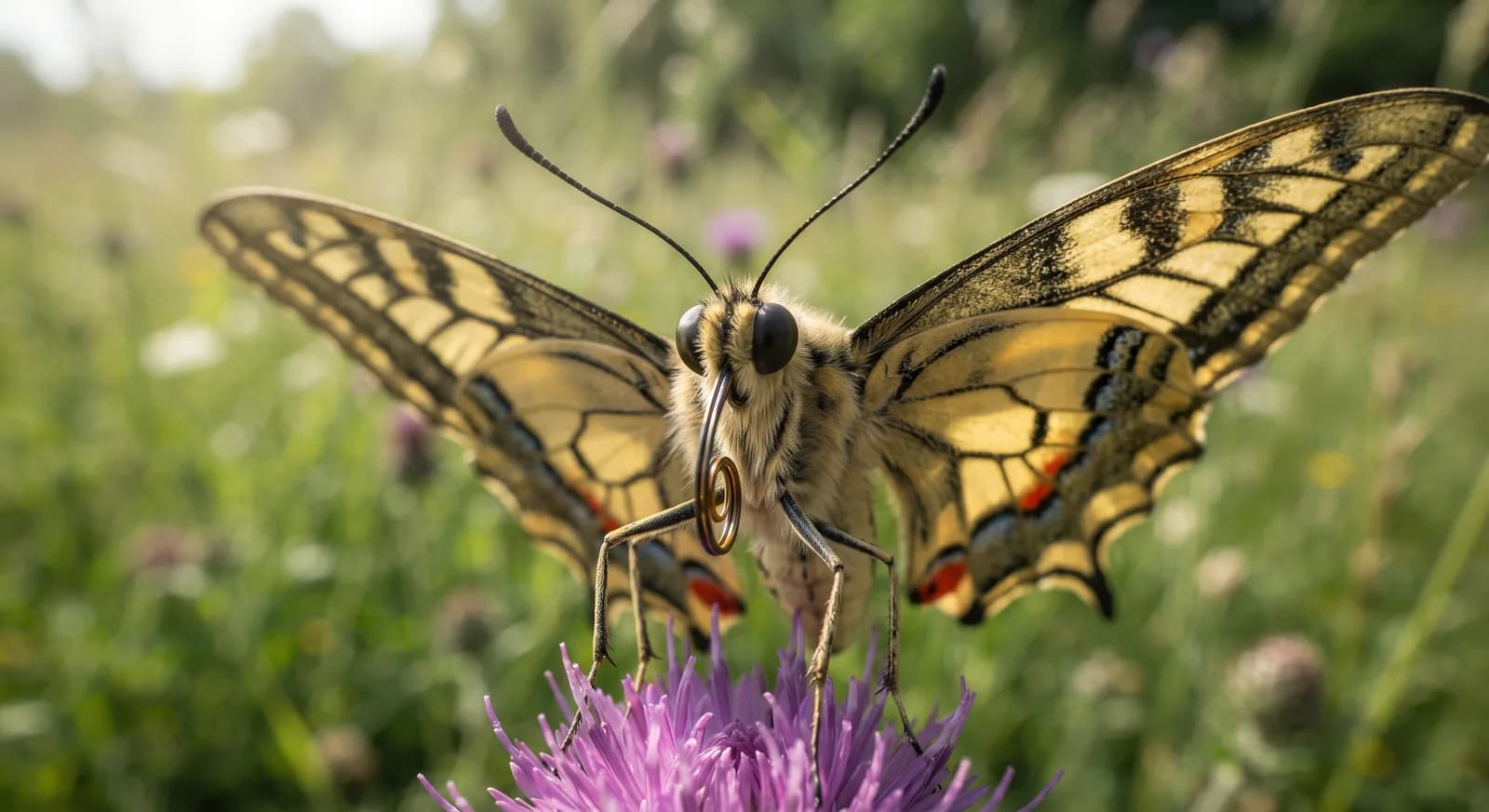
AI-generated images: illustrations, not photographs.

Fun facts

  • Its caterpillar defends itself with an osmeterium, a forked gland that squirts a foul-smelling fluid.
  • The caterpillar feeds on plants such as fennel, wild carrot and parsley.
  • The adult sips nectar from a wide range of flowers.
  • defensaIts caterpillars can push out a fleshy, foul-smelling structure (the osmeterium) from behind the head to fend off predators.
  • The caterpillar has an osmeterium: a forked orange organ that it flicks out suddenly behind its head, like the horns of a slug, and which releases an acrid, repellent smell.
  • It practises hilltopping: males gather on the tops of hills and mountains, where they defend prominent positions and wait for the females. It is an encounter strategy in low-density species, where searching for one another at random would be inefficient.
  • The caterpillar changes appearance completely as it grows: young ones are black with a white band and imitate a bird dropping, while older ones are green with black bands and orange spots.
  • The chrysalis is held to the stem by a silk girdle, and its colour depends on the substrate: green if it will not last long, brown if it is going to overwinter.
  • It is one of the largest and most striking butterflies in Europe, and in the United Kingdom it is restricted to the wetlands of Norfolk.

Life cycle and biology

Skeleton type
Invertebrate - chitin exoskeleton
Habitat and environment
Open meadows, gardens and herb-rich ground across Europe, Asia and North America (from the Arctic to Alaska)
Birth weight
A tiny spherical yellowish egg, laid singly on host plants
Size at birth
A tiny egg 1-2 mm across
Sexual maturity
The adult emerges already sexually mature and ready to breed
Gestation / incubation
1-2 weeks of egg development; 3-4 weeks as a caterpillar; 2-3 weeks as a chrysalis (or the whole winter if it overwinters at that stage)
Litter / clutch size
Eggs laid singly, in numbers that vary from female to female

Sources consulted: Swallowtail and Birdwing Butterfly Trust; Butterfly Boogie; Butterflies and Moths of North America; Plantiary; First Nature; Buy-Butterflies.com; Butterfly Identification

Where to find it

Loading map…

Where to see it

Parks and dive sites where this species has been documented — showing 10 of 211.

Related species

Other species in the catalogue with the most in common with Swallowtail — same habitat, park, country, tags or family.

Same taxonomic family
Shares a park
Shares a park
Shares a park
Shares a park

Keep exploring

Based on what we already know about swallowtail.

Comments

Share an experience, a fun fact or a tip for seeing the swallowtail.

Be the first to comment.

See full glossary
This page in other languages: Español · Deutsch · Français · Português · Italiano

The pins mark the parks where its presence is documented.

See its range on the interactive map→
SarekSweden
PadjelantaSweden
JotunheimenNorway
HardangerviddaNorway
Pallas-YllastunturiFinland
Urho KekkonenFinland
Swiss National ParkSwitzerland
Gran ParadisoItaly
VanoiseFrance
Hohe TauernAustria
See all 211 parks
Not Evaluated

Iberian Scarce Swallowtail

Iphiclides feisthamelii

ApolloLeast Concern

Apollo

Parnassius apollo

PeacockLeast Concern

Peacock

Aglais io

Large WhiteLeast Concern

Large White

Pieris brassicae

Praying MantisLeast Concern

Praying Mantis

Mantis religiosa

Least Concern

Conehead Mantis

Empusa pennata

CountriesPoland
ParksSarekSweden
TagsHerbivore
Herbivore
Diurnal
Solitary
Insect
Grassland

Europe46

Asia20

South America7

Africa6

North America3

Oceania2

Poland
Spain
Finland
Norway
Italy
Sweden
Albania
Andorra
Austria
Belarus
Belgium
Bosnia and Herzegovina
Bulgaria
Croatia
Cyprus
Czechia
Denmark
Estonia
Finland
France
Germany
Gibraltar
Greece
Hungary
Iceland
Ireland
Italy
Kosovo
Latvia
Liechtenstein
Lithuania
Luxembourg
Malta
Moldova
Monaco
Montenegro
Netherlands
North Macedonia
Norway
Poland
Portugal
Romania
San Marino
Serbia
Slovakia
Slovenia
Spain
Sweden
Switzerland
Ukraine
United Kingdom
Vatican City
Armenia
Azerbaijan
China
Georgia
India
Iran
Iraq
Israel
Japan
Jordan
Kazakhstan
Lebanon
Mongolia
Palestine
Russia
Saudi Arabia
South Korea
Syria
Türkiye
Uzbekistan
Argentina
Brazil
Chile
Colombia
Ecuador
Peru
Uruguay
Algeria
Egypt
Libya
Morocco
South Africa
Tunisia
Canada
Mexico
United States
Australia
New Zealand