Skip to content
WAnimals
  • Map
  • Species
  • Parks
  • Diving
Log inCreate account
WAnimals

The guide for travellers and animal lovers: discover, plan and share your wild adventures around the world.

Discover wildlife

  • Species
  • Ecosystems
  • Glossary
  • Tags

Explore places

  • Map
  • Countries
  • Parks
  • Diving

Plan experiences

  • Guides

Learn

  • Blog

Resources

  • Help centre
  • Contact
  • Install the app

Follow us

Account

  • Log in
  • Create account

© 2026 WAnimals. All rights reserved.

About usHow we build our profilesTerms of servicePrivacyLegal notice
MapSpeciesParksDiving
  1. Home
  2. Species
  3. Dwarf Cassowary

One of the 2 cassowaries on WAnimals

Birds · Casuariiformes · Casuariidae

Dwarf Cassowary

Casuarius bennetti

Near Threatened

It could become threatened in the near future if current threats go unchecked.

Spotted something wrong?

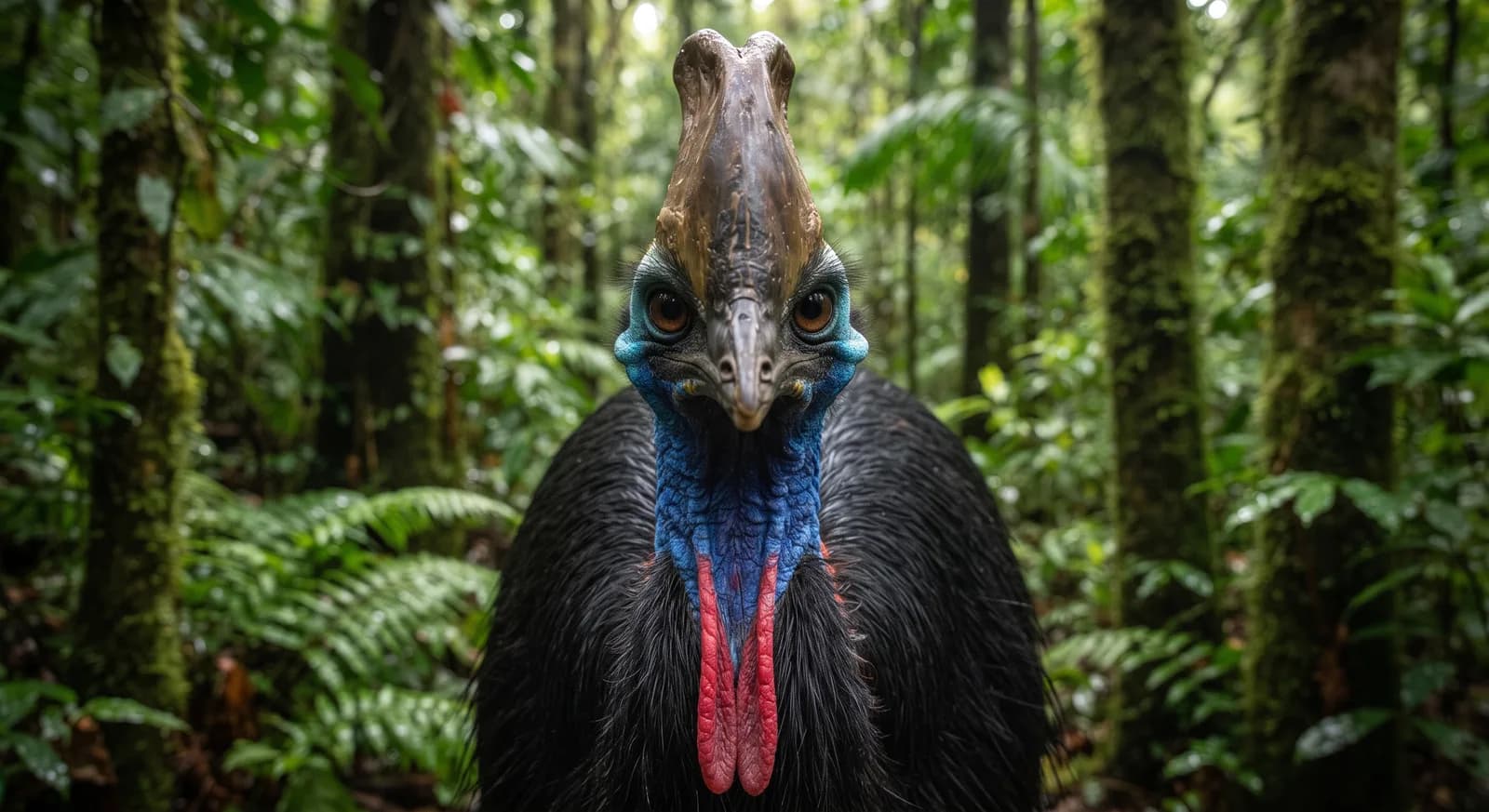
The dwarf cassowary, or Bennett's cassowary, is the smallest of the three cassowaries and the one that lives at the highest altitude. It is black with blue and red neck skin and a low, triangular horny casque on the head. Like its relatives it has an inner claw shaped like a dagger that can be more than ten centimetres long. The male incubates alone and raises the chicks for almost a year.

Weight

17 kg – 26 kg

Size

99 cm – 1.5 m

Life expectancy

40 years

Diet

Herbivore

Feeds mainly on plants.

Activity

Diurnal

Active mainly during the day.

Social structure

Solitary

Lives and hunts alone, joining others only to breed.

Sighting difficulty

Moderate

RainforestMountain
2countries3parks1same family

Fun facts

  • Its inner claw is a real weapon: a horny dagger more than ten centimetres long with which it can open up a predator in a single kick, and cassowaries are regarded as among the most dangerous birds in the world.
  • It is probably the bird with the oldest documented relationship with humans outside classical domestication: there is archaeological evidence that its eggs were being collected and reared in New Guinea more than 18,000 years ago.
  • The male does everything: he incubates for almost two months and then raises the chicks alone for nine months, while the female mates with other males.

Life cycle and biology

Skeleton type
Vertebrate - internal bony skeleton (bird)
Habitat and environment
Montane forest of New Guinea, between 500 and 3,300 metres in altitude
Sexual maturity
4 years
Gestation / incubation
50 days of incubation
Litter / clutch size
4 eggs

Sources consulted: https://es.wikipedia.org/wiki/Casuarius_bennetti

Where to find it

Loading map…

The pins mark the parks where its presence is documented.

Where to see it

Parks and dive sites where this species has been documented.

Related species

Other species in the catalogue with the most in common with Dwarf Cassowary — same habitat, park, country, tags or family.

Same taxonomic family
Shares a park
Shares a park
Shares a park
Shares a park
Shares a park

Keep exploring

Based on what we already know about dwarf cassowary.

Comments

Share an experience, a fun fact or a tip for seeing the dwarf cassowary.

Be the first to comment.

See full glossary
This page in other languages: Español · Deutsch · Français · Português · Italiano
See its range on the interactive map→
LorentzIndonesia
Kokoda TrackPapua New Guinea
VarirataPapua New Guinea
Southern CassowaryEndangered

Southern Cassowary

Casuarius casuarius

Near Threatened

Nicobar Pigeon

Caloenas nicobarica

Near Threatened

Palm Cockatoo

Probosciger aterrimus

Endangered

Queen Alexandra's Birdwing

Ornithoptera alexandrae

Least Concern

Western Superb Bird-of-Paradise

Lophorina superba

Least Concern

Moluccan Eclectus

Eclectus roratus

CountriesPapua New Guinea
ParksLorentzIndonesia
TagsHerbivore
Herbivore
Diurnal
Solitary
Near Threatened
Bird
Rainforest
Mountain
Papua New Guinea
Indonesia