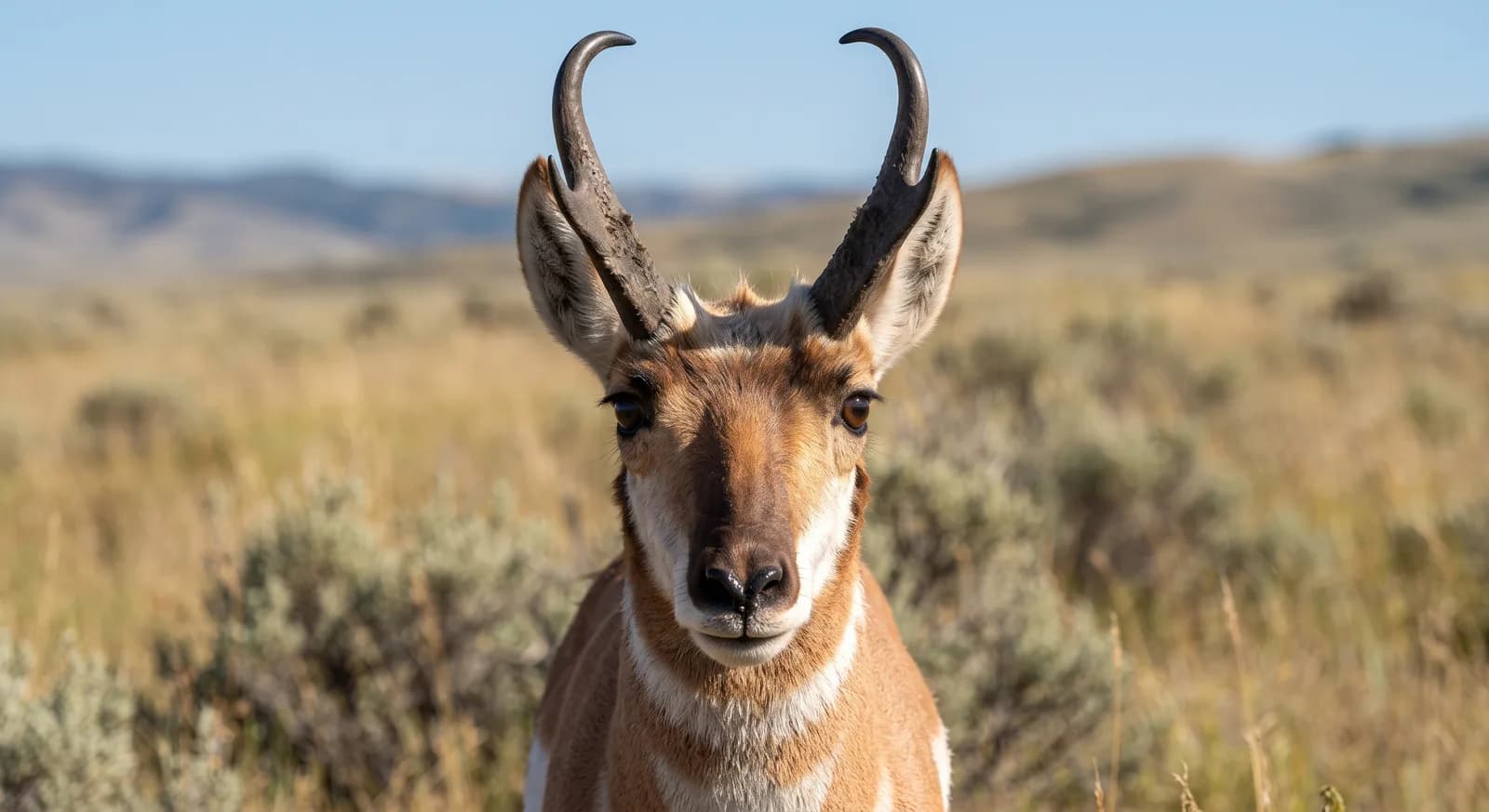
Mammals · Artiodactyla · Antilocapridae
Pronghorn
Antilocapra americana
The species is abundant and widely distributed; it faces no significant short-term risk. See full glossary
It is the fastest land mammal in North America and the second fastest in the world, able to hold speeds of up to 88 km/h.
Weight
40 kg – 59 kg
Size
1.3 m – 1.5 m
Lifespan
10 years
Diet
Herbivore
Feeds mainly on plants.
Activity
Diurnal
Active mainly during the day.
Social structure
Herd
Lives in large groups as a strategy against predators.
Sighting difficulty
Easy
Fun facts
- It is the only animal with branched horns that it sheds every year.
- Its numbers fell by 99%, from more than 35 million animals originally to a remnant by the early 20th century.
- It eats grasses, shrubs and cactus according to the season.
- locomociónIt is not a true antelope but the sole surviving member of an exclusively North American family, and it is the fastest land mammal in the Americas, able to hold high speeds over long distances.
Life cycle & biology
- Skeleton type
- Vertebrate - internal bony skeleton (mammal)
- Habitat & environment
- Grassland, scrub and temperate desert of western North America
- Birth weight
- 2-4 kg at birth (most commonly ~3 kg)
- Size at birth
- 2-4 kg at birth
- Sexual maturity
- ~15-16 months
- Gestation / incubation
- 235-252 days (~8 months)
- Litter / clutch size
- 1 young at the first birth, twins thereafter
- Lifespan in captivity
- Documented record of up to 14 years
Sources consulted: SDZWA Fact Sheet (Physical Characteristics); SDZWA Fact Sheet (Summary); Animal Diversity Web; Animalia.bio; EWASH; Britannica; Texas Tech NSRL Mammals of Texas; EBSCO Research Starters; Destination4x4
Where to watch it
Parks and dive sites where this species has been documented.
Related species
Other species in the catalogue with the most in common with Pronghorn — same habitat, park, country, tags or family.
 Least Concern
Black-tailed Prairie Dog
Cynomys ludovicianus
Ord's Kangaroo Rat
Dipodomys ordii
Mourning Dove
Zenaida macroura
Woodchuck
Marmota monax
Bighorn Sheep
Ovis canadensis
Roosevelt Elk
Cervus canadensis
Keep exploring
Based on what we already know about pronghorn.
Comments
Share an experience, a fun fact or a tip for seeing the pronghorn.
Be the first to comment.