One of the 4 storks on WAnimals
Birds · Ciconiiformes · Ciconiidae
Oriental Stork
Ciconia boyciana
It faces a very high risk of extinction in the wild in the near future. See full glossary
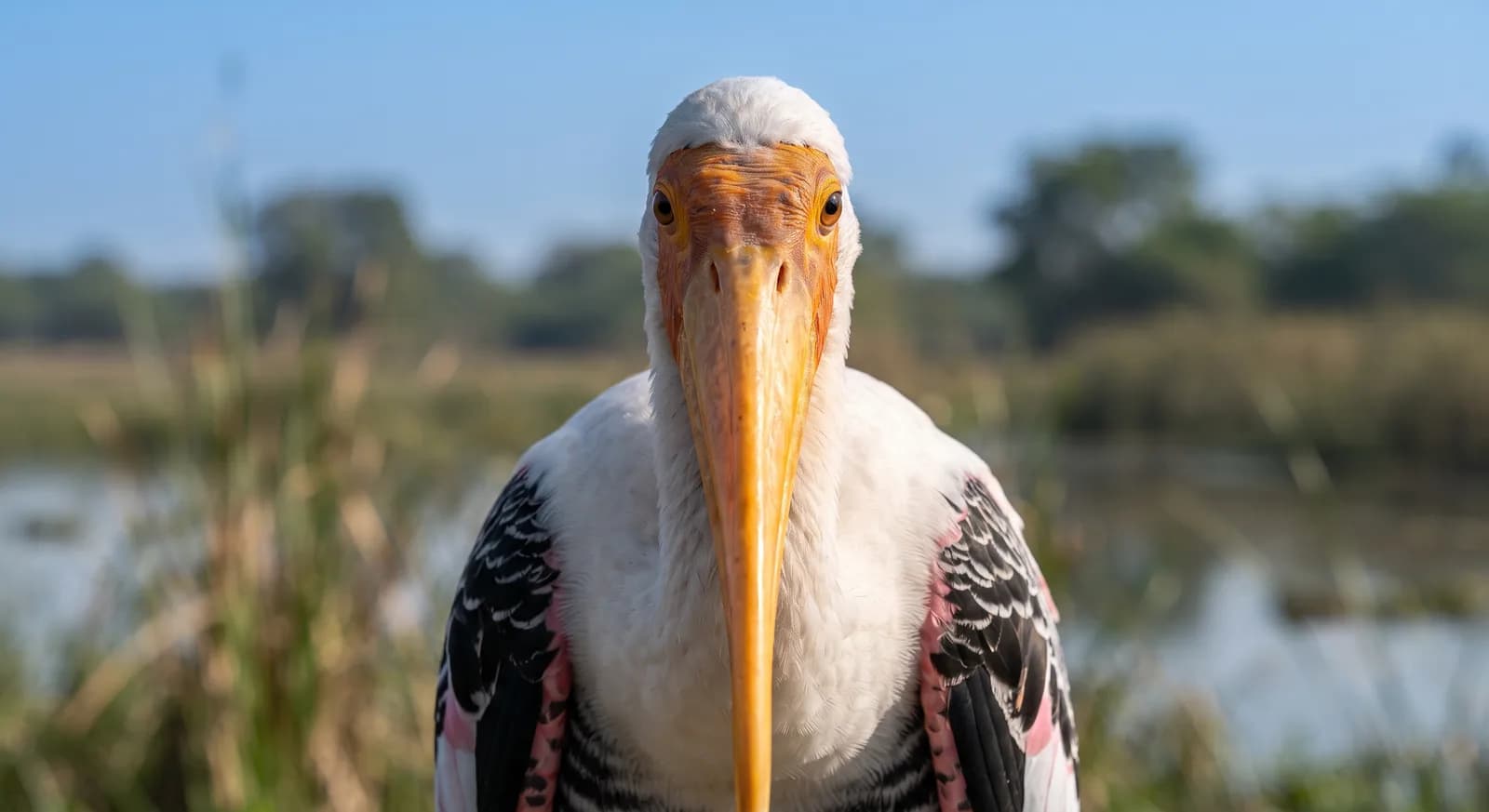
A large white stork with black flight feathers, bigger than the European white stork. It is told apart from that species by the bare skin around the eye being red, the iris whitish and the bill black instead of red. Juveniles are white with an orange bill.
Weight
2.8 kg – 5.9 kg
Diet
Piscivore
Feeds mainly on fish.
Activity
Diurnal
Active mainly during the day.
Social structure
In pairs
Usually lives in pairs, sometimes for life.
Sighting difficulty
Hard
Estimated population
A very small population
Fun facts
- It used to be treated as a subspecies of the European white stork, which is today considered its closest relative.
- Satellite tracking was decisive in discovering its migratory stopover areas, until then unknown.
- In Japan it is known as the konotori and has been the subject of reintroduction programmes after its local extinction.
Life cycle & biology
- Skeleton type
- Vertebrate - internal bony skeleton (bird)
- Habitat & environment
- Temperate woodland and wetlands. It nests in the tops of tall trees and on artificial structures such as electricity poles. It feeds in shallow open water, wetlands and occasionally coastal marshes
- Birth weight
- 73 g at hatching
- Size at birth
- The chicks fly at around 61 days
- Sexual maturity
- 3.5 years
- Gestation / incubation
- About 33 days of incubation
- Litter / clutch size
- 4 eggs, with a single clutch a year
Sources consulted: IUCN Red List (BirdLife International, ficha Ciconia boyciana); Van den Bossche et al. 2001 (seguimiento por satélite); BirdLife International 2001
Where to find it
See its range on the interactive mapBest time: It breeds in summer in the Amur and Ussuri basins; it winters on the lower Yangtze and in southern China
Where to watch it
Parks and dive sites where this species has been documented.
Related species
Other species in the catalogue with the most in common with Oriental Stork — same habitat, park, country, tags or family.
Blakiston's Eagle-owl
Bubo blakistoni
 Near Threatened
Painted Stork
Mycteria leucocephala
Mandarin Duck
Aix galericulata
Red-crowned Crane
Grus japonensis
Steller's Sea Eagle
Haliaeetus pelagicus
Siberian Crane
Leucogeranus leucogeranus
How to help
The oriental stork is classified as endangered. Organizations such as UICN, WWF y Wildlife Conservation Society work specifically on its conservation and that of its habitat; looking into their programs is a good starting point if you want to get involved.
It's documented in 5 real protected areas — part of why protecting these places matters for its conservation.
Keep exploring
Based on what we already know about oriental stork.
Comments
Share an experience, a fun fact or a tip for seeing the oriental stork.
Be the first to comment.