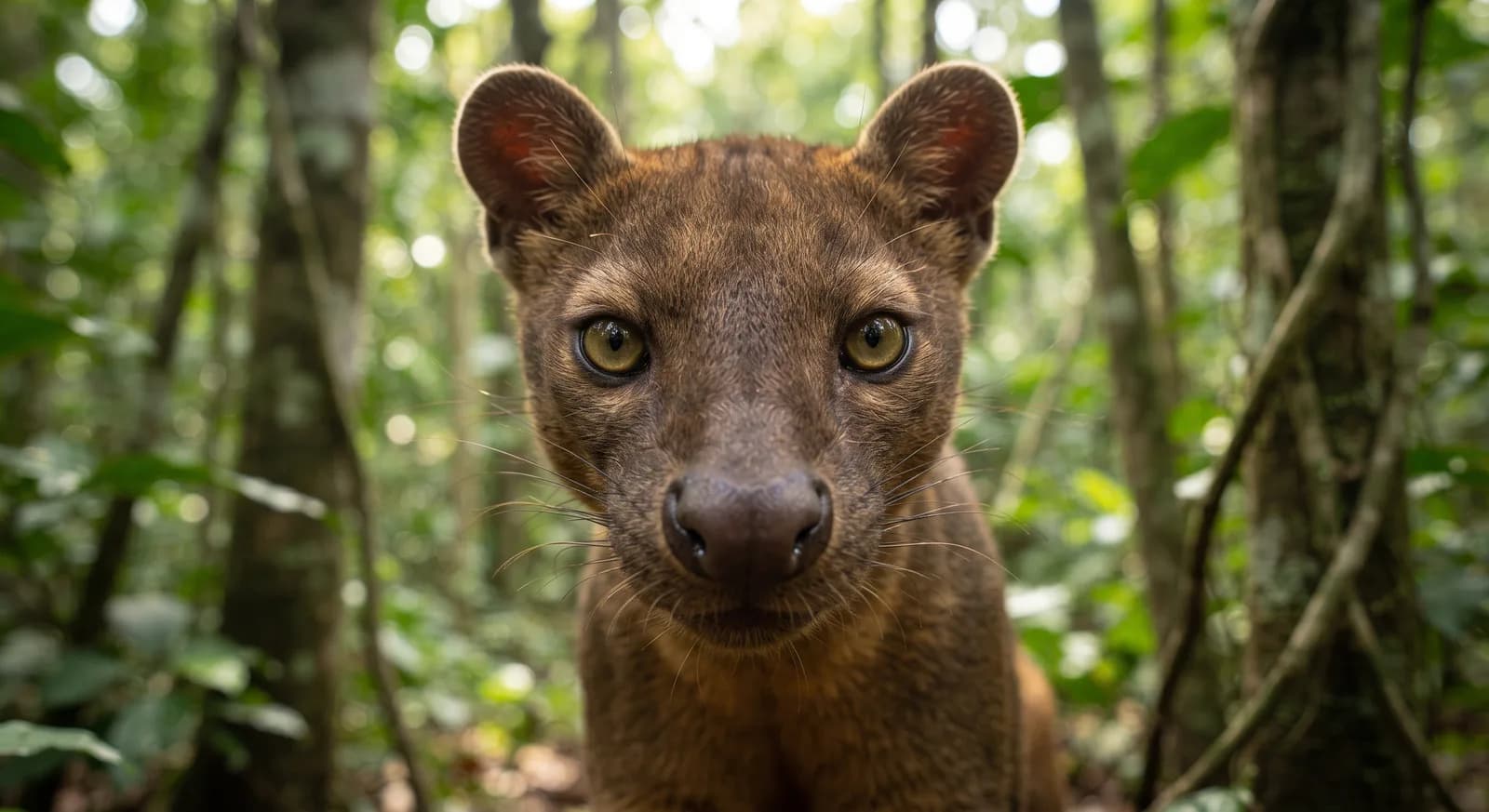
Mammals · Carnivora · Eupleridae
Fossa
Cryptoprocta ferox
It faces a high risk of extinction in the wild over the medium term. See full glossary
It is the largest land predator in Madagascar and the main natural check on the island's lemur populations. Its mating, which can last up to 165 minutes, takes place in traditional 'mating trees'.
Weight
5.5 kg – 12 kg
Size
61 cm – 80 cm
Lifespan
15 years
Diet
Carnivore
Feeds mainly on other animals.
Activity
Irregular activity
Active at irregular times, by day or night depending on circumstances.
Social structure
Solitary
Lives and hunts alone, joining others only to breed.
Sighting difficulty
Moderate
Fun facts
- taxonomíaIt is Madagascar's largest native predator, looking like something between a cat and a small puma, though it is more closely related to mongooses and civets.
- reproducciónFemales may mate with several males over long spells in the same tree, an unusual breeding behaviour among carnivores recorded in several wild populations.
Life cycle & biology
- Skeleton type
- Vertebrate - internal bony skeleton (mammal)
- Habitat & environment
- Tropical forest of Madagascar, both wet and dry, the species' only habitat in the world
- Birth weight
- 100 grams
- Size at birth
- Blind, toothless and with fine grey-brown fur at birth
- Sexual maturity
- 3-4 years
- Gestation / incubation
- 90 days (~3 months)
- Litter / clutch size
- 1 to 6 young per litter (most commonly 2-4)
- Lifespan in captivity
- Documented record of 20-23.1 years in captivity
Sources consulted: Nature Table; AnAge; A-Z Animals; ScientificLib; Creatures of the World Wiki; Animal Diversity Web; AnimalHub; SDZWA Library Fact Sheet
Where to watch it
Parques y spots de buceo donde se ha documentado esta especie — se muestran 10 de 12 documentados.
Related species
Other species in the catalogue with the most in common with Fossa — same habitat, park, country, tags or family.
Spotted Fanaloka
Fossa fossana
Rufous Mouse Lemur
Microcebus rufus
Brown Lemur
Eulemur fulvus
Greater Hedgehog Tenrec
Setifer setosus
Mongoose Lemur
Eulemur mongoz
Grey Mouse Lemur
Microcebus murinus
How to help
The fossa is classified as vulnerable. Organizations such as UICN, WWF y Wildlife Conservation Society work specifically on its conservation and that of its habitat; looking into their programs is a good starting point if you want to get involved.
It's documented in 8 real protected areas — part of why protecting these places matters for its conservation.
Keep exploring
Based on what we already know about fossa.
Comments
Share an experience, a fun fact or a tip for seeing the fossa.
Be the first to comment.